



CD58 Protein, Human (HEK293, His)
Based on 1 publication(s) in Google Scholar
CD58, a glycoprotein, is also known as lymphocyte-function antigen 3 (LFA-3). CD58 is a costimulatory receptor, and can interact with its natural ligand (CD2, primarily expressed on the surface of T/NK cells). The CD2-CD58 interaction can promote cell adhesion and recognition, and regulate antiviral responses, inflammatory responses in autoimmune diseases, immune rejection of transplantation, and immune evasion of tumor cells. CD58 Protein, Human (HEK293, His) is the recombinant human-derived CD58 protein, expressed by HEK293 , with C-6*His labeled tag.
- Species: Human
- Source: HEK293
-
Storage:Stored at -20°C for 2 years from date of receipt. After reconstitution, it is stable at 4°C for 1 week or -20°C for longer (with carrier protein). It is recommended to freeze aliquots at -20°C or -80°C for extended storage.


To place orders, for customer services and technical support, please contact: MedChemExpress USA
Tel: 609-228-6898 E-mail: [email protected] [email protected]


-
 Biological Activity
-
Technical Parameters
-
Product Properties
- Documentation
- Help & FAQs




Biological Activity
Description
CD58, a glycoprotein, is also known as lymphocyte-function antigen 3 (LFA-3). CD58 is a costimulatory receptor, and can interact with its natural ligand (CD2, primarily expressed on the surface of T/NK cells). The CD2-CD58 interaction can promote cell adhesion and recognition, and regulate antiviral responses, inflammatory responses in autoimmune diseases, immune rejection of transplantation, and immune evasion of tumor cells[1]. CD58 Protein, Human (HEK293, His) is the recombinant human-derived CD58 protein, expressed by HEK293 , with C-6*His labeled tag.
Background
CD58, a glycoprotein, also known as lymphocyte-function antigen 3 (LFA-3). CD58 is a costimulatory receptor, and is distributed on various human tissue cells, such as T lymphocytes, NK cells, thymocytes, and a subset of bone marrow cells. CD58 can interact with its natural ligand (CD2, primarily expressed on the surface of T/NK cells). The CD2-CD58 interaction can promote cell adhesion and recognition, and regulate antiviral responses, inflammatory responses in autoimmune diseases, immune rejection of transplantation, and immune evasion of tumor cells[1].
CD58 has two isoforms: a type-I transmembrane form and a glycosylphosphatidylinositol (GPI)-anchored form. The GPI-anchored CD58 form is more effective in enhancing adhesion, but the transmembrane form is more critical for signal transduction. Furthermore, a soluble form of CD58 (sCD58) also exist in cellular supernatant in vitro and in local tissues in vivo. sCD58 is an immunosuppressive factor, and is involved in T/NK cell-mediated immune responses by affecting CD2-CD58 interaction. Altered accumulation of sCD58 may lead to immunosuppression of T/NK cells in the tumor microenvironment. Therefore, sCD58 as a novel immunotherapeutic target.[1].
Verified Bioactivity
Measured in a cell proliferation assay using PHA-stimulated THP-1 human erythroleukemic cells. The ED50 for this effect is 0.4424 μg/mL,corresponding to a specific activity is 2.26×10³ units/mg.
MCE Validation Data
-
Purity - SDS-PAGE
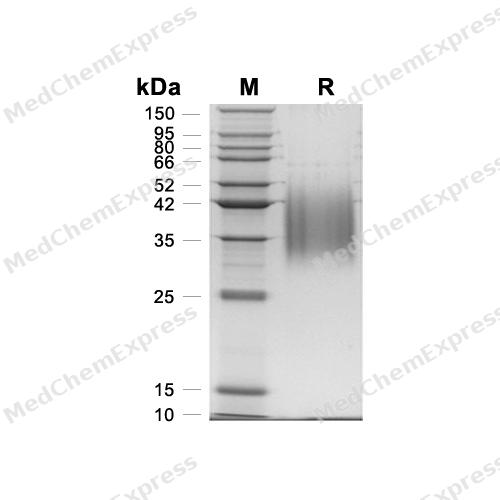
Purity - SDS-PAGE
-
Bioactivity - Cell-Based Assay
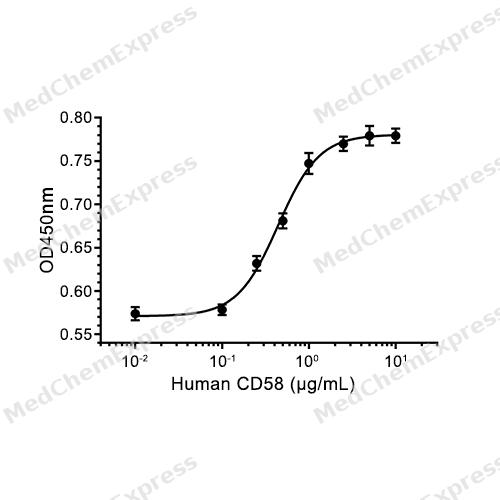
Bioactivity - Cell-Based Assay


Publications (1)
-
Journal Impact Factor
-
Most Recent
-
J Transl Med
CD58 acts as a tumor promotor in hepatocellular carcinoma via activating the AKT/GSK-3β/β-catenin pathway. [Abstract]2023 Aug 12;21(1):539. PMID: 37573318


Technical Parameters
-
Species Human
-
Source HEK293
-
Tag C-6*His
-
Accession
AAH05930 (F29-R215)
-
Molecular Construction
-
N-term
-
CD58 (F29-R215)
Accession # AAH05930 -
6*His
-
C-term
-
-
Protein Length
Partial
-
Synonyms
CD58; Ag3; Prev. LFA3; CD58 Antigen; CD58 Antigen, (Lymphocyte Function-Associated Antigen 3); CD58 Protein; Lymphocyte Function-Associated Antigen 3; LFA-3; Surface Glycoprotein LFA-3; CD58 Molecule; CD58 Antigen, (Lymphocyte Function-Associated Antigen
-
AA Sequence
FSQQIYGVVYGNVTFHVPSNVPLKEVLWKKQKDKVAELENSEFRAFSSFKNRVYLDTVSGSLTIYNLTSSDEDEYEMESPNITDTMKFFLYVLESLPSPTLTCALTNGSIEVQCMIPEYYNSHRGLIMYSWDCPMEQCKRNSTSIYFKMENDLPQKIQCTLSNPLFNTTSSIILTTCIPSSGHSRHR
-
Molecular Weight
Approximately 30-60 kDa, based on SDS-PAGE under reducing conditions, due to the glycosylation.
-
Purity
≥ 95%, as determined by reducing SDS-PAGE.


Product Properties
Lyophilized powder.
1.Lyophilized from a 0.22 μm filtered solution of PBS, pH 7.4.
2.Lyophilized from a 0.22 μm filtered solution of 20 mM PB, 150 mM NaCl, pH 7.4.
Please refer to the lot-specific COA for specific buffer information.
<1 EU/μg, determined by LAL method.
It is not recommended to reconstitute to a concentration less than 100 μg/mL in ddH2O. For long term storage it is recommended to add a carrier protein (0.1% BSA, 5% HSA, 10% FBS or 5% Trehalose).
Stored at -20°C for 2 years from date of receipt. After reconstitution, it is stable at 4°C for 1 week or -20°C for longer (with carrier protein). It is recommended to freeze aliquots at -20°C or -80°C for extended storage.
Room temperature in continental US; may vary elsewhere.


Documentation
-
Data Sheet (262 KB)
-
SDS (252 KB)
- English - EN (252 KB)
- Français - FR (252 KB)
- Deutsch - DE (252 KB)
- Norwegian - NO (252 KB)
- Español - ES (252 KB)
- Swedish - SV (252 KB)
- Italian - IT (252 KB)
- Korean - KR (252 KB)
- Portuguese - PT (252 KB)
-
Handling Instructions (2659 KB)

Calculators
Concentration (start) × Volume (start) = Concentration (final) × Volume (final)


 Powered by Bioz

