



CNPY4/PRAT4B Protein, Human (HEK293, His)

Based on 1 Customer Validation
CNPY4/PRAT4B Protein crucially modulates TLR4 cell surface expression, impacting innate immune system regulation. Its direct interaction with TLR4 shapes Toll-like receptor signaling dynamics, essential for pathogen-associated molecular pattern recognition. By regulating TLR4 expression, CNPY4/PRAT4B fine-tunes immune cell responsiveness, contributing to the delicate balance between activation and regulation in host defense and inflammation. CNPY4/PRAT4B Protein, Human (HEK293, His) is the recombinant human-derived CNPY4/PRAT4B protein, expressed by HEK293 , with C-His labeled tag.
- Species: Human
- Source: HEK293
-
Storage:Stored at -20°C for 2 years from date of receipt. After reconstitution, it is stable at 4°C for 1 week or -20°C for longer (with carrier protein). It is recommended to freeze aliquots at -20°C or -80°C for extended storage.


To place orders, for customer services and technical support, please contact: MedChemExpress USA
Tel: 609-228-6898 E-mail: [email protected] [email protected]


-
 Biological Activity
-
Technical Parameters
-
Product Properties
- Documentation
- Help & FAQs




Biological Activity
Description
CNPY4/PRAT4B Protein crucially modulates TLR4 cell surface expression, impacting innate immune system regulation. Its direct interaction with TLR4 shapes Toll-like receptor signaling dynamics, essential for pathogen-associated molecular pattern recognition. By regulating TLR4 expression, CNPY4/PRAT4B fine-tunes immune cell responsiveness, contributing to the delicate balance between activation and regulation in host defense and inflammation. CNPY4/PRAT4B Protein, Human (HEK293, His) is the recombinant human-derived CNPY4/PRAT4B protein, expressed by HEK293 , with C-His labeled tag.
Background
CNPY4/PRAT4B Protein assumes a crucial role in modulating the cell surface expression of TLR4, implicating its significance in the intricate regulatory mechanisms of the innate immune system. Its direct interaction with TLR4 underscores its functional involvement in shaping the dynamics of Toll-like receptor signaling, a pivotal pathway in the recognition of pathogen-associated molecular patterns. By participating in the regulation of TLR4 cell surface expression, CNPY4/PRAT4B emerges as a key molecular player in fine-tuning the responsiveness of immune cells to extracellular stimuli, ultimately contributing to the delicate balance between immune activation and regulation in the context of host defense and inflammation.
MCE Validation Data
-
Purity - SDS-PAGE
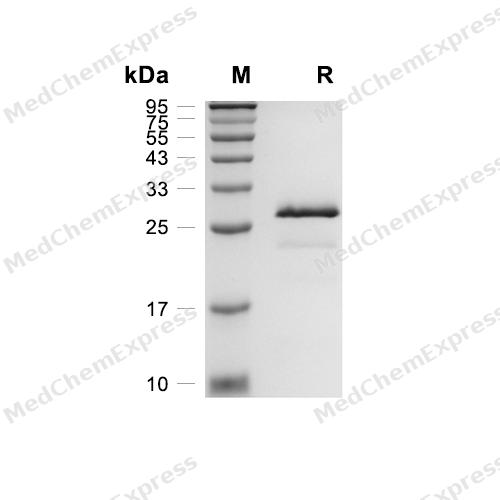
Purity - SDS-PAGE


Technical Parameters
-
Species Human
-
Source HEK293
-
Tag C-6*His
-
Accession
Q8N129 (G22-L248)
-
Molecular Construction
-
N-term
-
CNPY4 (G22-L248)
Accession # Q8N129 -
His
-
C-term
-
-
Protein Length
Full Length of Mature Protein
-
Synonyms
CNPY4; Protein Canopy Homolog 4; Canopy FGF Signaling Regulator 4; MGC40499; PRAT4B; Canopy 4 Homolog (Zebrafish); Protein Associated With TLR4; Canopy 4 Homolog
-
AA Sequence
GMLKEEDDDTERLPSKCEVCKLLSTELQAELSRTGRSREVLELGQVLDTGKRKRHVPYSVSETRLEEALENLCERILDYSVHAERKGSLRYAKGQSQTMATLKGLVQKGVKVDLGIPLELWDEPSVEVTYLKKQCETMLEEFEDIVGDWYFHHQEQPLQNFLCEGHVLPAAETACLQETWTGKEITDGEEKTEGEEEQEEEEEEEEEEGGDKMTKTGSHPKLDREDL
-
Molecular Weight
Approximately 32 kDa, based on SDS-PAGE under reducing conditions.
-
Purity
≥ 85%, as determined by reducing SDS-PAGE.


Product Properties
Lyophilized powder.
Lyophilized from a 0.22 μm filtered solution of PBS, pH 7.4.
<1 EU/μg, determined by LAL method.
It is not recommended to reconstitute to a concentration less than 100 μg/mL in ddH2O. For long term storage it is recommended to add a carrier protein (0.1% BSA, 5% HSA, 10% FBS or 5% Trehalose).
Stored at -20°C for 2 years from date of receipt. After reconstitution, it is stable at 4°C for 1 week or -20°C for longer (with carrier protein). It is recommended to freeze aliquots at -20°C or -80°C for extended storage.
Room temperature in continental US; may vary elsewhere.


Documentation
-
Data Sheet (236 KB)
-
SDS (251 KB)
- English - EN (251 KB)
- Français - FR (251 KB)
- Deutsch - DE (251 KB)
- Norwegian - NO (251 KB)
- Español - ES (251 KB)
- Swedish - SV (251 KB)
- Italian - IT (251 KB)
- Korean - KR (251 KB)
- Portuguese - PT (251 KB)
-
Handling Instructions (2659 KB)

Calculators
Concentration (start) × Volume (start) = Concentration (final) × Volume (final)


 Powered by Bioz

