



GLP1R Protein, Mouse (His-SUMO)
Based on 1 publication(s) in Google Scholar
GLP1R protein, a G-protein coupled receptor, binds to GLP-1, activating adenylyl cyclase and increasing intracellular cAMP levels. This interaction regulates insulin secretion and maintains glucose homeostasis. GLP1R can also form dimers with GIPR, suggesting complex regulatory mechanisms and interactions with other receptors. GLP1R Protein, Mouse (His-SUMO) is the recombinant mouse-derived GLP1R protein, expressed by E. coli , with N-6*His, N-SUMO labeled tag.
- Species: Mouse
- Source: E. coli
-
Storage:Stored at -20°C for 2 years from date of receipt. After reconstitution, it is stable at 4°C for 1 week or -20°C for longer (with carrier protein). It is recommended to freeze aliquots at -20°C or -80°C for extended storage.


To place orders, for customer services and technical support, please contact: MedChemExpress USA
Tel: 609-228-6898 E-mail: [email protected] [email protected]


-
 Biological Activity
-
Technical Parameters
-
Product Properties
- Documentation
- Help & FAQs




Biological Activity
Description
GLP1R protein, a G-protein coupled receptor, binds to GLP-1, activating adenylyl cyclase and increasing intracellular cAMP levels. This interaction regulates insulin secretion and maintains glucose homeostasis. GLP1R can also form dimers with GIPR, suggesting complex regulatory mechanisms and interactions with other receptors. GLP1R Protein, Mouse (His-SUMO) is the recombinant mouse-derived GLP1R protein, expressed by E. coli , with N-6*His, N-SUMO labeled tag.
Background
GLP1R, a G-protein coupled receptor, specifically binds to glucagon-like peptide 1 (GLP-1), initiating a signaling cascade that activates adenylyl cyclase, leading to elevated intracellular cAMP levels. This molecular interaction plays a pivotal role in the regulation of insulin secretion in response to GLP-1, contributing to glucose homeostasis. Furthermore, GLP1R exhibits the potential to form homodimers and heterodimers with the GIPR receptor, indicating possible complexities in its regulatory mechanisms and interplay with other receptors within the cellular context.
Verified Bioactivity
Measured by its binding ability in a functional ELISA. Immobilized Mouse GLP1R Protein at 2 μg/mL (100 μL/well) can bind Anti-GLP1R antibody. The ED50 for this effect is 155.0 ng/mL.
MCE Validation Data
-
Purity - SDS-PAGE
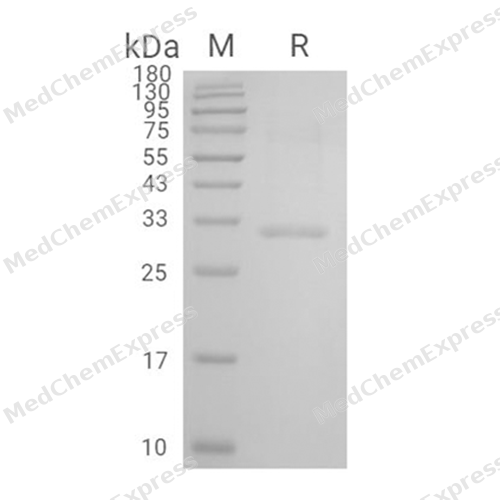
Purity - SDS-PAGE
-
Bioactivity - ELISA
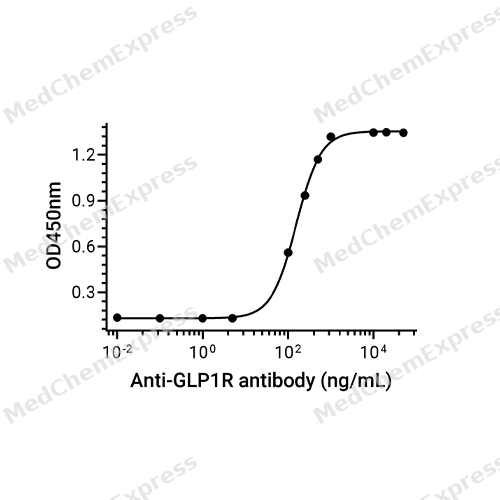
Bioactivity - ELISA


Publications (1)
-
Journal Impact Factor
-
Most Recent


Technical Parameters
-
Species Mouse
-
Source E. coli
-
Tag N-6*His;N-SUMO
-
Accession
O35659 (G22-Y145)
-
Molecular Construction
-
N-term
-
6*His-SUMO
-
GLP1R (G22-Y145)
Accession # O35659 -
C-term
-
-
Protein Length
Partial Extracellular Domain
-
Synonyms
GLP1R; GLP-1-R; Glucagon Like Peptide 1 Receptor; Seven Transmembrane Helix Receptor; Glucagon-Like Peptide 1 Receptor; GLP1 Receptor; GLP-1R; GLP-1; GLP-1 Receptor
-
AA Sequence
GPRPQGTTVSLSETVQKWREYRRQCQRFLTEAPLLATGLFCNRTFDDYACWPDGPPGSFVNVSCPWYLPWASSVLQGHVYRFCTAEGLWLHKDNSSLPWRDLSECEESKRGERNFPEEQLLSLY
-
Molecular Weight
Approximately 27-30 kDa, based on SDS-PAGE under reducing conditions.
-
Purity
≥ 90%, as determined by reducing SDS-PAGE.


Product Properties
Lyophilized powder
Lyophilized from a 0.22 μm filtered solution of 10 mM Tris-HCl, 1 mM EDTA, 6% trehalose, pH 8.0.
Note: For SPR assay, please replace the buffer. Primary amine components (e.g., Tris, imidazole) can affect protein-coupled chips.
<1 EU/μg, determined by LAL method.
It is not recommended to reconstitute to a concentration less than 100 μg/mL in ddH2O.
Stored at -20°C for 2 years from date of receipt. After reconstitution, it is stable at 4°C for 1 week or -20°C for longer (with carrier protein). It is recommended to freeze aliquots at -20°C or -80°C for extended storage.
Room temperature in continental US; may vary elsewhere.


Documentation
-
Data Sheet (236 KB)
-
SDS (251 KB)
- English - EN (251 KB)
- Français - FR (251 KB)
- Deutsch - DE (251 KB)
- Norwegian - NO (251 KB)
- Español - ES (251 KB)
- Swedish - SV (251 KB)
- Italian - IT (251 KB)
- Korean - KR (251 KB)
- Portuguese - PT (251 KB)
-
Handling Instructions (2659 KB)

Calculators
Concentration (start) × Volume (start) = Concentration (final) × Volume (final)


 Powered by Bioz

