



IFN-alpha 2b/IFNA2 Protein, Human (His)

Based on 1 Customer Validation
IFN-alpha 2 (IFNA2), belongs to type I interferon family, is a protein secreted by cells infected by a virus and acting on other cells to inhibit viral infection. IFN-alpha 2 increases the frequencies of cytotoxic CD8+ T cells and induces CD4+ T cell depletion. IFN-alpha 2b/IFNA2 Protein, Human contains 165 a.a., is produced in E. coli with N-6*His tagged.
- Species: Human
- Source: E. coli
-
Storage:Stored at -20°C for 2 years from date of receipt. After reconstitution, it is stable at 4°C for 1 week or -20°C for longer (with carrier protein). It is recommended to freeze aliquots at -20°C or -80°C for extended storage.


To place orders, for customer services and technical support, please contact: MedChemExpress USA
Tel: 609-228-6898 E-mail: [email protected] [email protected]


-
 Biological Activity
-
Technical Parameters
-
Product Properties
- Documentation
- Help & FAQs




Biological Activity
Description
IFN-alpha 2 (IFNA2), belongs to type I interferon family, is a protein secreted by cells infected by a virus and acting on other cells to inhibit viral infection[1]. IFN-alpha 2 increases the frequencies of cytotoxic CD8+ T cells and induces CD4+ T cell depletion[3]. IFN-alpha 2b/IFNA2 Protein, Human contains 165 a.a., is produced in E. coli with N-6*His tagged.
Background
IFN-alpha 2 (IFNA2; IFN-α2), belongs to the type I interferon family, produced by the plasmacytoid dendritic cells (pDCs) exposure to HIV-1BaL in order to inhibit viral infection[1].
Interferon (IFN) is originally identified as a substance ‘interfering’ with viral replication in vitro. IFN-α/β and related molecules are classified as type I IFNs, as for the other two types of type II IFN (IFN-γ) and type III IFNs (IFN-λ), respectively[2].
IFN-alpha 2 subtype is the only one that is currently licensed to treat infections caused by hepatitis B virus (HBV) and HCV[3].
IFN-alpha 2 shows a Sortilin-dependent trafficking in cells and increases the expression level of interferon-stimulated genes (ISGs) in HIV-infected cells[1][4].
IFN-alpha 2 increases the frequencies of cytotoxic CD8+ T cells and enhances CD4+ T cell depletion[3].
Among the IFN-alpha 2 alleles, IFN-alpha 2b is being the predominant allele while IFNα-2a is less predominant and IFNα-2c only a minor allelic variant[5].
IFN-alpha 2 has a bored application in research of cancer, including some hematological malignancies and solid tumors[6].
As for a wildly use of IFN in animal disease model, the sequence of amino acids in IFNA2a protein of human is very different from mouse (59.57%).
In Vivo
IFNA2a (hydrodynamic injection with plasmids) leads to upregulation of interferon-stimulated genes (ISGs) and results HIV-1 induced CD4+ T cell depletion in the hu-PBL humanized mouse model[3].
Verified Bioactivity
Measured in a cell proliferation assay using TF-1 human erythroleukemic cells. The ED50 this effect is 0.1225 ng/mL, corresponding to a specific activity is 8.16×10⁶ units/mg.
MCE Validation Data
-
Purity - SDS-PAGE
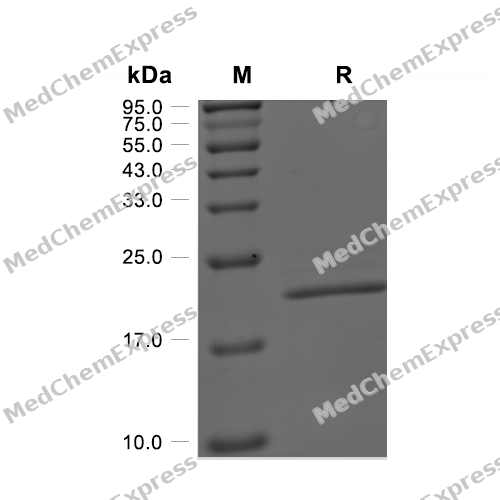
Purity - SDS-PAGE


Technical Parameters
-
Species Human
-
Source E. coli
-
Tag N-6*His
-
Accession
P01563 (C24-E188)
-
Molecular Construction
-
N-term
-
6*His
-
IFNA2 (C24-E188)
Accession # P01563 -
C-term
-
-
Protein Length
Full Length of Mature Protein
-
Synonyms
IFNA2; IFN-Alpha-2; Interferon Alpha 2; IFNA2B; IFN-AlphaA; LeIF A; IFNA; Interferon Alpha 2a; Alpha-2a Interferon; Interferon Alpha-A; Interferon Alpha 2b; Interferon 1AB4; Interferon Alpha A; IFNA2C; Interferon Alpha-2; IFNA2A
-
AA Sequence
CDLPQTHSLGSRRTLMLLAQMRRISLFSCLKDRHDFGFPQEEFGNQFQKAETIPVLHEMIQQIFNLFSTKDSSAAWDETLLDKFYTELYQQLNDLEACVIQGVGVTETPLMKEDSILAVRKYFQRITLYLKEKKYSPCAWEVVRAEIMRSFSLSTNLQESLRSKE
-
Predicted Molecular Mass
19.3 kDa
-
Molecular Weight
Approximately 21 kDa, based on SDS-PAGE under reducing conditions.
-
Purity
≥ 95%, as determined by reducing SDS-PAGE.


Product Properties
Lyophilized powder.
Lyophilized from a 0.22 μm filtered solution of 50 mM Tris-HCl, 300 mM NaCl, pH 7.4.
Note: For SPR assay, please replace the buffer. Primary amine components (e.g., Tris, imidazole) can affect protein-coupled chips.
<1 EU/μg, determined by LAL method.
It is not recommended to reconstitute to a concentration less than 100 μg/mL in ddH2O. For long term storage it is recommended to add a carrier protein (0.1% BSA, 5% HSA, 10% FBS or 5% Trehalose).
Stored at -20°C for 2 years from date of receipt. After reconstitution, it is stable at 4°C for 1 week or -20°C for longer (with carrier protein). It is recommended to freeze aliquots at -20°C or -80°C for extended storage.
Room temperature in continental US; may vary elsewhere.


Documentation
-
Data Sheet (262 KB)
-
SDS (252 KB)
- English - EN (252 KB)
- Français - FR (252 KB)
- Deutsch - DE (252 KB)
- Norwegian - NO (252 KB)
- Español - ES (252 KB)
- Swedish - SV (252 KB)
- Italian - IT (252 KB)
- Korean - KR (252 KB)
- Portuguese - PT (252 KB)
-
Handling Instructions (2659 KB)

Calculators
Concentration (start) × Volume (start) = Concentration (final) × Volume (final)


 Powered by Bioz

