



MMP-1 Protein, Human (HEK293, His, solution)
Based on 1 publication(s) in Google Scholar
The MMP-1 protein acts as an enzyme capable of cleaving types I, II, and III collagen at specific sites within the helical domain. In addition, it exhibits lytic activity against type VII and type X collagen. MMP-1 Protein, Human (HEK293, His, solution) is the recombinant human-derived MMP-1 protein, expressed by HEK293 , with C-6*His labeled tag.
- Species: Human
- Source: HEK293
-
Storage:Stored at -80°C for 1 year from date of receipt. It is stable at -20°C for 3 months after opening. It is recommended to freeze aliquots at -80°C for extended storage. Avoid repeated freeze-thaw cycles.


To place orders, for customer services and technical support, please contact: MedChemExpress USA
Tel: 609-228-6898 E-mail: [email protected] [email protected]


-
 Biological Activity
-
Technical Parameters
-
Product Properties
- Documentation
- Help & FAQs


-
HY-148905
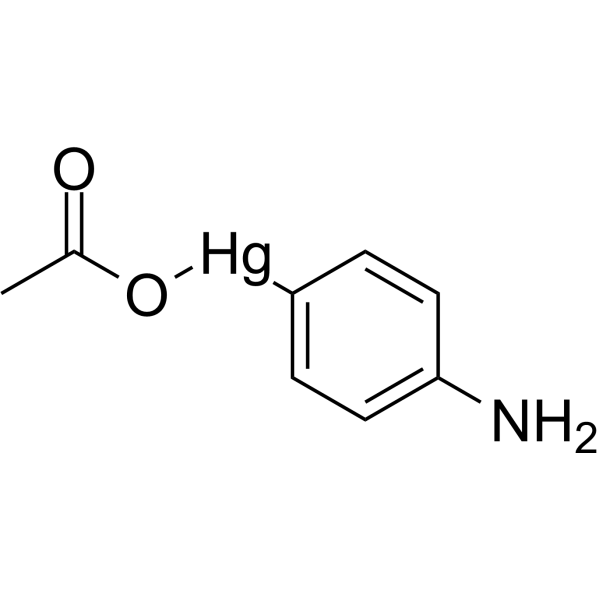
p-Aminophenylmercuric acetateMatrix Metalloproteinases Activator -

HY-P72507
MMP-8 Protein, Human (HEK293, His) -
HY-P73300
MMP-9 Protein, Human (HEK293) -
HY-P73296
MMP-2 Protein, Human (HEK293) -
HY-P70268
MMP-2 Protein, Human (HEK293, His) -
HY-P74744
MMP-12 Protein, Human -
HY-12169
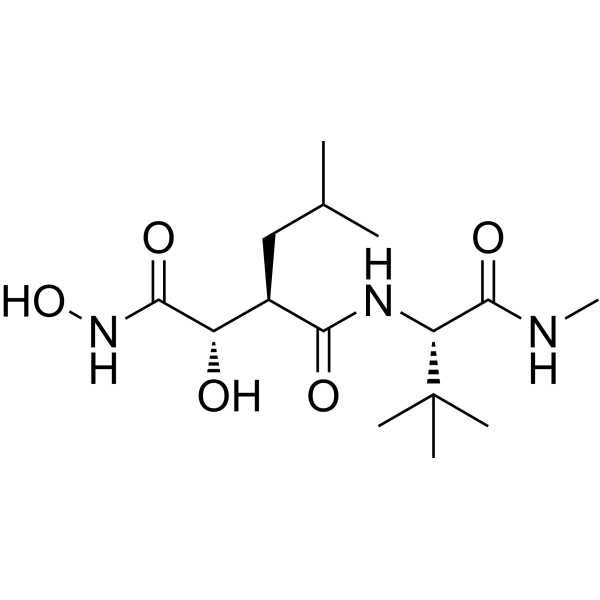
MarimastatMMP Inhibitor -
HY-P702527
MMP-13 Protein, Human (HEK293) -
HY-P7756
Cathepsin S Protein, Human (HEK293, His) -
HY-P72179
ELANE Protein, Human (GST) -
HY-P73298
MMP-8 Protein, Human (HEK293)


Biological Activity
Description
The MMP-1 protein acts as an enzyme capable of cleaving types I, II, and III collagen at specific sites within the helical domain. In addition, it exhibits lytic activity against type VII and type X collagen. MMP-1 Protein, Human (HEK293, His, solution) is the recombinant human-derived MMP-1 protein, expressed by HEK293 , with C-6*His labeled tag.
Background
Matrix metalloproteinase-1 (MMP-1) is a proteolytic enzyme known for its role in extracellular matrix remodeling. It exhibits a broad substrate specificity, cleaving collagens of types I, II, and III at a specific site within the helical domain. Additionally, MMP-1 demonstrates activity against collagens of types VII and X. Notably, in the context of HIV infection, MMP-1 interacts with and cleaves the secreted viral Tat protein, resulting in a decrease in neuronal Tat-mediated neurotoxicity. This interaction underscores the diverse functions of MMP-1 beyond its canonical role in extracellular matrix degradation, implicating it in processes associated with viral infection and neuroprotection (
Verified Bioactivity
Measured by its ability to cleave a fluorogenic peptide substrate Mca-KPLGL-Dpa-AR-NH2. Read at excitation and emission wavelengths of 360 nm and 405 nm. The specific activity is 4879.964 pmol/min/µg, as measured under the described conditions. (Activation description: The proenzyme needs to be activated by APMA (HY-148905) for an activated form.)
MCE Validation Data
-
Purity - SDS-PAGE
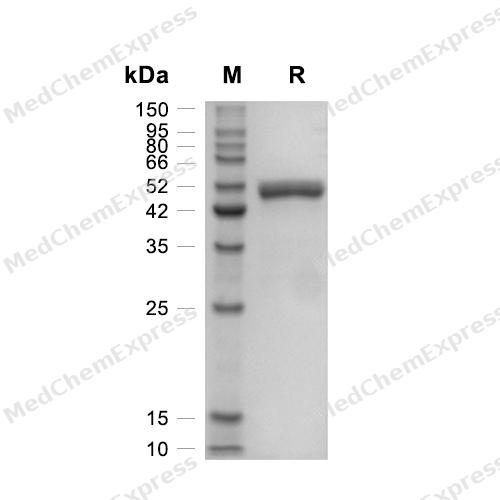
Purity - SDS-PAGE

Assay Procedure
Materials
Assay buffer: 50 mM Tris, 10 mM CaCl2, 150 mM NaCl, 0.05% (w/v) Brij-35, pH 7.5 (TCNB)
Test Protein: MMP-1 Protein, Human (HEK293, His, solution) (HY-P70250)
Activator: 4-Aminophenylmercuriacetic acid (APMA, HY-148905), dissolved in DMSO to 100 mM
Substrate: MCA-Lys-Pro-Leu-Gly-Leu-DPA-Ala-Arg-NH2< (HY-131498)
Standard: MCA-Pro-Leu-OH
Procedure
1. Standard curve: Dilute MCA-Pro-Leu-OH to concentrations of 0, 1.5625, 3.125, 6.25, 12.5, 25, 50, and 100 μmol/L using assay buffer. Add 100 μL of each dilution to black microplate wells. Read at 320 nm excitation and 405 nm emission (top read) in kinetic mode for 5 minutes. Plot the standard curve with measured RFU on the y-axis and standard substance amount on the x-axis to derive the standard curve equation.
2. Resuspend proteins in water to 200 μg/mL. Dilute Human MMP-1 to 50 μg/mL using assay buffer containing 1 mM APMA.
3. Activation: Incubate at 37°C for 2 hours.
4. Dilute the activated Human MMP-1 protein to 1 ng/μL using buffer.
5. Dilute the substrate to 20 μM using assay buffer.
6. Experimental group: 50 μL, 1 ng/μL Human MMP-1 protein + 50 μL, 20 μM substrate.
Control group: 50 μL, 20 μM substrate + 50 μL buffer.
7. Read for 5 minutes in kinetic mode at excitation and emission wavelengths of 320 nm and 405 nm respectively.
8. Calculate specific activity:
Specific Activity (pmol/min/μg) = | Adjusted Vmax* (RFU/min) x Conversion Factor ** (pmol/RFU) |
| amount of enzyme (μg) |
*Adjusted for Substrate Blank
**Derived using calibration standard


Publications (1)
-
Journal Impact Factor
-
Most Recent
-
J Biotechnol
Production of recombinant human type I collagen homotrimers in CHO cells and their physicochemical and functional properties. [Abstract]2024 Nov 20:395:149-160. PMID: 39357624


Technical Parameters
-
Species Human
-
Source HEK293
-
Tag C-6*His
-
Accession
P03956 (F20-N469)
-
Molecular Construction
-
N-term
-
MMP-1 (F20-N469)
Accession # P03956 -
6*His
-
C-term
-
-
Protein Length
Full Length of Mature Protein (with propeptide)
-
Synonyms
MMP1; Matrix Metallopeptidase 1 (Interstitial Collagenase); Prev. CLG; Matrix Metalloproteinase 1; Interstitial Collagenase; Matrix Metalloprotease 1; Fibroblast Collagenase; Alternative Protein MMP1; Matrix Metalloproteinase 1 (Interstitial Collagenase); MMP-1; Matrix Metallopeptidase 1; Matrix Metalloproteinase-1
-
AA Sequence
FPATLETQEQDVDLVQKYLEKYYNLKNDGRQVEKRRNSGPVVEKLKQMQEFFGLKVTGKPDAETLKVMKQPRCGVPDVAQFVLTEGNPRWEQTHLTYRIENYTPDLPRADVDHAIEKAFQLWSNVTPLTFTKVSEGQADIMISFVRGDHRDNSPFDGPGGNLAHAFQPGPGIGGDAHFDEDERWTNNFREYNLHRVAAHELGHSLGLSHSTDIGALMYPSYTFSGDVQLAQDDIDGIQAIYGRSQNPVQPIGPQTPKACDSKLTFDAITTIRGEVMFFKDRFYMRTNPFYPEVELNFISVFWPQLPNGLEAAYEFADRDEVRFFKGNKYWAVQGQNVLHGYPKDIYSSFGFPRTVKHIDAALSEENTGKTYFFVANKYWRYDEYKRSMDPGYPKMIAHDFPGIGHKVDAVFMKDGFFYFFHGTRQYKFDPKTKRILTLQKANSWFNCRKN
-
Molecular Weight
Approximately 55-57 kDa, based on SDS-PAGE under reducing conditions.
-
Glycosylation
Yes
-
Purity
≥ 95%, as determined by reducing SDS-PAGE.


Product Properties
Solution
1.Supplied as a 0.22 μm filtered solution of 20 mM MES, 150 mM NaCl, 2 mM CaCl2, 1mM DTT, 0.05% Brij35, 10% glycerol, pH 5.0.
2.Supplied as a 0.22 μm filtered solution of 20 mM MES, 150 mM NaCl, 2 mM CaCl2, 1 mM DTT, 0.05% Brij35, 10% glycerol, pH 5.0.
3.Supplied as a 0.22 μm filtered solution of 20 mM Tris-HCl, 150 mM NaCl, pH 8.0.
4.Supplied as a 0.22 μm filtered solution of 20 mM MES, 150 mM NaCl, 2 mM CaCl2, 1 mM DTT, 10% glycerol, pH 7.4.
Please refer to the lot-specific COA for specific buffer information.
Note: For SPR assay, please replace the buffer. Primary amine components (e.g., Tris, imidazole) can affect protein-coupled chips.
<1 EU/μg, determined by LAL method.
Stored at -80°C for 1 year from date of receipt. It is stable at -20°C for 3 months after opening. It is recommended to freeze aliquots at -80°C for extended storage. Avoid repeated freeze-thaw cycles.
Shipping with dry ice.


Documentation
-
Data Sheet (239 KB)
-
SDS (252 KB)
- English - EN (252 KB)
- Français - FR (252 KB)
- Deutsch - DE (252 KB)
- Norwegian - NO (252 KB)
- Español - ES (252 KB)
- Swedish - SV (252 KB)
- Italian - IT (252 KB)
- Korean - KR (252 KB)
- Portuguese - PT (252 KB)
-
Handling Instructions (2659 KB)

Calculators
Concentration (start) × Volume (start) = Concentration (final) × Volume (final)


 Powered by Bioz

