



Nicotinamide N-Methyltransferase/NNMT Protein, Human (His)

Based on 1 Customer Validation
The nicotinamide N-methyltransferase (NNMT) protein catalyzes the methylation of nicotinamide using S-adenosyl-L-methionine to form N1-methylnicotinamide. NNMT affects pluripotent embryonic stem cell development and acts as a metabolic regulator, affecting adipose tissue energy expenditure, gluconeogenesis, and cholesterol biosynthesis. Nicotinamide N-Methyltransferase/NNMT Protein, Human (His) is the recombinant human-derived Nicotinamide N-Methyltransferase/NNMT protein, expressed by E. coli , with C-His labeled tag.
- Species: Human
- Source: E. coli
-
Storage:Stored at -80°C for 1 year from date of receipt. It is stable at -20°C for 3 months after opening. It is recommended to freeze aliquots at -80°C for extended storage. Avoid repeated freeze-thaw cycles.


To place orders, for customer services and technical support, please contact: MedChemExpress USA
Tel: 609-228-6898 E-mail: [email protected] [email protected]


-
 Biological Activity
-
Technical Parameters
-
Product Properties
- Documentation
- Help & FAQs




Biological Activity
Description
The nicotinamide N-methyltransferase (NNMT) protein catalyzes the methylation of nicotinamide using S-adenosyl-L-methionine to form N1-methylnicotinamide. NNMT affects pluripotent embryonic stem cell development and acts as a metabolic regulator, affecting adipose tissue energy expenditure, gluconeogenesis, and cholesterol biosynthesis. Nicotinamide N-Methyltransferase/NNMT Protein, Human (His) is the recombinant human-derived Nicotinamide N-Methyltransferase/NNMT protein, expressed by E. coli , with C-His labeled tag.
Background
Nicotinamide N-Methyltransferase (NNMT) is responsible for catalyzing the N-methylation of nicotinamide, utilizing the universal methyl donor S-adenosyl-L-methionine to produce N1-methylnicotinamide and S-adenosyl-L-homocysteine, representing a prominent pathway for nicotinamide/vitamin B3 clearance. This enzymatic activity plays a central role in cellular methylation potential regulation by consuming S-adenosyl-L-methionine, thus limiting its availability for other methyltransferases. NNMT actively orchestrates genome-wide epigenetic and transcriptional changes through the hypomethylation of repressive chromatin marks, such as H3K27me3, and contributes to the establishment of low levels of repressive histone marks in pluripotent embryonic stem cell pre-implantation state during development. Functionally, NNMT acts as a metabolic regulator impacting white adipose tissue energy expenditure, hepatic gluconeogenesis, and cholesterol biosynthesis. In white adipocytes, it regulates polyamine flux and controls NAD(+) levels through the salvage pathway. Additionally, NNMT, by producing N1-methylnicotinamide, influences protein acetylation in hepatocytes, repressing the ubiquitination and enhancing the stability of the SIRT1 deacetylase. Furthermore, NNMT exhibits versatility by N-methylating other pyridines structurally related to nicotinamide, suggesting a role in xenobiotic detoxification.
Verified Bioactivity
1. Measured in a cell proliferation assay using A549 cells. The ED50 for this effect is 0.0488 μg/mL, corresponding to a specific activity is 2.049×10⁴ units/mg.
2. Measured by its ability to methylate nicotinamide. The specific activity is 114.696 pmol/min/μg.
MCE Validation Data
-
Purity - SDS-PAGE
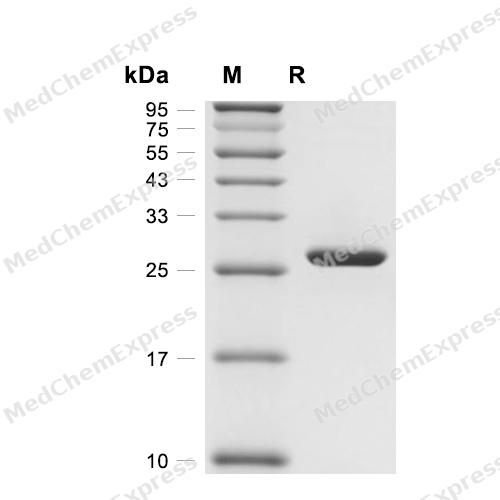
Purity - SDS-PAGE
-
Bioactivity - Cell-Based Assay
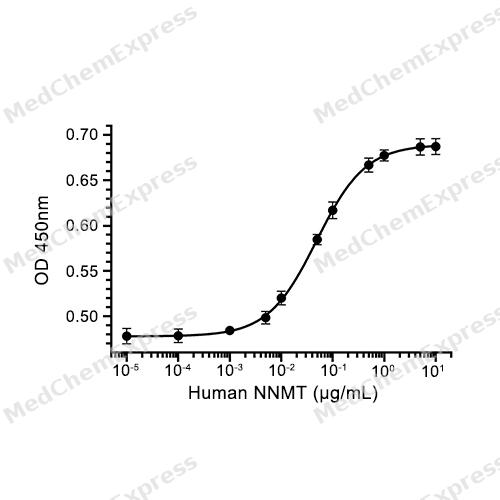
Bioactivity - Cell-Based Assay


Technical Parameters
-
Species Human
-
Source E. coli
-
Tag C-6*His
-
Accession
P40261 (M1-L264)
-
Molecular Construction
-
N-term
-
NNMT (M1-L264)
Accession # P40261 -
6*His
-
C-term
-
-
Protein Length
Full Length
-
Synonyms
NNMT; NNMT Protein; Nicotinamide N-Methyltransferase
-
AA Sequence
MESGFTSKDTYLSHFNPRDYLEKYYKFGSRHSAESQILKHLLKNLFKIFCLDGVKGDLLIDIGSGPTIYQLLSACESFKEIVVTDYSDQNLQELEKWLKKEPEAFDWSPVVTYVCDLEGNRVKGPEKEEKLRQAVKQVLKCDVTQSQPLGAVPLPPADCVLSTLCLDAACPDLPTYCRALRNLGSLLKPGGFLVIMDALKSSYYMIGEQKFSSLPLGREAVEAAVKEAGYTIEWFEVISQSYSSTMANNEGLFSLVARKLSRPL
-
Molecular Weight
Approximately 25-29 kDa, based on SDS-PAGE under reducing conditions.
-
Purity
≥ 95%, as determined by reducing SDS-PAGE.


Product Properties
Solution
Supplied as a 0.22 μm filtered solution of 50 mM Tris-HCl, 300 mM NaCl, pH 7.4, 10% glycerol.
Note: For SPR assay, please replace the buffer. Primary amine components (e.g., Tris, imidazole) can affect protein-coupled chips.
<1 EU/μg, determined by LAL method.
Stored at -80°C for 1 year from date of receipt. It is stable at -20°C for 3 months after opening. It is recommended to freeze aliquots at -80°C for extended storage. Avoid repeated freeze-thaw cycles.
Shipping with dry ice.


Documentation
-
Data Sheet (237 KB)
-
SDS (251 KB)
- English - EN (251 KB)
- Français - FR (251 KB)
- Deutsch - DE (251 KB)
- Norwegian - NO (251 KB)
- Español - ES (251 KB)
- Swedish - SV (251 KB)
- Italian - IT (251 KB)
- Korean - KR (251 KB)
- Portuguese - PT (251 KB)
-
Handling Instructions (2659 KB)

Calculators
Concentration (start) × Volume (start) = Concentration (final) × Volume (final)


 Powered by Bioz

