



Serpin A3N Protein, Mouse (HEK293, His)

Based on 1 Customer Validation
The serpin A3N protein is ubiquitously found in a variety of tissues, showing elevated expression in the brain, heart, liver, lung, spleen, testis, and thymus, implying a variety of physiological functions.In contrast, it shows lower expression in bone marrow, kidney, and skeletal muscle, suggesting a tissue-specific pattern of regulation.Serpin A3N Protein, Mouse (HEK293, His) is the recombinant mouse-derived Serpin A3N protein, expressed by HEK293 , with C-6*His labeled tag.
- Species: Mouse
- Source: HEK293
-
Storage:Stored at -80°C for 1 year from date of receipt. It is stable at -20°C for 3 months after opening. It is recommended to freeze aliquots at -80°C for extended storage. Avoid repeated freeze-thaw cycles.


To place orders, for customer services and technical support, please contact: MedChemExpress USA
Tel: 609-228-6898 E-mail: [email protected] [email protected]


-
 Biological Activity
-
Technical Parameters
-
Product Properties
- Documentation
- Help & FAQs




Biological Activity
Description
The serpin A3N protein is ubiquitously found in a variety of tissues, showing elevated expression in the brain, heart, liver, lung, spleen, testis, and thymus, implying a variety of physiological functions.In contrast, it shows lower expression in bone marrow, kidney, and skeletal muscle, suggesting a tissue-specific pattern of regulation.Serpin A3N Protein, Mouse (HEK293, His) is the recombinant mouse-derived Serpin A3N protein, expressed by HEK293 , with C-6*His labeled tag.
Background
Serpin A3N protein, a ubiquitous player in various tissues, is expressed at elevated levels in the brain, heart, liver, lung, spleen, testis, and thymus. Its presence in these tissues underscores its potential involvement in diverse physiological functions within these organs. In contrast, Serpin A3N is expressed at lower levels in the bone marrow, kidney, and skeletal muscle, suggesting a differential regulatory pattern across tissues. The varying expression levels highlight the tissue-specific roles and regulatory mechanisms of Serpin A3N, emphasizing its importance in maintaining homeostasis and contributing to the functionality of specific organs and systems.
MCE Validation Data
-
Purity - SDS-PAGE
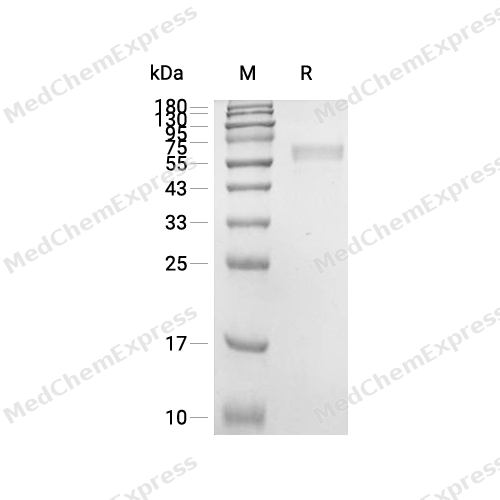
Purity - SDS-PAGE


Technical Parameters
-
Species Mouse
-
Source HEK293
-
Tag C-6*His
-
Accession
Q91WP6 (F21-K418)
-
Gene ID20716 [NCBI]
-
Molecular Construction
-
N-term
-
Serpin A3N (F21-K418)
Accession # Q91WP6 -
6*His
-
C-term
-
-
Protein Length
Full Length of Mature Protein
-
Synonyms
Serine protease inhibitor A3N; Serpin A3N; Serpina3n; Spi2
-
AA Sequence
FPDGTLGMDAAVQEDHDNGTQLDSLTLASINTDFAFSLYKELVLKNPDKNIVFSPLSISAALAVMSLGAKGNTLEEILEGLKFNLTETSEADIHQGFGHLLQRLNQPKDQVQISTGSALFIEKRQQILTEFQEKAKTLYQAEAFTADFQQPRQAKKLINDYVRKQTQGMIKELVSDLDKRTLMVLVNYIYFKAKWKVPFDPLDTFKSEFYAGKRRPVIVPMMSMEDLTTPYFRDEELSCTVVELKYTGNASALFILPDQGRMQQVEASLQPETLRKWKNSLKPRMIDELHLPKFSISTDYSLEDVLSKLGIREVFSTQADLSAITGTKDLRVSQVVHKAVLDVAETGTEAAAATGVKFVPMSAKLYPLTVYFNRPFLIMIFDTETEIAPFIAKIANPK
-
Predicted Molecular Mass
45.6 kDa
-
Molecular Weight
Approximately 58 kDa, based on SDS-PAGE under reducing conditions.
-
Glycosylation
Yes
-
Purity
≥ 95%, as determined by reducing SDS-PAGE.


Product Properties
Solution
Supplied as a 0.22 μm filtered solution of 20 mM Tris-HCl, 150 mM NaCl, pH 8.0.
Note: For SPR assay, please replace the buffer. Primary amine components (e.g., Tris, imidazole) can affect protein-coupled chips.
<1 EU/μg, determined by LAL method.
Stored at -80°C for 1 year from date of receipt. It is stable at -20°C for 3 months after opening. It is recommended to freeze aliquots at -80°C for extended storage. Avoid repeated freeze-thaw cycles.
Shipping with dry ice.


Documentation
-
Data Sheet (237 KB)
-
SDS (252 KB)
- English - EN (252 KB)
- Français - FR (252 KB)
- Deutsch - DE (252 KB)
- Norwegian - NO (252 KB)
- Español - ES (252 KB)
- Swedish - SV (252 KB)
- Italian - IT (252 KB)
- Korean - KR (252 KB)
- Portuguese - PT (252 KB)
-
Handling Instructions (2659 KB)

Calculators
Concentration (start) × Volume (start) = Concentration (final) × Volume (final)


 Powered by Bioz

