



SF20/MYDGF Protein, Human (HEK293, His)

Based on 1 Customer Validation
The MYDGF protein is derived from bone marrow mononuclear cells and significantly promotes cardioprotection and post-myocardial infarction (MI) repair. Its functions include promoting cardiomyocyte survival and promoting adaptive angiogenesis. SF20/MYDGF Protein, Human (HEK293, His) is the recombinant human-derived SF20/MYDGF protein, expressed by HEK293 , with C-His labeled tag.
- Species: Human
- Source: HEK293
-
Storage:Stored at -20°C for 2 years from date of receipt. After reconstitution, it is stable at 4°C for 1 week or -20°C for longer (with carrier protein). It is recommended to freeze aliquots at -20°C or -80°C for extended storage.


To place orders, for customer services and technical support, please contact: MedChemExpress USA
Tel: 609-228-6898 E-mail: [email protected] [email protected]


-
 Biological Activity
-
Technical Parameters
-
Product Properties
- Documentation
- Help & FAQs




Biological Activity
Description
The MYDGF protein is derived from bone marrow mononuclear cells and significantly promotes cardioprotection and post-myocardial infarction (MI) repair. Its functions include promoting cardiomyocyte survival and promoting adaptive angiogenesis. SF20/MYDGF Protein, Human (HEK293, His) is the recombinant human-derived SF20/MYDGF protein, expressed by HEK293 , with C-His labeled tag.
Background
MYDGF Protein, a paracrine-acting protein derived from bone marrow monocytes, plays a crucial role in cardiac protection and repair following myocardial infarction (MI). Its multifaceted functions include the promotion of cardiac myocyte survival and the facilitation of adaptive angiogenesis. MYDGF stimulates endothelial cell proliferation through a signaling pathway involving MAPK1/3, STAT3, and CCND1. Additionally, it inhibits cardiac myocyte apoptosis through a PI3K/AKT-dependent signaling pathway. The protein's involvement in endothelial cell proliferation and angiogenesis underscores its significance in mediating processes crucial for cardiac recovery and tissue repair, making it a potential therapeutic target for cardiovascular conditions.
Verified Bioactivity
Measured by its binding ability in a functional ELISA. When Recombinant Human SF20/MYDGF is immobilized at 2 μg/mL. Recombinant Human P4HB binds with an ED50 of 2-5 μg/mL.
MCE Validation Data
-
Purity - SDS-PAGE
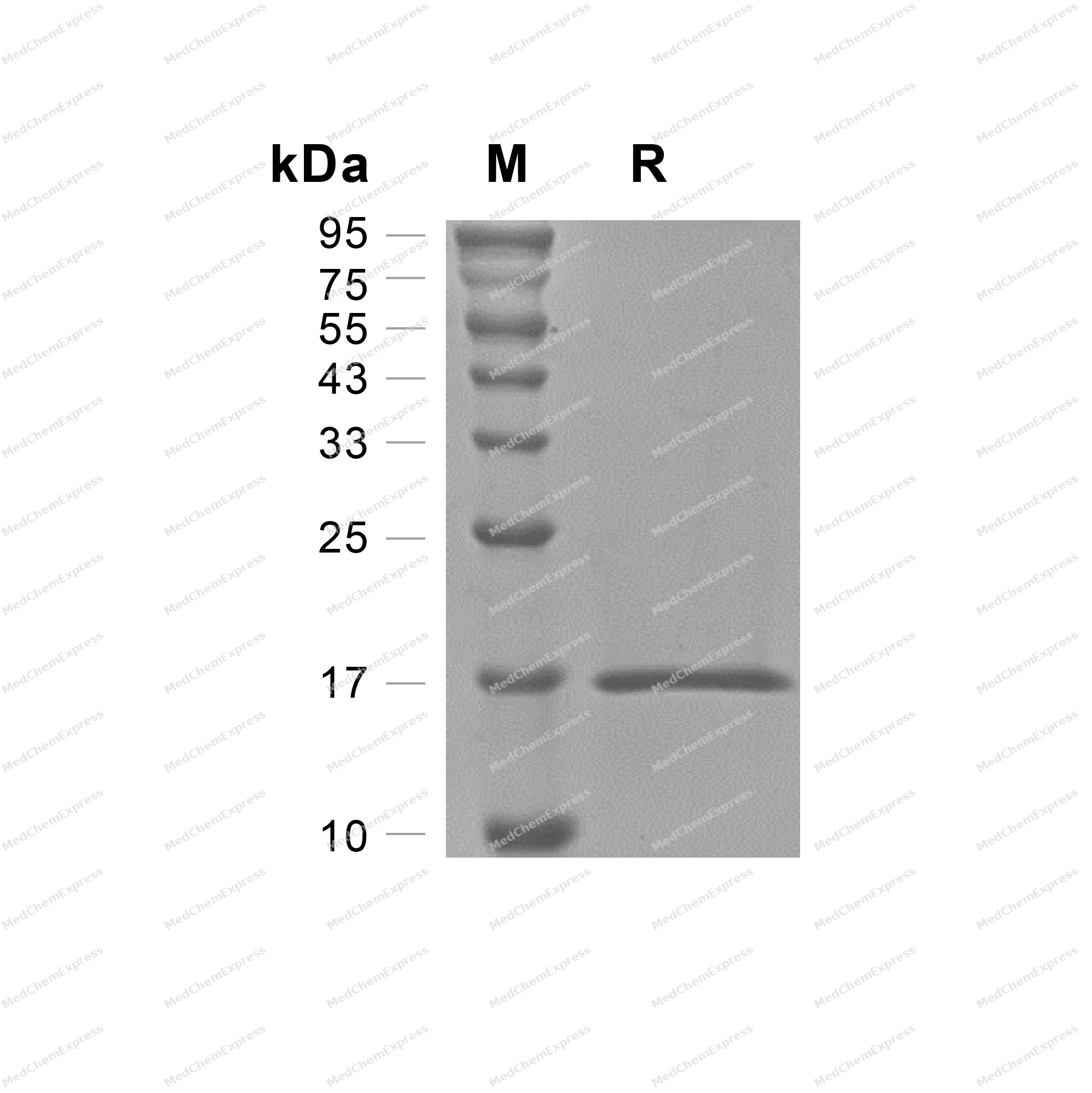
Purity - SDS-PAGE
-
Bioactivity - ELISA
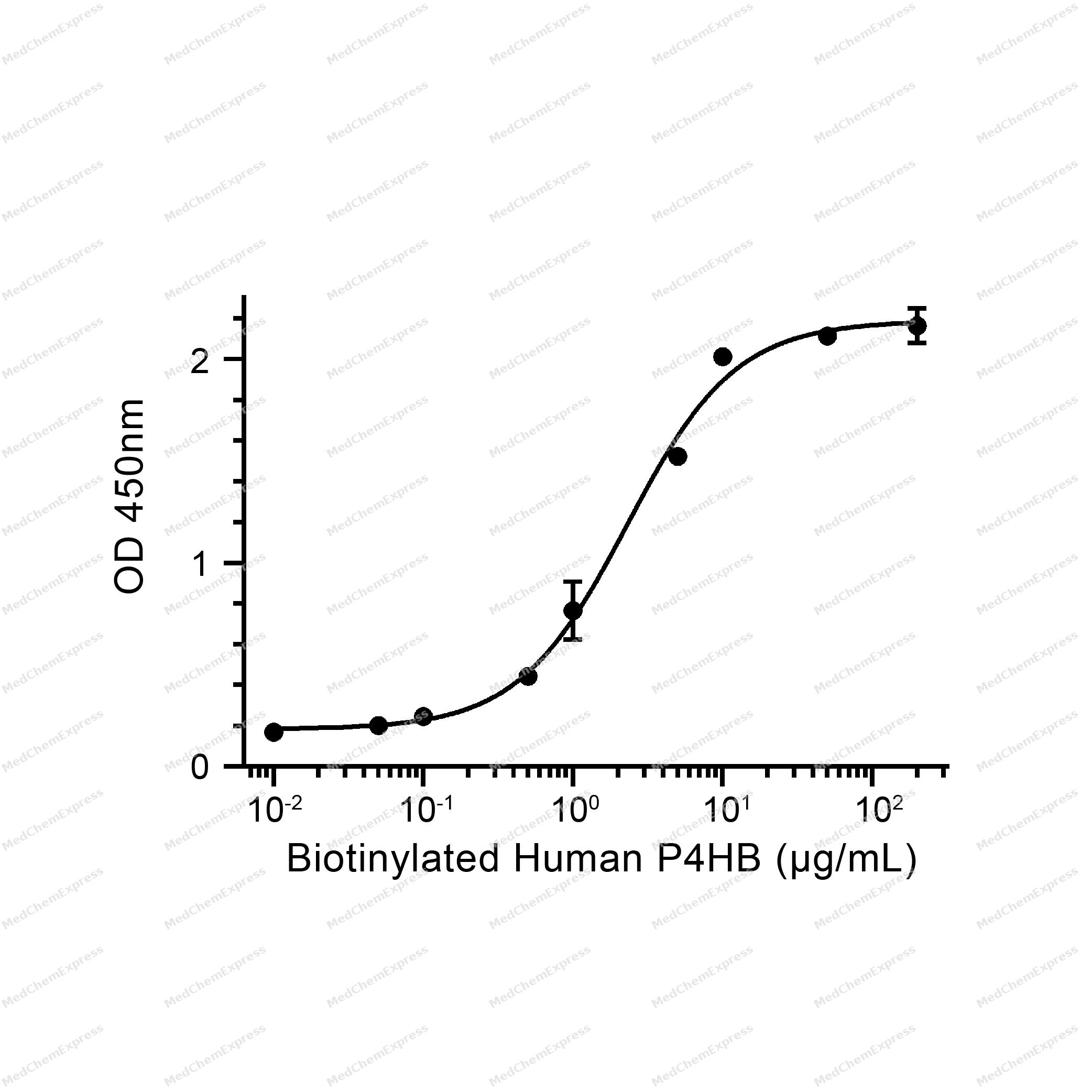
Bioactivity - ELISA


Technical Parameters
-
Species Human
-
Source HEK293
-
Tag C-6*His
-
Accession
Q969H8 (V32-L173)
-
Molecular Construction
-
N-term
-
SF20 (V32-L173)
Accession # Q969H8 -
6*His
-
C-term
-
-
Protein Length
Full Length of Mature Protein
-
Synonyms
MYDGF; Myeloid-Derived Growth Factor; Prev. C19orf10; IL-25; Prev. IL27w; Stromal Cell-Derived Growth Factor SF20; Prev. IL27; Chromosome 19 Open Reading Frame 10; R33729_1; UPF0556 Protein C19orf10; SF20; EUROIMAGE1875335; IL25; Interleukin-25; Interleuk
-
AA Sequence
VSEPTTVAFDVRPGGVVHSFSHNVGPGDKYTCMFTYASQGGTNEQWQMSLGTSEDHQHFTCTIWRPQGKSYLYFTQFKAEVRGAEIEYAMAYSKAAFERESDVPLKTEEFEVTKTAVAHRPGAFKAELSKLVIVAKASRTEL
-
Predicted Molecular Mass
17.3 kDa
-
Molecular Weight
Approximately 18 kDa, based on SDS-PAGE under reducing conditions.
-
Purity
≥ 95%, as determined by reducing SDS-PAGE.


Product Properties
Lyophilized powder
Lyophilized from a 0.22 μm filtered solution of PBS, pH 7.4.
<1 EU/μg, determined by LAL method.
It is not recommended to reconstitute to a concentration less than 100 μg/mL in ddH2O. For long term storage it is recommended to add a carrier protein (0.1% BSA, 5% HSA, 10% FBS or 5% Trehalose).
Stored at -20°C for 2 years from date of receipt. After reconstitution, it is stable at 4°C for 1 week or -20°C for longer (with carrier protein). It is recommended to freeze aliquots at -20°C or -80°C for extended storage.
Room temperature in continental US; may vary elsewhere.


Documentation
-
Data Sheet (236 KB)
-
SDS (252 KB)
- English - EN (252 KB)
- Français - FR (252 KB)
- Deutsch - DE (252 KB)
- Norwegian - NO (252 KB)
- Español - ES (252 KB)
- Swedish - SV (252 KB)
- Italian - IT (252 KB)
- Korean - KR (252 KB)
- Portuguese - PT (252 KB)
-
Handling Instructions (2659 KB)

Calculators
Concentration (start) × Volume (start) = Concentration (final) × Volume (final)


 Powered by Bioz

