



TARC/CCL17 Protein, Dog (HEK293, His)

Based on 1 Customer Validation
The TARC/CCL17 protein attracts T lymphocytes, particularly Th2 cells, and is involved in inflammation and immunity. It binds to CCR4 on T cells and contributes to GM-CSF/CSF2-induced pain and inflammation. In the brain, it maintains hippocampal microglia morphology and aids in adapting to neuroinflammation. Additionally, it plays a role in wound healing by promoting fibroblast migration. TARC/CCL17 Protein, Dog (HEK293, His) is the recombinant dog-derived TARC/CCL17 protein, expressed by HEK293 , with C-6*His labeled tag.
- Species: Dog
- Source: HEK293
-
Storage:Stored at -20°C for 2 years from date of receipt. After reconstitution, it is stable at 4°C for 1 week or -20°C for longer (with carrier protein). It is recommended to freeze aliquots at -20°C or -80°C for extended storage.


To place orders, for customer services and technical support, please contact: MedChemExpress USA
Tel: 609-228-6898 E-mail: [email protected] [email protected]


-
 Biological Activity
-
Technical Parameters
-
Product Properties
- Documentation
- Help & FAQs




Biological Activity
Description
The TARC/CCL17 protein attracts T lymphocytes, particularly Th2 cells, and is involved in inflammation and immunity. It binds to CCR4 on T cells and contributes to GM-CSF/CSF2-induced pain and inflammation. In the brain, it maintains hippocampal microglia morphology and aids in adapting to neuroinflammation. Additionally, it plays a role in wound healing by promoting fibroblast migration. TARC/CCL17 Protein, Dog (HEK293, His) is the recombinant dog-derived TARC/CCL17 protein, expressed by HEK293 , with C-6*His labeled tag.
Background
TARC/CCL17 protein serves as a chemokine with specific chemotactic activity for T lymphocytes, particularly Th2 cells, while exhibiting no such attraction for monocytes or granulocytes. Its involvement extends to various inflammatory and immunological processes, facilitated by the binding to CCR4 on the surface of T cells. Additionally, TARC/CCL17 contributes to GM-CSF/CSF2-driven pain and inflammation. In the brain, this chemokine is crucial for maintaining the characteristic, highly branched morphology of hippocampal microglia under homeostatic conditions and may play a pivotal role in adapting microglial morphology and synaptic plasticity during acute lipopolysaccharide (LPS)-induced neuroinflammation. Moreover, TARC/CCL17 plays a significant role in wound healing, primarily by inducing fibroblast migration into the wound.
Verified Bioactivity
Measured by its ability to chemoattract BaF3 mouse pro-B cells transfected with Human CCR4. The ED50 for this effect is 3-10 ng/mL.
MCE Validation Data
-
Purity - SDS-PAGE
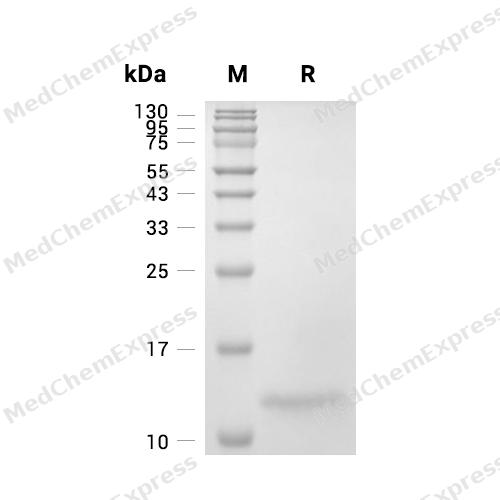
Purity - SDS-PAGE
-
Bioactivity - Cell-Based Assay
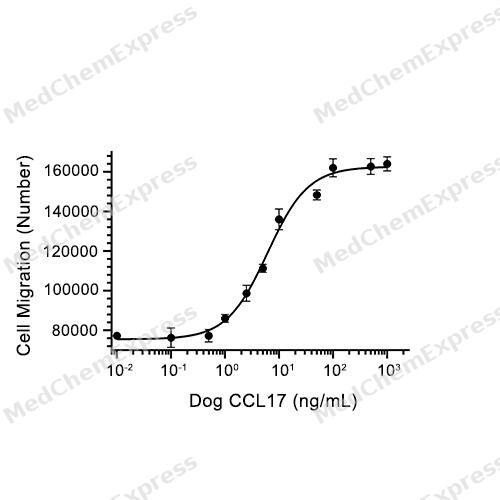
Bioactivity - Cell-Based Assay


Technical Parameters
-
Species Dog
-
Source HEK293
-
Tag C-6*His
-
Accession
Q95N01 (A24-S99)
-
Molecular Construction
-
N-term
-
CCL17 (A24-S99)
Accession # Q95N01 -
6*His
-
C-term
-
-
Protein Length
Full Length of Mature Protein
-
Synonyms
CCL17; Chemokine (C-C Motif) Ligand 17; Prev. SCYA17; C-C Motif Chemokine 17; TARC; CC Chemokine TARC; ABCD-2; T Cell-Directed CC Chemokine; Small Inducible Cytokine Subfamily A (Cys-Cys), Member 17; A-152E5.3; Thymus And Activation-Regulated Chemokine; C
-
AA Sequence
ARGTNVGRECCLEYFKGAIPISRLTRWYKTSGECPKDAIVFVTVQGKSICSDPKDKRVKKAVRYLQRTWKGGPQES
-
Predicted Molecular Mass
9.4 kDa
-
Molecular Weight
Approximately 10-12 kDa, based on SDS-PAGE under reducing conditions.
-
Purity
≥ 90%, as determined by reducing SDS-PAGE.


Product Properties
Lyophilized powder
Lyophilized from a 0.2 μm filtered solution of PBS, 6% Trehalose, pH 7.4.
<1 EU/μg, determined by LAL method.
It is not recommended to reconstitute to a concentration less than 100 μg/mL in ddH2O.
Stored at -20°C for 2 years from date of receipt. After reconstitution, it is stable at 4°C for 1 week or -20°C for longer (with carrier protein). It is recommended to freeze aliquots at -20°C or -80°C for extended storage.
Room temperature in continental US; may vary elsewhere.


Documentation
-
Data Sheet (236 KB)
-
SDS (252 KB)
- English - EN (252 KB)
- Français - FR (252 KB)
- Deutsch - DE (252 KB)
- Norwegian - NO (252 KB)
- Español - ES (252 KB)
- Swedish - SV (252 KB)
- Italian - IT (252 KB)
- Korean - KR (252 KB)
- Portuguese - PT (252 KB)
-
Handling Instructions (2659 KB)

Calculators
Concentration (start) × Volume (start) = Concentration (final) × Volume (final)


 Powered by Bioz

