



UBE2D1 Protein, Human (GST)

Based on 1 Customer Validation
The UBE2D1 protein is critical in cellular processes. It accepts ubiquitin from the E1 complex and preferentially catalyzes "Lys-48"-linked polyubiquitination in vitro, demonstrating multifunctionality. It mediates the selective degradation of short-lived and aberrant proteins and is involved in E6/E6-AP-induced ubiquitination of p53/TP53. UBE2D1 Protein, Human (GST) is the recombinant human-derived UBE2D1 protein, expressed by E. coli , with N-GST labeled tag.
- Species: Human
- Source: E. coli
-
Storage:Stored at -80°C for 1 year from date of receipt. It is stable at -20°C for 3 months after opening. It is recommended to freeze aliquots at -80°C for extended storage. Avoid repeated freeze-thaw cycles.


To place orders, for customer services and technical support, please contact: MedChemExpress USA
Tel: 609-228-6898 E-mail: [email protected] [email protected]


-
 Biological Activity
-
Technical Parameters
-
Product Properties
- Documentation
- Help & FAQs




Biological Activity
Description
The UBE2D1 protein is critical in cellular processes. It accepts ubiquitin from the E1 complex and preferentially catalyzes "Lys-48"-linked polyubiquitination in vitro, demonstrating multifunctionality. It mediates the selective degradation of short-lived and aberrant proteins and is involved in E6/E6-AP-induced ubiquitination of p53/TP53. UBE2D1 Protein, Human (GST) is the recombinant human-derived UBE2D1 protein, expressed by E. coli , with N-GST labeled tag.
Background
The UBE2D1 protein plays a pivotal role in cellular processes by accepting ubiquitin from the E1 complex and facilitating its covalent attachment to diverse proteins (source). In vitro, UBE2D1 demonstrates a catalytic preference for 'Lys-48'-linked polyubiquitination, showcasing its versatility in modifying target proteins (source). Functioning as a key mediator in the selective degradation of short-lived and aberrant proteins, UBE2D1 also participates in the E6/E6-AP-induced ubiquitination of p53/TP53. Moreover, it facilitates the ubiquitination of PEX5 and orchestrates the auto-ubiquitination of STUB1, TRAF6, and TRIM63/MURF1 (sources). UBE2D1 exhibits the capability to ubiquitinate STUB1-associated HSP90AB1 in vitro, underscoring its involvement in intricate cellular pathways (source). Notably, UBE2D1 lacks inherent specificity for any particular lysine residue of ubiquitin, highlighting its dynamic nature in ubiquitin modification processes (source). Its essential role in viral activation of IRF3 and mediation of the polyubiquitination of CYP3A4 further emphasizes UBE2D1's multifaceted contributions to cellular function (sources).
Verified Bioactivity
The enzyme activity of this recombinant protein is testing in progress, we cannot offer a guarantee yet.
MCE Validation Data
-
Purity - SDS-PAGE
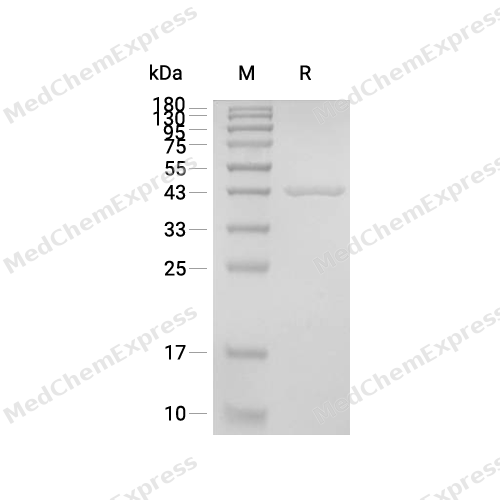
Purity - SDS-PAGE


Technical Parameters
-
Species Human
-
Source E. coli
-
Tag N-GST
-
Accession
P51668 (M1-M147)
-
Molecular Construction
-
N-term
-
GST
-
UBE2D1 (M1-M147)
Accession # P51668 -
C-term
-
-
Protein Length
Full Length
-
Synonyms
UBE2D1; Ubiquitin Conjugating Enzyme E2 D1; SFT; UBCH5; Stimulator Of Fe Transport; E2(17)KB1; UbcH5A; UBC4/5; Ubiquitin-Conjugating Enzyme E2D 1 (UBC4/5 Homolog,Yeast); (E3-Independent) E2 Ubiquitin-Conjugating Enzyme D1; Ubiquitin-Conjugating Enzyme E2-
-
AA Sequence
MALKRIQKELSDLQRDPPAHCSAGPVGDDLFHWQATIMGPPDSAYQGGVFFLTVHFPTDYPFKPPKIAFTTKIYHPNINSNGSICLDILRSQWSPALTVSKVLLSICSLLCDPNPDDPLVPDIAQIYKSDKEKYNRHAREWTQKYAM
-
Predicted Molecular Mass
42.9 kDa
-
Molecular Weight
Approximately 40 kDa, based on SDS-PAGE under reducing conditions.
-
Purity
≥ 95%, as determined by reducing SDS-PAGE.


Product Properties
Solution
Supplied as a 0.22 μm filtered solution of 50 mM HEPES, 150 mM NaCl, 2 mM DTT, 10% Glycerin, pH 7.5.
<1 EU/μg, determined by LAL method.
Stored at -80°C for 1 year from date of receipt. It is stable at -20°C for 3 months after opening. It is recommended to freeze aliquots at -80°C for extended storage. Avoid repeated freeze-thaw cycles.
Shipping with dry ice.


Documentation
-
Data Sheet (236 KB)
-
SDS (252 KB)
- English - EN (252 KB)
- Français - FR (252 KB)
- Deutsch - DE (252 KB)
- Norwegian - NO (252 KB)
- Español - ES (252 KB)
- Swedish - SV (252 KB)
- Italian - IT (252 KB)
- Korean - KR (252 KB)
- Portuguese - PT (252 KB)
-
Handling Instructions (2659 KB)

Calculators
Concentration (start) × Volume (start) = Concentration (final) × Volume (final)


 Powered by Bioz

