



USP14 Protein, Human (His)
Based on 1 publication(s) in Google Scholar
USP14 is a proteasome-associated deubiquitinase that regulates ubiquitin dynamics by releasing ubiquitin from proteins marked for degradation. As a reversible proteasome subunit, USP14 ensures ubiquitin replenishment. USP14 Protein, Human (His) is the recombinant human-derived USP14 protein, expressed by E. coli , with N-6*His labeled tag.
- Species: Human
- Source: E. coli
-
Storage:Stored at -80°C for 1 year from date of receipt. It is stable at -20°C for 3 months after opening. It is recommended to freeze aliquots at -80°C for extended storage. Avoid repeated freeze-thaw cycles.


To place orders, for customer services and technical support, please contact: MedChemExpress USA
Tel: 609-228-6898 E-mail: [email protected] [email protected]


-
 Biological Activity
-
Technical Parameters
-
Product Properties
- Documentation
- Help & FAQs




Biological Activity
Description
USP14 is a proteasome-associated deubiquitinase that regulates ubiquitin dynamics by releasing ubiquitin from proteins marked for degradation. As a reversible proteasome subunit, USP14 ensures ubiquitin replenishment. USP14 Protein, Human (His) is the recombinant human-derived USP14 protein, expressed by E. coli , with N-6*His labeled tag.
Background
USP14, a proteasome-associated deubiquitinase, emerges as a crucial player in cellular processes, particularly in the dynamic regulation of ubiquitin at the proteasome. Functioning as a reversibly associated subunit of the proteasome, USP14 ensures the release of ubiquitin from ubiquitinated proteins targeted for degradation, facilitating the regeneration of ubiquitin within the cellular environment. Beyond its role in proteasome-mediated protein turnover, USP14 plays a pivotal role in diverse physiological contexts. It is involved in the degradation of the chemokine receptor CXCR4, a critical event for CXCL12-induced cell chemotaxis. Additionally, USP14 serves as a physiological inhibitor of endoplasmic reticulum-associated degradation (ERAD) under non-stressed conditions, interacting with ERN1 and modulating the degradation of unfolded endoplasmic reticulum proteins. Furthermore, USP14 contributes to synaptic development and function at neuromuscular junctions (NMJs) and participates in the innate immune defense against viruses by stabilizing the viral DNA sensor CGAS, thereby impeding its autophagic degradation.
Verified Bioactivity
1.Measured in a cell proliferation assay using A549 cells. The ED50 for this effect is 13.76 ng/mL, corresponding to a specific activity is 7.27×10⁴ units/mg.
2.Measured by the hydrolysis of Ubiquitin-AMC that incubate at 37℃ in kinetic mode for 40 minutes. The specific activity is 2.858 pmol/min/μg.
MCE Validation Data
-
Purity - SDS-PAGE
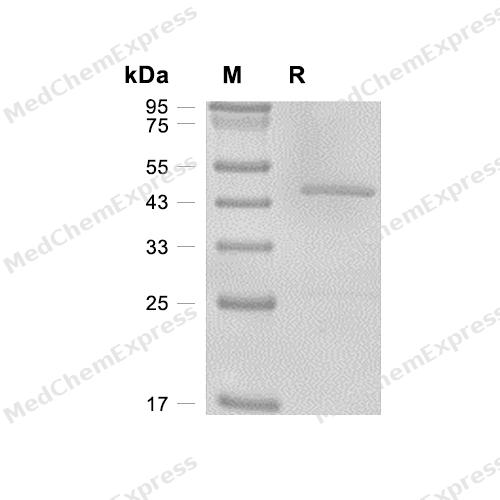
Purity - SDS-PAGE
-
Bioactivity - Cell-Based Assay
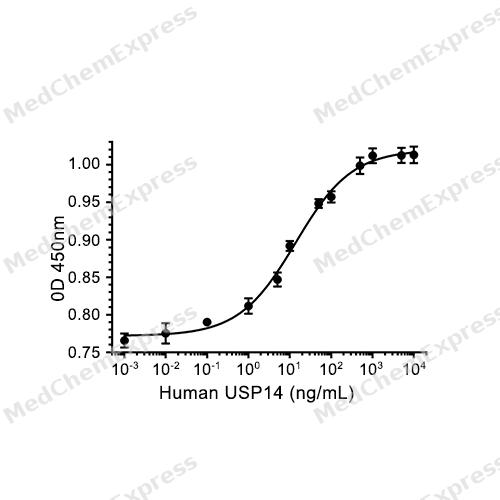
Bioactivity - Cell-Based Assay


Publications (1)
-
Journal Impact Factor
-
Most Recent
-
Bioorg Chem
Discovery of selective and potent USP22 inhibitors via structure-based virtual screening and bioassays exerting anti-tumor activity. [Abstract]2023 Dec:141:106842. PMID: 37769523


Technical Parameters
-
Species Human
-
Source E. coli
-
Tag N-6*His
-
Accession
P54578-1 (D91-Q494)
-
Molecular Construction
-
N-term
-
6*His
-
USP14 (D91-Q494)
Accession # P54578-1 -
C-term
-
-
Protein Length
Partial
-
Synonyms
USP14; Ubiquitin Specific Peptidase 14; TGT; Ubp6; Ubiquitin Specific Peptidase 14 (TRNA-Guanine Transglycosylase); Ubiquitin Specific Protease 14 (TRNA-Guanine Transglycosylase); Ubiquitin Carboxyl-Terminal Hydrolase 14; Deubiquitinating Enzyme 14; Ubiqu
-
AA Sequence
DMTEEQLASAMELPCGLTNLGNTCYMNATVQCIRSVPELKDALKRYAGALRASGEMASAQYITAALRDLFDSMDKTSSSIPPIILLQFLHMAFPQFAEKGEQGQYLQQDANECWIQMMRVLQQKLEAIEDDSVKETDSSSASAATPSKKKSLIDQFFGVEFETTMKCTESEEEEVTKGKENQLQLSCFINQEVKYLFTGLKLRLQEEITKQSPTLQRNALYIKSSKISRLPAYLTIQMVRFFYKEKESVNAKVLKDVKFPLMLDMYELCTPELQEKMVSFRSKFKDLEDKKVNQQPNTSDKKSSPQKEVKYEPFSFADDIGSNNCGYYDLQAVLTHQGRSSSSGHYVSWVKRKQDEWIKFDDDKVSIVTPEDILRLSGGGDWHIAYVLLYGPRRVEIMEEESEQ
-
Predicted Molecular Mass
46.2 kDa
-
Molecular Weight
Approximately 52 kDa, based on SDS-PAGE under reducing conditions.
-
Purity
≥ 90%, as determined by reducing SDS-PAGE.


Product Properties
Solution
Supplied as a 0.22 μm filtered solution of 20 mM Tris-HCl, 100 mM NaCl, 20% glycerol, pH 8.0.
Note: For SPR assay, please replace the buffer. Primary amine components (e.g., Tris, imidazole) can affect protein-coupled chips.
<1 EU/μg, determined by LAL method.
Stored at -80°C for 1 year from date of receipt. It is stable at -20°C for 3 months after opening. It is recommended to freeze aliquots at -80°C for extended storage. Avoid repeated freeze-thaw cycles.
Shipping with dry ice.


Documentation
-
Data Sheet (238 KB)
-
SDS (252 KB)
- English - EN (252 KB)
- Français - FR (252 KB)
- Deutsch - DE (252 KB)
- Norwegian - NO (252 KB)
- Español - ES (252 KB)
- Swedish - SV (252 KB)
- Italian - IT (252 KB)
- Korean - KR (252 KB)
- Portuguese - PT (252 KB)
-
Handling Instructions (2659 KB)

Calculators
Concentration (start) × Volume (start) = Concentration (final) × Volume (final)


 Powered by Bioz

