



CXCR6
CXCR6 is a class A GPCR that binds CXCL16, mediating leukocyte adhesion through transmembrane CXCL16 and migration through soluble CXCL16[1]. Mechanistically, the CXCL16/CXCR6 axis activates Akt, MAPK, and context-specific inflammatory programs in epithelial, immune, and tumor models[2][3]. In intestinal inflammation, CXCR6-expressing cells respond to CXCL16, and CXCL16 expression increases in Crohn’s disease tissues and inflammatory mouse models[2]. In liver injury models, CXCR6-dependent hepatic NKT cell accumulation promotes inflammatory cytokine production and liver fibrosis[4]. In CNS viral recovery, CXCL16/CXCR6 maintains CD8+ tissue-resident T cells, glial activation, and ongoing synapse elimination[5]. Compared with related chemokine receptors, CXCR6 carries a DRF motif rather than the typical DRY motif, supporting adhesion and cell retention while reducing chemotactic response[1]. For experimental applications, CXCR6 blockade or CXCL16 targeting can test tissue-resident T-cell maintenance, inflammatory recruitment, fibrosis progression, and tumor-immune interactions[4][5][6].
References:
- [1]. Koenen A, et al. The DRF motif of CXCR6 as chemokine receptor adaptation to adhesion. PLoS One. 2017 Mar 7;12(3):e0173486. [Content Brief]
- [2]. Diegelmann J, et al. Expression and regulation of the chemokine CXCL16 in Crohn's disease and models of intestinal inflammation. Inflamm Bowel Dis. 2010 Nov;16(11):1871-81. [Content Brief]
- [3]. Han J, et al. CXCL16 Promotes Gastric Cancer Tumorigenesis via ADAM10-Dependent CXCL16/CXCR6 Axis and Activates Akt and MAPK Signaling Pathways. Int J Biol Sci. 2021 Jul 5;17(11):2841-2852. [Content Brief]
- [4]. Wehr A, et al. Chemokine receptor CXCR6-dependent hepatic NK T Cell accumulation promotes inflammation and liver fibrosis. J Immunol. 2013 May 15;190(10):5226-36. [Content Brief]
- [5]. Rosen SF, et al. Single-cell RNA transcriptome analysis of CNS immune cells reveals CXCL16/CXCR6 as maintenance factors for tissue-resident T cells that drive synapse elimination. Genome Med. 2022 Sep 24;14(1):108. [Content Brief]
- [6]. Mabrouk N, et al. CXCR6 expressing T cells: Functions and role in the control of tumors. Front Immunol. 2022 Oct 12;13:1022136. [Content Brief]
All Product Categories
-
CXCR6 Related Products (4)
Related Products (4)

-
ML339
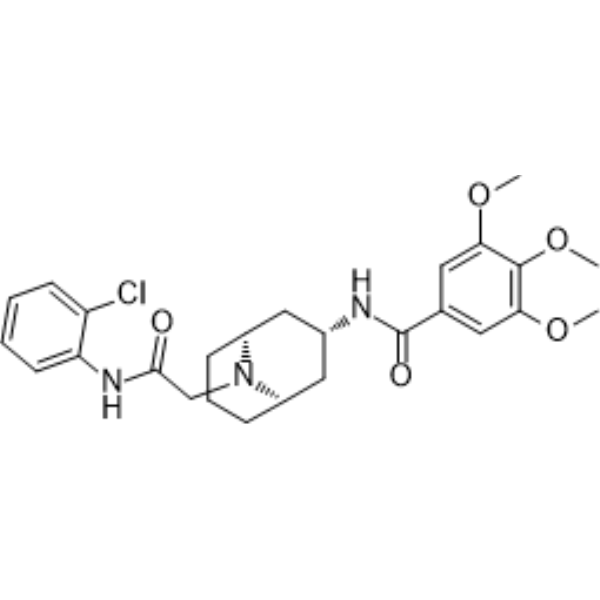 0 ImagesML339 is a selective CXCR6 antagonist with an IC50 of 140 nM. ML339 antagonizes β-arrestin recruitment and cAMP signaling pathway of human CXCR6 receptor induced by CXCL16, with IC50 of 0.3 μM and 1.4 μM, respectively. ML339 shows weaker activity against the recruitment of β-arrestin in mouse CXCR6 receptors, with an IC50 of 18 μM. ML339 has no inhibitory effect on CXCR5,CXCR4,CXCR6 and apelin receptor (APJ), with IC50 >79 μM. ML339 has the potential to promote the development of prostate cancer research.
-
Anti-Mouse CXCL16 Antibody (12-81)
 0 ImagesCat. No.: HY-P991752Anti-Mouse CXCL16 Antibody (12-81) is an antibody targeting mouse CXCL16. Anti-Mouse CXCL16 Antibody (12-81) blocks the CXCL16/CXCR6 signaling axis. Anti-Mouse CXCL16 Antibody (12-81) reduces the recruitment of CD8+ T cells into the brain. Anti-Mouse CXCL16 Antibody (12-81) alleviates the reduction of hippocampal neurogenesis. Anti-Mouse CXCL16 Antibody (12-81) attenuates anxiety-like behaviors in mice. Anti-Mouse CXCL16 Antibody (12-81) can be used in studies related to anxiety-like behaviors. The recommended isotype control is Rat IgG1 kappa, Isotype Control (HY-P99979).
-
Anti-Mouse CXCR6 Antibody (Cx6Mab-1)
 0 ImagesCat. No.: HY-P991781Purity: 99.32%Anti-Mouse CXCR6 Antibody (Cx6Mab-1) is a monoclonal antibody targeting mouse CXC chemokine receptor 6 (mCXCR6), with a KD of 1.7 nM against CHO/mCXCR6-overexpressing cells. Anti-Mouse CXCR6 Antibody (Cx6Mab-1) binds to the N-terminal domain epitope of mCXCR6 containing Ser8, Ala9, Leu10, Tyr11, Gly13 and His14, and interacts with both overexpressed and endogenous forms of the receptor. Anti-Mouse CXCR6 Antibody (Cx6Mab-1) can be used in studies related to mouse lymphoma.
-
CXCR6 antagonist 1
 0 ImagesCat. No.: HY-133151CAS No.: 2579689-85-1CXCR6 antagonist 1 (Compound 81) is an orally active CXCR6 antagonist. CXCR6 antagonist 1 inhibits the CXCR6 receptor signaling pathway, including β-arrestin recruitment and Forskolin (HY-15371)-induced cAMP production. CXCR6 antagonist 1 reduces tumor growth in a mouse xenograft model of hepatocellular carcinoma. CXCR6 antagonist 1 can be used in research related to hepatocellular carcinoma.



