



Serine β-lactamase (SBL)
Serine β-lactamases (SBLs) hydrolyze β-lactam antibiotics and thereby protect bacteria from penicillins, cephalosporins, and related agents[1]. Mechanistically, class A, C, and D β-lactamases use an active-site serine residue to catalyze β-lactam-ring hydrolysis through an acyl-enzyme intermediate[2][3]. This catalytic process makes β-lactamase production a major mechanism of acquired β-lactam resistance in Gram-negative pathogens, including Enterobacteriaceae, Pseudomonas aeruginosa, and Acinetobacter baumannii[2]. In disease-relevant models, β-lactamase-mediated resistance affects clinical pathogens and can be evaluated through catalytic activity and inhibition assays[3]. Compared with metallo-β-lactamases, SBLs are distinct because they use serine-dependent catalysis, whereas class B enzymes require zinc or another metal cofactor[2][4]. Within SBLs, class A enzymes include clinically important variants, while class C AmpC β-lactamase supports inhibitor design through enzymology, microbiology, and X-ray crystallography[5]. For experimental applications, clavulanate inhibits selected β-lactamases by forming a stable complex with the active-site serine[6]. Newer boronic acid inhibitors, including QPX7728, inhibit key serine β-lactamases and support combination studies with multiple β-lactam antibiotics[7].
References:
- [1]. Oefner C, et al. Refined crystal structure of beta-lactamase from Citrobacter freundii indicates a mechanism for beta-lactam hydrolysis. Nature. 1990 Jan 18;343(6255):284-8.
- [2]. Pérez-Llarena FJ, et al. Beta-lactamase inhibitors: the story so far. Curr Med Chem. 2009;16(28):3740-65. [Content Brief]
- [3]. Viswanatha T, et al. Assays for beta-lactamase activity and inhibition. Methods Mol Med. 2008;142:239-60. [Content Brief]
- [4]. Bahr G, et al. Metallo-β-lactamases in the Age of Multidrug Resistance: From Structure and Mechanism to Evolution, Dissemination, and Inhibitor Design. Chem Rev. 2021 Jul 14;121(13):7957-8094. [Content Brief]
- [5]. Morandi F, et al. Nanomolar inhibitors of AmpC beta-lactamase. J Am Chem Soc. 2003 Jan 22;125(3):685-95. [Content Brief]
- [6]. Neu HC. Contribution of beta-lactamases to bacterial resistance and mechanisms to inhibit beta-lactamases. Am J Med. 1985 Nov 29;79(5B):2-12. doi: 10.1016/0002-9343(85)90123-8. PMID: 3907341. et al. Contribution of beta-lactamases to bacterial resistance and mechanisms to inhibit beta-lactamases. Am J Med. 1985 Nov 29;79(5B):2-12. [Content Brief]
- [7]. Tsivkovski R, et al. Biochemical Characterization of QPX7728, a New Ultrabroad-Spectrum Beta-Lactamase Inhibitor of Serine and Metallo-Beta-Lactamases. Antimicrob Agents Chemother. 2020 May 21;64(6):e00130-20. [Content Brief]
All Product Categories
-
Serine β-lactamase (SBL) Related Products (6)
Related Products (6)

-
BLI-489 hydrate
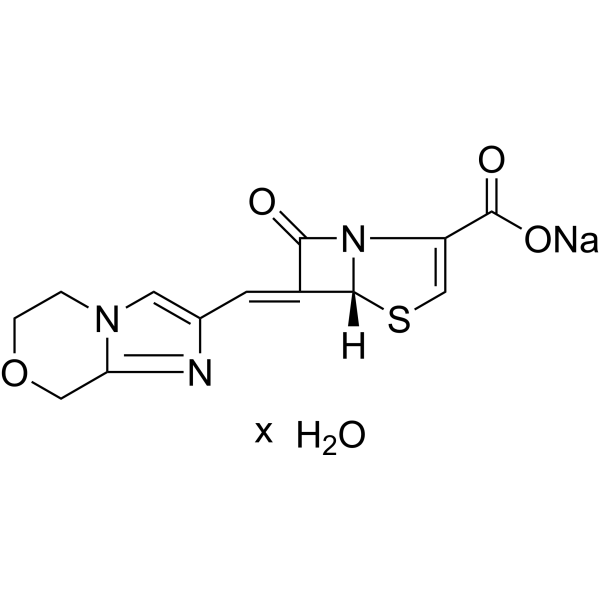 0 ImagesBLI-489 hydrate is a Beta-lactamase inhibitor. BLI-489 hydrate is an antibacterial adjuvant that significantly enhances the antibacterial efficacy of β-lactam antibiotics. BLI-489 hydrate blocks the hydrolytic activity of the enzyme by forming a stable intermediate in serine Beta-lactamase, or by coordinating with the binuclear Zn2+ through an oxygen atom in metallo-Beta-lactamase. BLI-489 hydrate can be used for research on bacterial infections.
-
BLI-489
 0 ImagesCat. No.: HY-108062CAS No.: 623564-40-9BLI-489 is a Beta-lactamase inhibitor. BLI-489 is an antibacterial adjuvant that significantly enhances the antibacterial efficacy of β-lactam antibiotics. BLI-489 blocks the hydrolytic activity of the enzyme by forming a stable intermediate in serine Beta-lactamase, or by coordinating with the binuclear Zn2+ through an oxygen atom in metallo-Beta-lactamase. BLI-489 can be used for research on bacterial infections.
-
β-Lactamase/Ferroptosis-IN-1
 0 ImagesCat. No.: HY-184667CAS No.: 3115648-56-8β-Lactamase/Ferroptosis-IN-1 is a dual inhibitor of β-Lactamase and ferroptosis, β-Lactamase/Ferroptosis-IN-1 inhibits NDM-1 (metallo-β-lactamase, MBLs, IC50 = 1.8 μM) and KPC-2 (serine-β-lactamase, SBLs, IC50 = 2.6 μM). β-Lactamase/Ferroptosis-IN-1 exerts synergistic antibacterial effects with antibiotics against multidrug-resistant Gram-negative bacteria (MDR-GNB), and alleviates LPS (HY-D1056)-induced acute lung injury by inhibiting ferroptosis via upregulating FTH1 and GPX4 expression and reducing MDA levels. β-Lactamase/Ferroptosis-IN-1 can be used for the study of MDR-GNB infections and acute lung injury.
-
BLI-489 free base
 0 ImagesCat. No.: HY-108062BCAS No.: 635322-76-8BLI-489 free base is a Beta-lactamase inhibitor. BLI-489 free base is an antibacterial adjuvant that significantly enhances the antibacterial efficacy of β-lactam antibiotics. BLI-489 free base blocks the hydrolytic activity of the enzyme by forming a stable intermediate in serine Beta-lactamase, or by coordinating with the binuclear Zn2+ through an oxygen atom in metallo-Beta-lactamase. BLI-489 free base can be used for research on bacterial infections.
-
YL6113
 0 ImagesCat. No.: HY-178976YL6113 is a potent and selective dual inhibitor of metallo-β-lactamases (MBLs) and serine-β-lactamases (SBLs). YL6113 shows inhibitory effect to MBLs, such as NDm-1, VIM-2, IMP-1, with IC50 values of 0.25, 27.16 and 3.55 μM. YL6113 shows inhibitory effect to SBLs, such as KPC-2, AmpC, OXA-48, with IC50 values of 0.2, 34.1 and 1.31 μM. YL6113 enhances the antibacterial efficacy of Meropenem (HY-13678) against carbapenem-resistant Gram-negative bacteria. YL6113 can be used for the research of infection.
-
BLI-489 (Standard)
 0 ImagesCat. No.: HY-108062RCAS No.: 623564-40-9BLI-489 Standard is the analytical standard of BLI-489 (HY-108062). This product is intended for research and analytical applications. BLI-489 is a Beta-lactamase inhibitor. BLI-489 is an antibacterial adjuvant that significantly enhances the antibacterial efficacy of β-lactam antibiotics. BLI-489 blocks the hydrolytic activity of the enzyme by forming a stable intermediate in serine Beta-lactamase, or by coordinating with the binuclear Zn2+ through an oxygen atom in metallo-Beta-lactamase. BLI-489 can be used for research on bacterial infections.



