



Cracking the PROTAC Permeability Barrier: CD36-Mediated Endocytosis as a Potential Breakthrough
2025-12-03
In recent years, proteolysis-targeting chimeras (PROTACs) have shown tremendous promise in targeting "undruggable" proteins. By simultaneously engaging a target protein and an E3 ubiquitin ligase, PROTACs trigger selective protein degradation and enable precise removal of disease-driving proteins.
However, PROTACs are typically large and highly polar, with molecular weights often exceeding 800 Da---far beyond Lipinski's Rule of Five (Ro5) for orally bioavailable small-molecule drugs. As a result, they are widely believed to suffer from poor membrane permeability and inefficient cellular uptake---mechanisms that remain poorly understood. Overcoming these limitations has become a key challenge in medicinal chemistry.
A collaborative study from The University of Texas Health Science Center, Duke University, University of Arkansas and others reports that CD36 (cluster of differentiation 36) is a membrane receptor that mediates cellular uptake of PROTACs and other "beyond-Rule-of-Five" (bRo5/eRo5) molecules.
Using biotin-probe profiling, gene knockout/knock-in models, UPLC-MS metabolomics and computational simulations, the researchers demonstrated that:
• CD36 binds multiple PROTAC molecules (including SIM1-Me, MZ1 and ARV-110) as well as large-molecule drugs such as rapamycin, navitoclax, birinapant, tubacin and doxorubicin, thereby promoting their cellular uptake and pharmacological activity.
• Loss of CD36 drastically reduces drug uptake and target protein degradation, whereas restoring CD36 expression rescues PROTAC efficacy.
• CD36-mediated drug internalization depends on classical endocytosis via the Rab5/EEA1 early endosome pathway.
• Structural optimization that enhances PROTAC affinity for CD36 can significantly improve permeability and activity.

(1) CD36 recognizes and internalizes multiple "large-molecule" therapeutics.
Through membrane proteomics screening using biotin-labeled PROTAC probes, the team identified CD36 as a major binding partner of both CRBN- and VHL-based PROTACs, as well as several non-traditional small-molecule therapeutics such as rapamycin and doxorubicin.
This work reveals that CD36 is not limited to fatty-acid transport---its broad ligand recognition ability positions it as a potential "drug-transport receptor."

(A) Structure of trivalent biotin probe, BRD-VHL-biotin. The BRD4 binding motif, VHL E3 ligase binding motif, D-(+)-biotin motif, and linker are colored red, blue, purple, and black, respectively. Compound structure is represented by tethered triangles and a cycle.(B) Workflow for detecting membrane targets of BRD4-VHL-biotin.(C) Structures of trivalent PROTACs SIM1 and SIM1-Me. BRD4 binding motifs in SIM1 or SIM1-Me, VHL E3 ligase binding motifs, and linkers are colored as red, blue, and black, respectively. Compound structure is represented by tethered triangles.(D) Densitometric analyses (left) and a representative immunoblotting assay (right) showing the relative expression of CD36 in membrane and cytosolic fractions from LNCaP cells. CD36 expression in membrane and cytosolic fractions from LNCaP cells (right) was examined by immunoblotting assays and normalized to a-tubulin for densitometric analyses (left). Data are mean ± SEM, n = 3.(E) Biotin pull-down assay showing SIM1-Me is competitive with BRD-VHL-biotin for binding with CD36 in membrane fractions from LNCaP cells under indicated conditions.(F) Representative sensograms from surface plasmon resonance assays showing the binding affinity of SIM1-Me to an hCD36-coated Series S sensor chip CM5 from Cytiva.
(2) CD36 knockout significantly reduces uptake of PROTACs and other bRo5 compounds.
Using shRNA to silence CD36 in LNCaP prostate cancer cells, the researchers found that treatment with SIM1-Me (10 nM) or ARV-110 (50 nM) led to:
• 5.6-fold and 19.6-fold reductions, respectively, in cellular drug uptake
• dramatically impaired target protein degradation
• markedly reduced cytotoxicity (up to 423-fold)
Re-expression of CD36 restored activity, and loss of EEA1 also diminished SIM1-Me and ARV-110 cytotoxicity---confirming a dependence on the Rab5/EEA1 endocytic pathway.
Similar effects were also observed with representative bRo5 molecules in TNBC and prostate cancer cells.
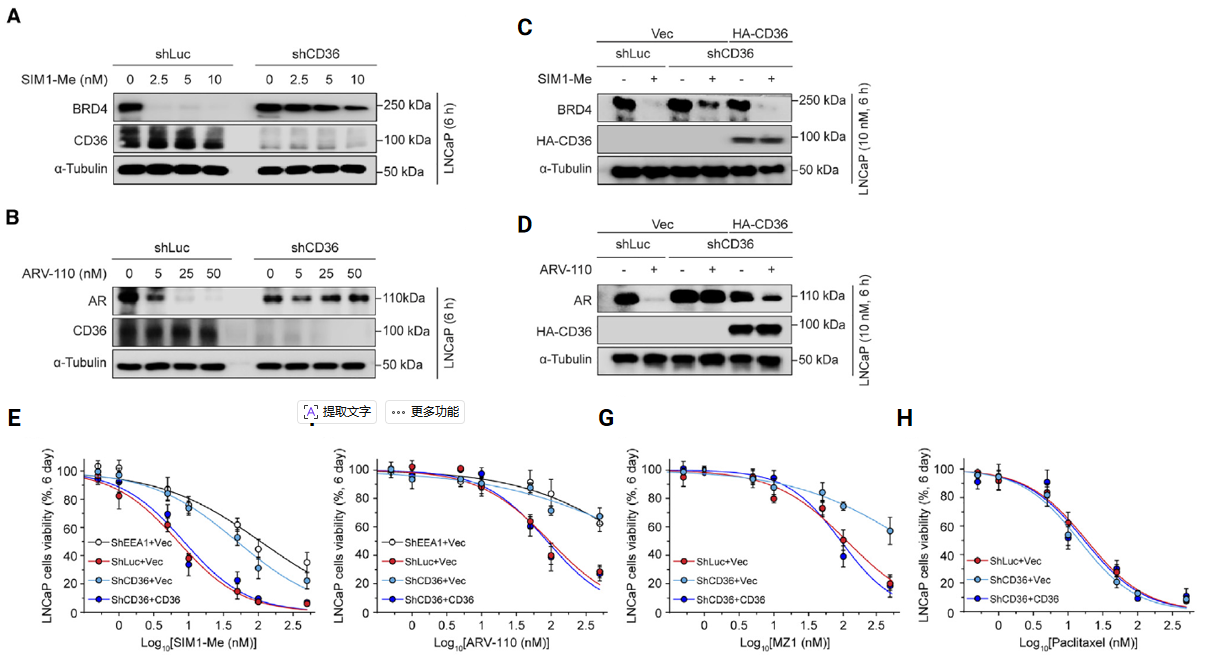
(A and B) Immunoblotting assays showing shCD36 reverses BRD4 and AR degradation by SIM1-Me (A) and ARV-110 (B), respectively, in LNCaP cells under indicated conditions.(E and F) Immunoblotting assays showing increasing expression of HA-tagged CD36 protein in shCD36-LNCaP cells restores BRD4 and AR degradation by SIM1-Me (E) and ARV-110 (F), respectively, in LNCaP cells under indicated conditions.(G–J) Viability of shEEA1+Vec-, shLuc+Vec-, shCD36+Vec-, shCD36+CD36-LNCaP cells determined by MTT assays after incubation with increasing concentrations of SIM1-Me (G), ARV-110 (H), MZ1 (I), or paclitaxel (J). Data are mean ± SEM, n = 3.
.png)
(3) Structural optimization to enhance CD36 affinity improves permeability and drug potency.
To increase affinity toward CD36, researchers modified the linker region of the VHL-based PROTAC MZ1 by introducing cleavable polar groups (e.g., carboxyl, amino, Boc-protected groups). These "prodrug-like" derivatives---such as MZ1-C14-Na and MZ1-C12-NB---showed
• 22.3-fold and 7.7-fold increases in intracellular accumulation vs. MZ1
• superior tumor-killing activity
• rapid intracellular conversion back to active MZ1 (>60% within 1 hr)
This demonstrates that tuning CD36 affinity offers a feasible strategy to improve permeability of PROTACs and other large molecules.
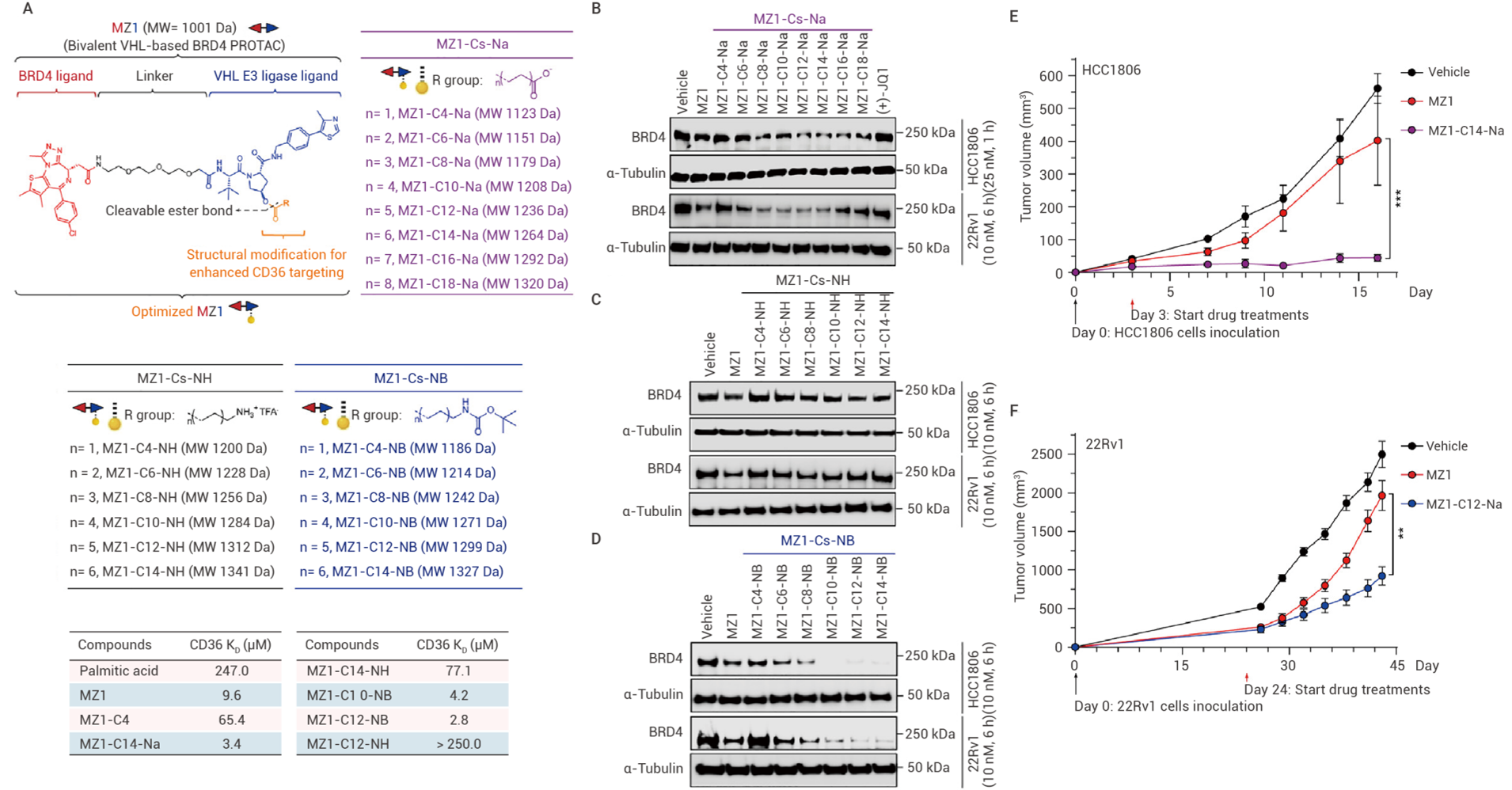
(A) Chemical structures and CD36 binding affinity of VHL-based BRD4 PROTAC MZ1 and optimized MZ1 analogs. The BRD4 binding motif, VHL E3 ligase binding motif, linker, and structural modifications for enhanced CD36 binding affinity and permeability are colored as red, blue, black, and orange, respectively. Compound structure is represented by tethered triangles and a cycle.(B–D) Immunoblotting assays showing the BRD4 protein levels in HCC1806 or 22Rv1 cells after incubation with vehicle, BRD4 inhibitor (+)-JQ1 (C), BRD4 PROTAC MZ1 (C–E), optimized MZ1 analogs MZ1-Cs-Na (C), MZ1-Cs-NH (D), or MZ1-Cs-NB (E) under indicated conditions.E: Tumor volume after vehicle, MZ1, or MZ1-C14-Na treatment.G: Tumor volume after vehicle, MZ1, or MZ1-C12-NB treatment.
Implications for drug discovery
CD36 is now recognized as a major receptor facilitating cellular uptake of PROTACs, divalent inhibitors and high-molecular-weight drugs (543--2145 Da). Screening for receptor-mediated uptake (e.g., via CD36) should therefore be incorporated into medicinal chemistry workflows.
Implications for drug development
The discovery of CD36 as a "universal carrier" suggests that medicinal chemists can rationally enhance CD36 binding to improve intracellular exposure. This may become a broadly applicable strategy for PROTAC and bRo5 drug design---although further validation is required.
Implications for precision medicine
Mutations or loss of CD36 may contribute to reduced PROTAC efficacy or resistance. Additionally, clinically advancing PROTACs may benefit from optimization toward receptor-mediated uptake.
This groundbreaking Cell publication is the first to establish CD36 as a key endocytic receptor for bRo5-class drugs and to propose a generalized "CD36-mediated chemical endocytosis" strategy. The findings greatly expand the theoretical and practical foundation for large-molecule drug discovery.
As structurally complex therapeutics continue to emerge, this work offers a powerful "key" to unlock the cell membrane---paving the way for next-generation PROTACs, targeted therapies and precision oncology.
However, the current study was conducted primarily in prostate and breast cancer cell lines; whether CD36 is universally required for PROTAC uptake across other cell types remains to be further explored.
| Related product recommended |
| 1000+ PROTACs |
| 1000+ Ligands for E3 Ligase |
| 4000+ PROTAC linkers |
| 400+ Ligands for Target Protein for PROTAC |
| PROTAC-Related Custom Services MedChemExpress (MCE) can provide one-stop services for the design, synthesis, analysis, purification, optimization, detection and evaluation of PROTAC-related products (Ligand for E3 Ligase、PROTAC Linker、Ligand for Target Protein for PROTAC、E3 Ligase Ligand-Linker Conjugate、Target Protein Ligand-Linker Conjugate、PROTAC、SNIPER、PROTAC-Linker Conjugate for PAC). |
 LinkedIn
 Researchgate
 Instagram
 X
X Facebook
 WhatsApp
 Reddit
 Mail
Mail