



14-3-3 Protein
Eukaryotic 14-3-3 Protein
14-3-3 proteins are conserved eukaryotic scaffolding proteins that primarily regulate target-protein function through phosphorylation-dependent binding[1]. Mechanistically, 14-3-3 recognizes phosphoserine-binding motifs and connects protein kinase signaling to protein-complex assembly, localization, and activity control[2][3]. Therefore, 14-3-3 participates in cell-cycle control, apoptosis, signal transduction, energy metabolism, and protein trafficking[1][4]. In disease models, the 14-3-3 interaction network regulates cancer-relevant apoptosis, cell-cycle progression, autophagy, glucose metabolism, and cell motility[5]. Compared with broadly expressed 14-3-3β, γ, ε, ζ, η, and τ, 14-3-3σ shows stronger relevance to cell-cycle and tumor-suppressor biology in cancer research[4][6]. 14-3-3η also acts as a serum biomarker in rheumatoid arthritis by complementing RF and ACPA testing and associating with worse disease[7]. For experimental applications, small-molecule modulators of 14-3-3 proteins support studies of protein interactions, cell cycle, apoptosis, and disease-linked signaling pathways[8].14-3-3 proteins connect phosphorylation-dependent binding with cell-cycle, apoptosis, metabolism, and trafficking research.
Isoform-focused studies distinguish 14-3-3σ cancer biology from 14-3-3η rheumatoid arthritis biomarkers.
14-3-3 modulators enable protein-protein interaction, signaling pathway, and disease model experiments.
Isoform-focused studies distinguish 14-3-3σ cancer biology from 14-3-3η rheumatoid arthritis biomarkers.
14-3-3 modulators enable protein-protein interaction, signaling pathway, and disease model experiments.
References:
- [1]. Obsilova V, et al. Structural insights into the functional roles of 14-3-3 proteins. Front Mol Biosci. 2022;9:1016071. [Content Brief]
- [2]. Muslin AJ, et al. Interaction of 14-3-3 with signaling proteins is mediated by the recognition of phosphoserine. Cell. 1996;84(6):889-897. [Content Brief]
- [3]. Yang X, et al. Structural basis for protein-protein interactions in the 14-3-3 protein family. Proc Natl Acad Sci U S A. 2006;103(46):17237-17242. [Content Brief]
- [4]. Gardino AK, et al. 14-3-3 proteins as signaling integration points for cell cycle control and apoptosis. Semin Cell Dev Biol. 2011;22(7):688-695. [Content Brief]
- [5]. Pennington KL, et al. The dynamic and stress-adaptive signaling hub of 14-3-3: emerging mechanisms of regulation and context-dependent protein-protein interactions. Oncogene. 2018;37(42):5587-5604. [Content Brief]
- [6]. Li Z, et al. 14-3-3σ, the double-edged sword of human cancers. Am J Transl Res. 2009;1(4):326-340. [Content Brief]
- [7]. Maksymowych WP, et al. Serum 14-3-3η is a novel marker that complements current serological measurements to enhance detection of patients with rheumatoid arthritis. J Rheumatol. 2014;41(11):2104-2113. [Content Brief]
- [8]. Aghazadeh Y, et al. The role of the 14-3-3 protein family in health, disease, and drug development. Drug Discov Today. 2016;21(2):278-287. [Content Brief]
14-3-3 Protein Isoform Specific Products
All Product Categories
-
14-3-3 Protein Related Products (16)
Related Products (16)

-
14-3-3 Protein Isoform Comparison
- 1
-
WS3
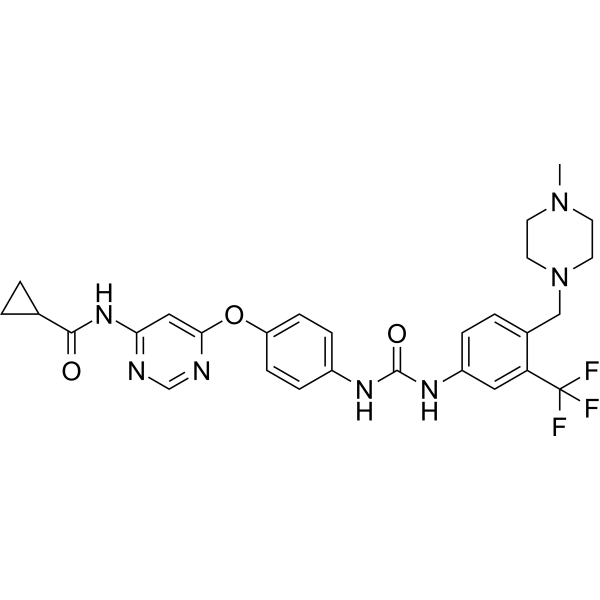 0 ImagesWS3 is an allosteric inhibitor of 14-3-3 (14-3-3ζ: Kd = 2.29 μM). WS3 activates GSK3β by disrupting the binding of 14-3-3-pGSK3β, promotes the ubiquitination and degradation of NRF2, and inhibits the NRF2-ARE signaling pathway (IC50 = 135 nM). It exerts antioxidant inhibition and chemotherapeutic/ferroptosis sensitizing effects in tumors with hyperactivated NRF2. WS3 binds to EBP1/IKKε and promotes the proliferation of β cells and retinal pigment epithelial (RPE) cells, which can be applied to islet regeneration and RPE expansion transplantation. WS3 is applicable to research related to age-related macular degeneration, retinal degeneration and non-small cell lung cancer.
-
(E)-FOBISIN101
 0 ImagesCat. No.: HY-115501CAS No.: 1370281-06-3(E)-FOBISIN101 is a 14-3-3 protein-protein interaction (14-3-3 protein-protein interaction) inhibitor, with IC50 values of 9.3 and 16.4 μM for disrupting the binding of 14-3-3ζ or 14-3-3γ to PRAS40, respectively. (E)-FOBISIN101 inhibits the binding of 14-3-3 to Raf-1 and proline-rich AKT substrate, and neutralizes the ability of 14-3-3 to activate exotoxin S ADP-ribosyltransferase. (E)-FOBISIN101 is applicable to 14-3-3-mediated cancer research.
-
14-3-3η Protein inhibitor 1
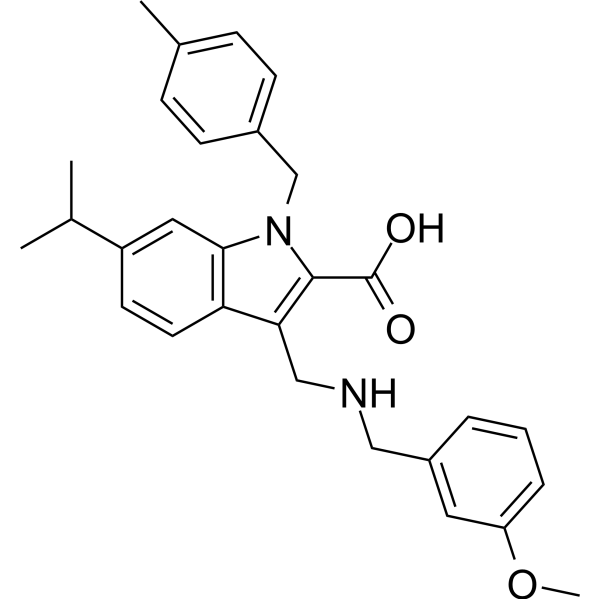 0 Images14-3-3η Protein inhibitor 1 (Compound C11) is a 14-3-3η protein inhibitor with a KD of 35 µM. 14-3-3η Protein inhibitor 1 shows inhibitory activities against several typical human liver cancer cell lines. 14-3-3η Protein inhibitor 1 induces cell apoptosis and G1-S cell cycle arrest with good metabolic stability.
-
GR–14-3-3 stabilizer-1
 0 ImagesGR-14-3-3 stabilizer-1 is a molecular glue stabilizer for the protein-protein interaction between 14‑3‑3 and glucocorticoid receptor (GR), and functions by stabilizing the GR‑14‑3‑3 protein-protein interaction. GR-14-3-3 stabilizer-1 is applicable to research related to diseases such as tumors.
-
PAV-104
 0 ImagesSynonyms: MAV-104PAV-104 (MAV-104) is a host-targeted, pan-respiratory viral assembly inhibitor. PAV-104 targets a small subset of the host protein 14-3-3 within a transient multi-protein complex. PAV-104 inhibits SARS-CoV-2 replication by blocking post-entry viral assembly/budding through interaction with viral nucleocapsid (N) protein and interference with its oligomerization. PAV-104 is orally active in cats and shows favorable pharmacokinetic properties in rats. PAV-104 can be used for the study of COVID-19 and other respiratory viral infections, including Feline Infectious Peritonitis (FIP).
-
ChREBPα/14-3-3 regulator-1
 0 ImagesCat. No.: HY-170593CAS No.: 3067202-14-3ChREBPα/14-3-3 regulator-1 is a molecular glue that selectively stabilizes ChREBPα/14-3-3 PPI, with an EC50 of 3.8 μM. ChREBPα/14-3-3 regulator-1 sequesters ChREBPα in the cytoplasm, inhibits ChREBPβ and TXNIP responses, reduces glucolipotoxicity-induced β-cell death, and maintains β-cell identity and function. ChREBPα/14-3-3 regulator-1 can be used in studies related to type 2 diabetes.
-
14-3-3γ/SLP76 stabilizer-1
 0 ImagesCat. No.: HY-W678610CAS No.: 136715-68-914-3-3γ/SLP76 degrader-1 is a stabiliser of the 14-3-3γ/phosphorylated SLP76 protein-protein interaction. 14-3-3γ/SLP76 degrader-1 lacks stabilising activity on the unrelated IL17/IL17R protein-protein interaction. 14-3-3γ/SLP76 degrader-1 lacks stabilising activity on the 14-3-3ζ/p27 protein-protein interaction. 14-3-3γ/SLP76 degrader-1 can be used for the research of autoimmune and inflammatory conditions.
-
14-3-3-IN-2
 0 Images14-3-3-IN-2 is a 14-3-3 protein inhibitor with an IC50 of 15 nM. 14-3-3-IN-2 can disrupt the interaction of 14-3-3α with aminopeptidase N and down-regulate 14-3-3α increased MMP-1 mRNA levels.
-
ADHPE
 0 ImagesCat. No.: HY-N13798CAS No.: 138870-97-0ADHPE is a stabilizer of 14-3-3σ and p65 protein complex. ADHPE inhibits NF-κB (p65) signaling pathway and reduces the inflammatory response. ADHPE can be used for pediatric pneumonia-related acute lung injury and acute respiratory distress syndrome study.
-
UTKO1
 0 ImagesCat. No.: HY-171977CAS No.: 868136-01-0UTKO1 (Compound 2) is a derivate of Moverastin.UTKO1 has optical activity and significant inhibitory activity against tumor cell migration by abrogating the binding of 14-3-3ζ/Tiam1. UTKO1 can be used for cancers like esophageal cancer and epidermoid carcinoma research.
-
Epibestatin hydrochloride
 0 ImagesEpibestatin hydrochloride is an epimer of Bestatin (HY-B0134), a DPP4 inhibitor and protease inhibitor, with an IC50 of 17 μM against DPP4. As a stabilizer, Epibestatin hydrochloride binds to the cleft between 14-3-3 protein and plant proton pump PMA2, selectively stabilizing their interaction without affecting other 14-3-3 client proteins. Epibestatin hydrochloride triggers stomatal opening in leaf epidermis of Commelina communis. Epibestatin hydrochloride can be used in studies related to type 2 diabetes.
-
QS-57
 0 ImagesCat. No.: HY-169081QS-57 is a heterobifunctional targeted protein localization (TPL) agent. QS-57 binds to BRD4 via its JQ1 domain and covalently targets 14-3-3σ to form a ternary complex. QS-57 sequesters nuclear BRD4 in the cytoplasm, impairing the nuclear transcriptional regulatory function mediated by BRD4. QS-57 significantly reduces the nuclear BRD4 protein level and increases the cytoplasmic BRD4 protein abundance in cancer cells. QS-57 can be used for research on breast cancer and colorectal cancer.

-
EN171
 0 ImagesEN171 is a covalent 14-3-3σ molecular glue ligand that sequesters neonuclear substrates, including BRD4 and BLC6, into the cytoplasm by recruiting 14-3-3σ. EN171 covalently targets C38 and C96 on 14-3-3 to enhance the interaction between 14-3-3 and ERα, YAP, and TAZ (with EC50 values of 9 μM for human ERα, 45 μM for YAP, and 107 μM for TAZ). EN171 inhibits the transcriptional activity of estrogen receptors and the Hippo pathway in breast cancer cells. EN171 can be used in studies related to breast cancer.

-
14-3-3σ/ERα stabilizer-2
 0 ImagesCat. No.: HY-17587214-3-3σ/ERα stabilizer-2 (Compound 41) is a covalent 14-3-3σ/ERα stabilizer with a Kd of 10.1 nM. 14-3-3σ/ERα stabilizer-2 significantly decreases the dissociation rate of ERα, stabilizing the binary ERα/14-3-3σ interaction. 14-3-3σ/ERα stabilizer-2 can be used for molecular glues research.
- 1



