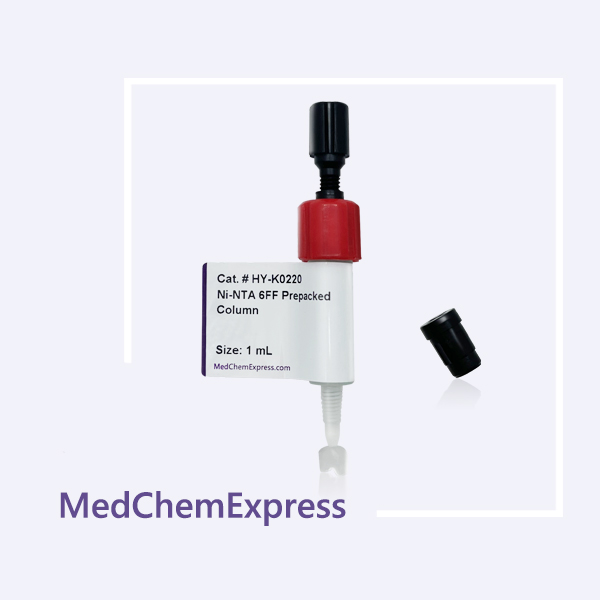
Ni-NTA 6FF Prepacked Column
Based on 1 publication(s) in Google Scholar
MCE Ni-NTA 6FF Prepacked Column is ideal for high performance purification of polyhistidine-tagged proteins expressed in E.coli, yeast, insect and mammalian expression systems.
-
Storage :
4°C, 2 years.

To place orders, for customer services and technical support, please contact: MedChemExpress USA
Tel: 609-228-6898 E-mail: [email protected] [email protected]





Description & Advantages
Ni-NTA His-Tag Purification Agarose, a 6% highly cross-linked agarose medium covalently coupled to a chelating agent that binds Ni2+ by four coordination sites, enables high-yield, high-purity purification of polyhistidine-tagged proteins. Ni-NTA His-Tag Purification Agarose has low Ni2+ leakage, high protein-binding capacity and stability, and is compatible with a wide range of chemicals and pH values. This makes Ni-NTA 6FF Prepacked Column ideal for high performance purification of polyhistidine-tagged proteins expressed in E.coli, yeast, insect and mammalian expression systems.
| Characteristics | |
|---|---|
| Composition | 6% highly cross-linked agarose |
| Bead Diameter | 45-165 μm |
| Binding Capacity | > 40 mg 6× His-tagged Protein/mL |
| Maximum Pressure | 0.3 MPa, 3 bar |
| Storage Solution | 50% slurry in a 20% ethanol solution |


Protocols
1. Buffer Preparation:
Select suitable buffers according to the sample type. Alternative buffer systems may also be prepared according to the user's preferred protocol. The basic principles are “sample loading at a low imidazole concentration and elution at a high imidazole concentration” or “sample loading at a high pH and elution at a low pH.” Before use, filter the buffers through a 0.22 μm or 0.45 μm membrane for sterilization.
Ni-NTA 6FF Prepacked Column can be used for the purification of soluble proteins and inclusion body proteins. Different buffers are required for these two applications, as described below.
Buffers and Formulations for Purification of Soluble His-Tagged Proteins
| Name | Volume | Composition |
|---|---|---|
| Lysis Buffer | 1 L |
50 mM NaH2PO4 (7.80 g NaH2PO4 · 2H2O); 300 mM NaCl (17.54 g NaCl); 10 mM imidazole (0.68 g imidazole); Adjust the pH to 8.0 with NaOH solution and sterilize by filtration through a 0.22 μm or 0.45 μm membrane. |
| Wash Buffer | 1 L |
50 mM NaH2PO4 (7.80 g NaH2PO4 · 2H2O); 300 mM NaCl (17.54 g NaCl); 20 mM imidazole (1.36 g imidazole); Adjust the pH to 8.0 with NaOH solution and sterilize by filtration through a 0.22 μm or 0.45 μm membrane. |
| Elution Buffer | 1 L |
50 mM NaH2PO4 (7.80 g NaH2PO4 · 2H2O); 300 mM NaCl (17.54 g NaCl); 250 mM imidazole (17.0 g imidazole); Adjust the pH to 8.0 with NaOH solution and sterilize by filtration through a 0.22 μm or 0.45 μm membrane. |
Buffers and Formulations for Purification of His-Tagged Inclusion Body Proteins
| Name | Volume | Composition |
|---|---|---|
| Lysis Buffer | 1 L |
8 M urea (480.50 g urea); 100 mM NaH2PO4 (15.60 g NaH2PO4 · 2H2O); 100 mM Tris-HCl (15.76 g Tris-HCl); Adjust the pH to 8.0 with hydrochloric acid and sterilize by filtration through a 0.22 μm or 0.45 μm membrane. |
| Wash Buffer | 1 L |
8 M urea (480.50 g urea); 100 mM NaH2PO4 (15.60 g NaH2PO4 · 2H2O); 100 mM Tris-HCl (15.76 g Tris-HCl); Adjust the pH to 6.3 with hydrochloric acid and sterilize by filtration through a 0.22 μm or 0.45 μm membrane. |
| Elution Buffer | 1 L |
8 M urea (480.50 g urea); 100 mM NaH2PO4 (15.60 g NaH2PO4 · 2H2O); 100 mM Tris-HCl (15.76 g Tris-HCl); Adjust the pH to 4.5 with hydrochloric acid and sterilize by filtration through a 0.22 μm or 0.45 μm membrane. |
2. Sample Preparation
Proteins Expressed in Bacteria or Yeast
(1) Pick a single colony and inoculate it into a culture medium containing the appropriate antibiotic. Add the inducer at the concentration specified in the vector instructions and induce protein expression for the recommended period.
(2) After expression, transfer the culture to a centrifuge tube and centrifuge at 7,000 rpm for 15 min. Discard the supernatant and collect the cell pellet. Resuspend the pellet in Lysis Buffer at a cell pellet-to-buffer ratio of 1:10 (W/V). Add PMSF to a final concentration of 1 mM and lysozyme to a working concentration of 0.2-0.4 mg/mL. Lysozyme may be omitted when the expression host contains pLysS or pLysE. Protease inhibitors may also be added, provided that they do not interfere with the binding of the target protein to the agarose resin.
(3) Thoroughly resuspend the cell pellet. For highly concentrated cultures, 10 μg/mL RNase A and 5 μg/mL DNase I may also be added. Keep the sample on ice and disrupt the cells by sonication until the lysate becomes substantially clear.
(4) Transfer the clarified lysate to a centrifuge tube and centrifuge at 10,000 rpm and 4°C for 20-30 min. Collect the supernatant and keep it on ice until use or store it at -20°C.
Soluble Proteins Secreted by Yeast, Insect, or Mammalian Cells
(1) Transfer the cell culture medium to a centrifuge tube and centrifuge at 5,000 rpm for 10 min. Retain the supernatant and discard the pellet. If the supernatant does not contain EDTA, histidine, reducing agents, or similar substances, it may be applied directly to the column. If these substances are present, dialyze the sample against Lysis Buffer at 4°C before loading.
(2) For large-volume supernatants, concentrate the protein by ammonium sulfate precipitation and then dialyze the sample against Lysis Buffer at 4°C before loading it onto the column.
Inclusion Body Proteins under Denaturing Conditions
(1) Transfer the culture to a centrifuge tube and centrifuge at 7,000 rpm for 15 min. Discard the supernatant and collect the cell pellet.
(2) Resuspend the pellet in Lysis Buffer without 8 M urea at a cell pellet-to-buffer ratio of 1:10 (W/V), and disrupt the cells by sonication in an ice bath.
(3) Transfer the lysate to a centrifuge tube and centrifuge at 10,000 rpm and 4°C for 20-30 min. Discard the supernatant and repeat Steps (2) and (3) once.
(4) Resuspend the inclusion bodies in Lysis Buffer containing 8 M urea at a cell pellet-to-buffer ratio of 1:10 (W/V).
(5) Purify the His-tagged recombinant protein under denaturing conditions.
3. Sample Purification Using an AKTA System as an Example
Ni-NTA 6FF is a prepacked column designed for His-tagged protein purification and is compatible with conventional low- and medium-pressure chromatography systems.
(1) Fill the pump tubing with deionized water. Remove the upper stopper, connect the prepacked column to the chromatography system, break off the bottom closure, and securely connect the column to the system.
(2) Wash the column with 3-5 column volumes of deionized water to remove the storage buffer.
(3) Equilibration: Equilibrate the column with at least 5 column volumes of Lysis Buffer.
(4) Sample Loading: Load the sample using a pump or syringe. To prevent column clogging, centrifuge the sample or filter it through a 0.22 μm or 0.45 μm membrane before loading.
(5) Washing: Wash the column with Wash Buffer until the UV absorbance reaches a stable baseline, generally using at least 10-15 column volumes. Collect the flow-through and wash fractions.
Note: Adding a low concentration of imidazole to the equilibration buffer can improve sample purity.
(6) Elution: Elute the protein with Elution Buffer using either step elution or linear-gradient elution. Step elution generally requires 5 column volumes of elution buffer. For linear-gradient elution, a shallow gradient of approximately 20 column volumes or more can be used to separate proteins with different binding strengths.
(7) Equilibrate the resin sequentially with 3 column volumes of Lysis Buffer and 5 column volumes of deionized water. Then equilibrate it with 5 column volumes of 20% ethanol and store the column in 20% ethanol at 4°C.
(8) SDS-PAGE Analysis: Analyze the original sample and the purified flow-through, wash, and elution fractions by SDS-PAGE to evaluate purification performance.
4. Cleaning-in-Place (CIP)
(1) Removal of strongly hydrophobically bound proteins, lipoproteins, and lipids: Wash the column with 5-10 column volumes of 30% isopropanol and allow a contact time of 15-20 min. Then wash the column with 10 column volumes of deionized water.
Alternatively, wash the column with 2 column volumes of an acidic or alkaline solution containing detergent and allow a contact time of 1-2 h. Then wash with 5 column volumes of 70% ethanol, followed by 10 column volumes of deionized water.
(2) Removal of proteins bound through ionic interactions: Wash the column with 1.5 M NaCl solution and allow a contact time of 10-15 min. Then wash with 10 column volumes of deionized water.
5. Resin Regeneration
If the resin becomes lighter in color or its binding capacity decreases significantly during use, the nickel ions should be stripped and reloaded. Pack the resin into a suitable chromatography column and perform the following procedure:
(1) Wash once with 2 column volumes of 0.2 M acetic acid containing 6 M GuHCl.
(2) Wash once with 5 column volumes of deionized water.
(3) Wash once with 3 column volumes of 2% SDS.
(4) Wash once with 5 column volumes of deionized water.
(5) Wash once with 5 column volumes of absolute ethanol.
(6) Wash once with 5 column volumes of deionized water.
(7) Wash once with 5 column volumes of 100 mM EDTA, pH 8.0.
(8) Wash once with 5 column volumes of deionized water.
(9) Wash once with 5 column volumes of 100 mM NiSO4.
(10) Wash once with 10 column volumes of deionized water.
(11) After regeneration, the resin may be used immediately or stored in 20% ethanol at 4°C.


Publications
-
Journal Impact Factor
-
Most Recent
Storage
4°C, 2 years.


Components
| Cat. No. | Product Name | Package |
|---|---|---|
| HY-K0220-1 mL | Ni-NTA 6FF Prepacked Column | 1 mL |
| HY-K0220-5 mL | Ni-NTA 6FF Prepacked Column | 5 mL |


 Please enter the correct Lot Number