OptiLNP RNA Transfection Reagent

Based on 1 Customer Validation
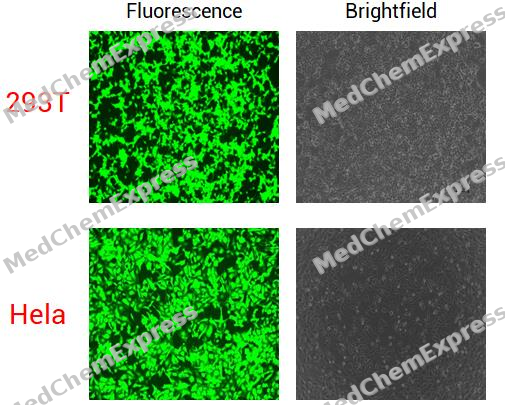
MCE OptiLNP RNA Transfection Reagent is a ready-to-use transfection reagent based on LNP technology. It is designed for the efficient transfection of various RNA types into common cells.
-
Storage :
4℃, 1 year. Do not freeze.


To place orders, for customer services and technical support, please contact: MedChemExpress USA
Tel: 609-228-6898 E-mail: [email protected] [email protected]





Description & Advantages
Lipid nanoparticles (LNP) are a lipid-based nanoscale drug delivery system widely used for the delivery of nucleic acids (such as mRNA, siRNA, DNA, etc.) and small molecule drugs.
Naked RNA is a negatively charged hydrophilic macromolecule that faces challenges in entering cells due to electrostatic repulsion from the cell membrane and is easily degraded by RNases. By encapsulating RNA within LNP, RNA can effectively traverse the cell membrane and be released into the cytoplasm, enabling efficient delivery.
MCE OptiLNP RNA Transfection Reagent is a ready-to-use transfection reagent based on LNP technology. It utilizes the unique transmembrane transport and escape mechanism of LNP to achieve efficient delivery of RNA, making it suitable for transfection of various types of RNA in common cells.
Features of MCE OptiLNP RNA Transfection Reagent
1. Lipid Nanoparticle (LNP) Technology: Utilizes LNP carriers to effectively protect RNA from degradation and immune system clearance during the delivery process.
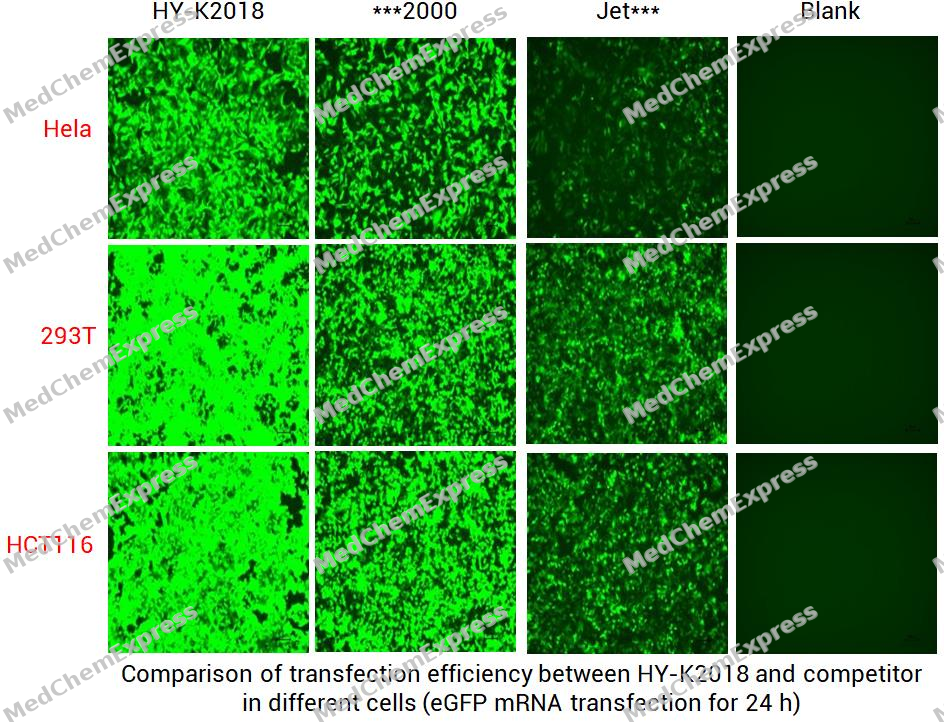
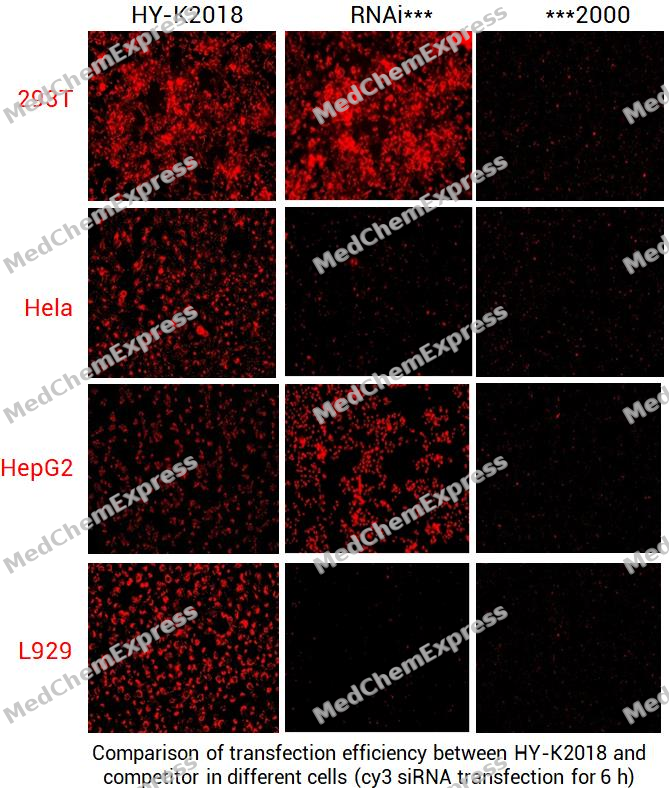
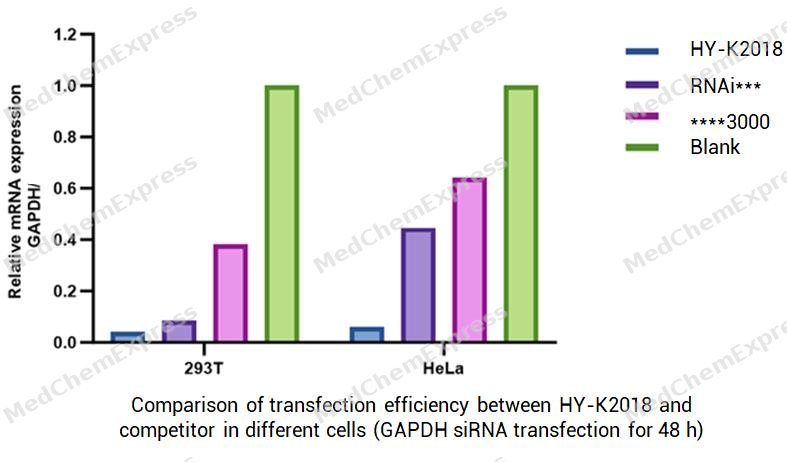
2. Efficient Intracellular Delivery: The unique transmembrane transport and escape mechanisms of LNPs achieve an encapsulation rate of over 80% for small sample amounts, enabling efficient transfection of RNA in common cells.
3. Wide Applicability: Suitable for in vitro RNA transfection of various types of common cells. Supports a variety of RNA types such as siRNA, miRNA, gRNA, mRNA, saRNA, and circRNA.
4. User-Friendly Operation: No encapsulation equipment is required; RNA-LNP encapsulation and transfection can be completed in a single mixing step, and there is no need to replace with fresh culture medium after transfection.
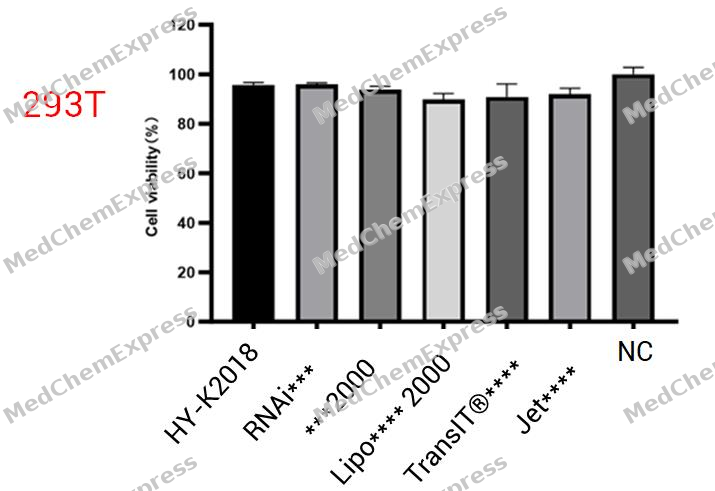
5. Biocompatibility: Low cytotoxicity, effectively balancing high transfection efficiency with cell viability, and providing gentle action.
6. Safety: The formulation is ethanol-free and uses biodegradable lipid materials to ensure safety.


Protocols
Take the 24-well plate as an example; the cell volume of other culture well plates can be designed according to the conventional experiments.
1) For adherent cells: Plate the cells dissociated with trypsin one day before transfection (0.1 - 1 × 10⁵ cells cells plated in a 24-well plate), until the density reaches 70-90% for cell transfection.
2) Foe suspension cells: Plate the cells before transfection and suspend in fresh medium (1-2 × 10⁵ cells/500 μL medium).
Note: The viability and general health of cells prior to transfection significantly affect the transfection result. Cells should be at least 90% viable prior to transfection and have had sufficient time to recover from passaging.
RNA-LNP Complex Preparation
1. Prepare RNA Pre-mix Solution: Dilute the RNA stock solution with the dilution buffer. Adjust the RNA concentration to 40 ng/μL or the siRNA concentration to 3 pmol/μL.
2. Prepare RNA-LNP Complex (Choose one of the following two methods):
a. No Dilution of Transfection Reagent: Mix equal volumes of transfection reagent and RNA pre-mix directly. Pipette up and down at least 20 times to ensure thorough mixing.
b. Dilution of Transfection Reagent: Refer to Tables 3 and 4. Dilute the transfection reagent 2-fold with the dilution buffer to prepare the transfection reagent pre-mix. Mix equal volumes of the transfection reagent pre-mix and RNA pre-mix. Pipette up and down at least 20 times to ensure thorough mixing.
Cell Transfection
Add RNA-LNP Complex to each well, mix gently and incubator for further culture.
Analyze transfection efficiency
After incubation of 24 - 48 h, the transfection effect can be analyzed by fluorescence detection, Western Blot, ELISA, flow cytometry, reporter gene, immunofluorescence staining and other methods according to the experimental needs.
Storage
4℃, 1 year.
Do not freeze.


Attention
1. This product has been filtered using a 0.22 μm membrane.
2. For optimal transfection efficiency, it is recommended to dissolve the RNA stock in nuclease-free sterile water. Other solvents may affect transfection efficiency.
3. Recommended RNA stock concentration: mRNA > 200 ng/μL, Short-chain RNA > 100 ng/μL, siRNA > 10 μM.
4. It is recommended to prepare RNA pre-mixes using the dilution buffer provided with the kit to dilute the RNA stock solution.
5. The recommended concentration for RNA premix is 40 ng/μL, with a final concentration of 20 ng/μL. For co-transfection of multiple RNAs, the RNA premix concentration should be the sum of the concentrations of all RNAs. It is recommended to dilute the transfection reagent as part of the transfection protocol. For example, in co-transfection of CRISPR Cas9 mRNA and gRNA, the RNA pre-mix concentration should be the sum of the Cas9 mRNA and gRNA concentrations. The recommended ratio of Cas9 mRNA (μg) to gRNA (μg) is 1:1 - 1:2.
6. Common short-chain RNAs (e.g., siRNA) typically weigh between 13 - 15 μg per 1 nmol without special modifications. The exact weight can be calculated based on the specific nucleic acid sequence and modifications.
7. The RNA/LNP ratio is crucial for LNP encapsulation. If the per-well RNA amount needs adjustment, the volume of RNA-LNP complex added to each well should be proportionally adjusted.
8. RNA-LNP complexes can be stably stored at room temperature for up to 8 hours. Do not store RNA-LNP complexes under freezing conditions.
9. There is no need to replace the culture medium before or after transfection. Complete medium containing serum and antibiotics does not significantly affect transfection efficiency.
10. 6 h after transfection, standard cell culture processes, such as medium replacement, can be performed.
11. Cell conditions greatly influence transfection efficiency. It is recommended to use cells in good growth condition for transfection.
12. There are many factors affecting transfection efficiency, such as cell type, cell state and density, nucleic acid quality and concentration, ratio of transfection reagents to nucleic acids, etc. It is recommended to perform pre-experiment to determine optimal transfection conditions.
13. To avoid RNAse contamination, RNA-free enzymes and non-pyrogenic materials should be used throughout the experiment.
14. This product is for R&D use only, not for drug, household, or other uses.
15. For your safety and health, please wear a lab coat and disposable gloves to operate.


Components
| Components | HY-K2018-0.5 mL | HY-K2018-1.5 mL | HY-K2018-3 mL | HY-K2018-5 mL |
|---|---|---|---|---|
| Transfection Reagent | 0.5 mL | 1.5 mL | 3 mL | 5 mL |
| Dilution Buffer | 2.5 mL | 8 mL | 8 mL × 2 | 8 mL × 3 |


 Please enter the correct Lot Number