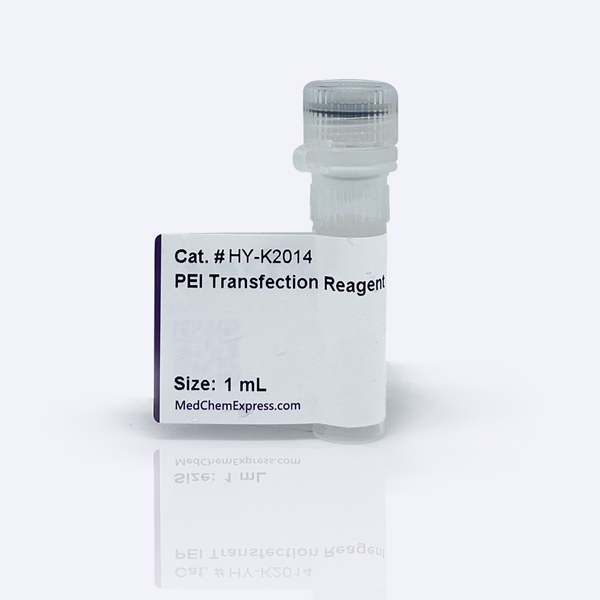
PEI Transfection Reagent
Based on 67 publication(s) in Google Scholar
MCE PEI Transfection Reagent is designed based on 25 kDa PEI. It has high-efficiency, low-toxicity, strong-stability, and is suitable for many cell types, such as HEK-293、HEK-293T、CHO-K1、COS-1、COS-7、NIH/3T3、Sf9、HepG2 and HeLa et, even some hard-to-transfect cells. It can also be applied to large-scale recombinant protein expression and virus production. The 1 mL is defined as the base specification. All larger sizes correspond to incremental volumes of this base.
-
Storage :
-20°C, 1 year. Avoid repetitive freeze-thaw cycles.

To place orders, for customer services and technical support, please contact: MedChemExpress USA
Tel: 609-228-6898 E-mail: [email protected] [email protected]



-
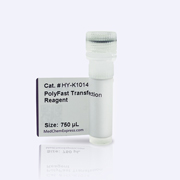
HY-K1014
PolyFast Transfection Reagent -
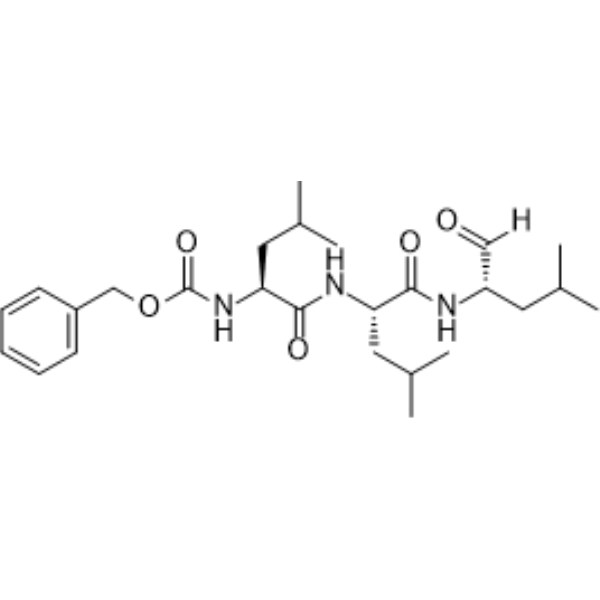
HY-13259
MG-132Proteasome Inhibitor -
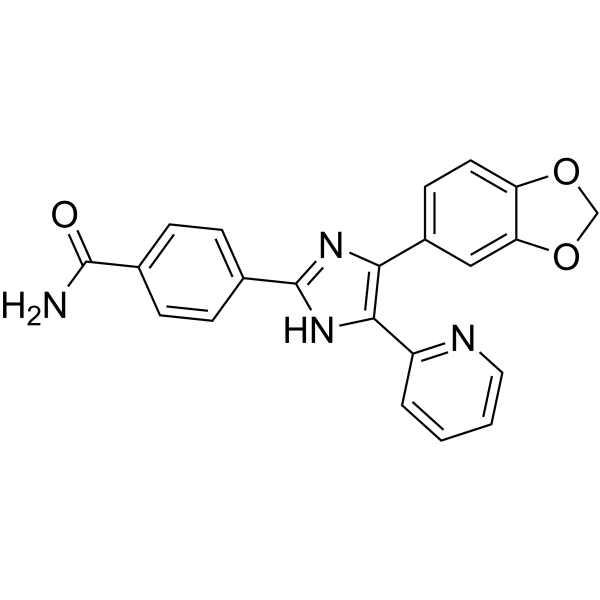
HY-10431
SB-431542TGF-β Receptor Kinase Inhibitor -
HY-K0202
Protein A/G Magnetic Beads -
HY-112735
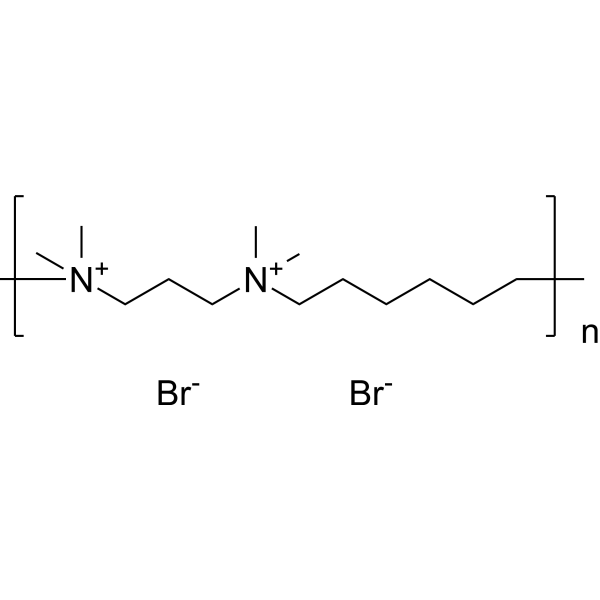
Hexadimethrine bromideCationic Polyelectrolyte -
HY-10583
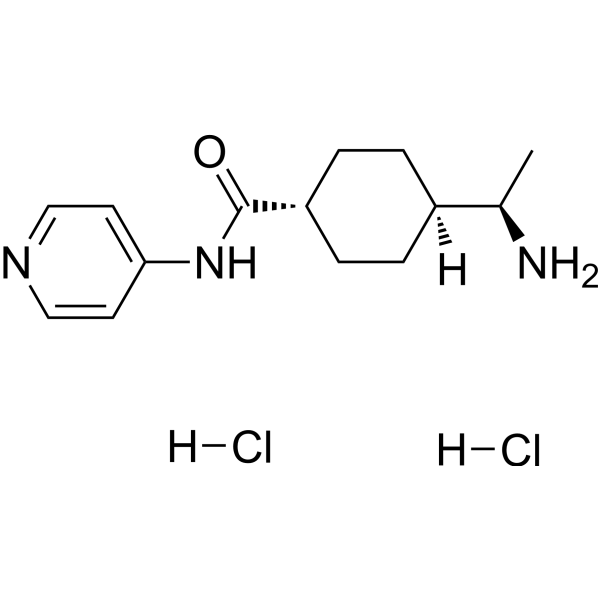
Y-27632 dihydrochlorideROCK Inhibitor -
HY-13418A
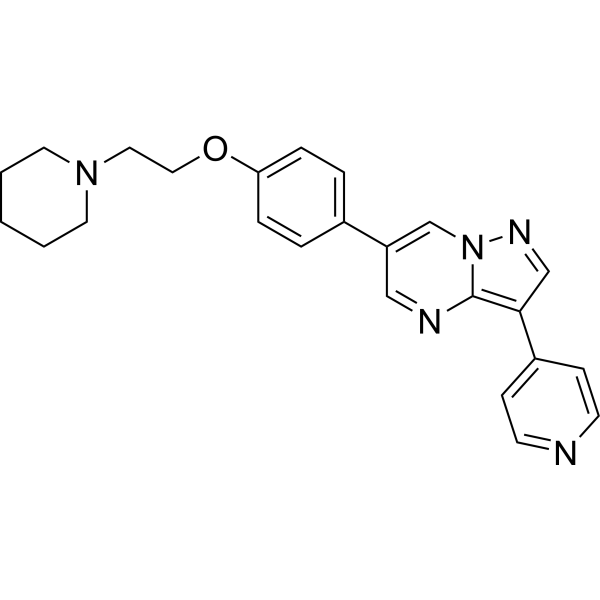
DorsomorphinAMPK Inhibitor -
HY-K0010
Protease Inhibitor Cocktail (EDTA-Free, 100× in DMSO) -
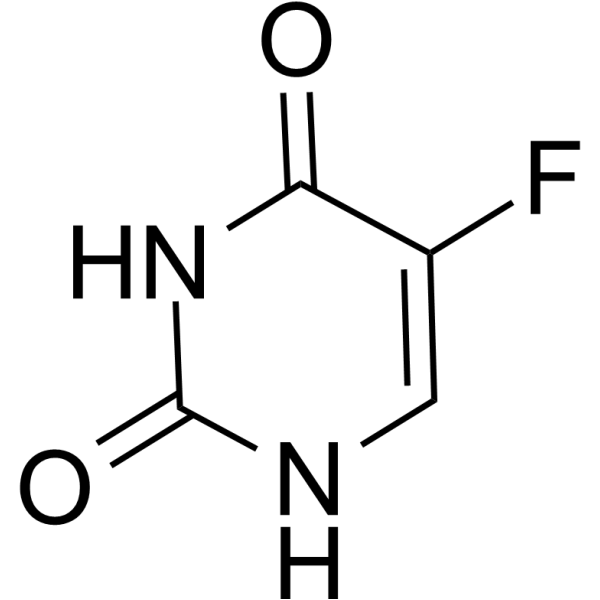
HY-90006
5-FluorouracilThymidylate Synthase Inhibitor -
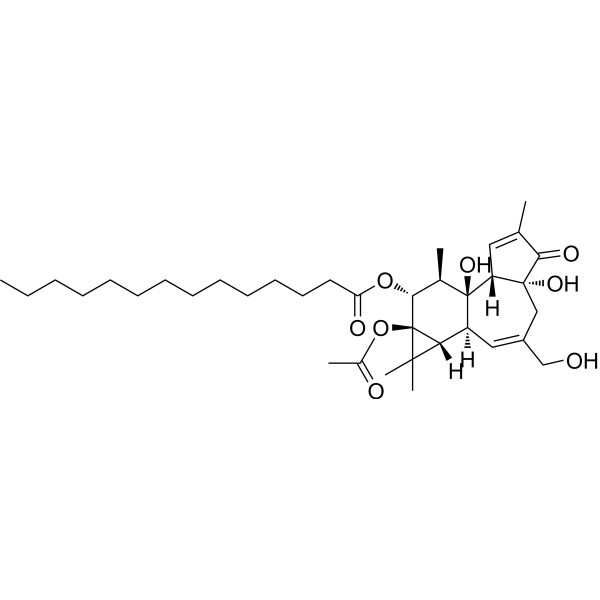
HY-18739
Phorbol 12-myristate 13-acetatePKC Activator -
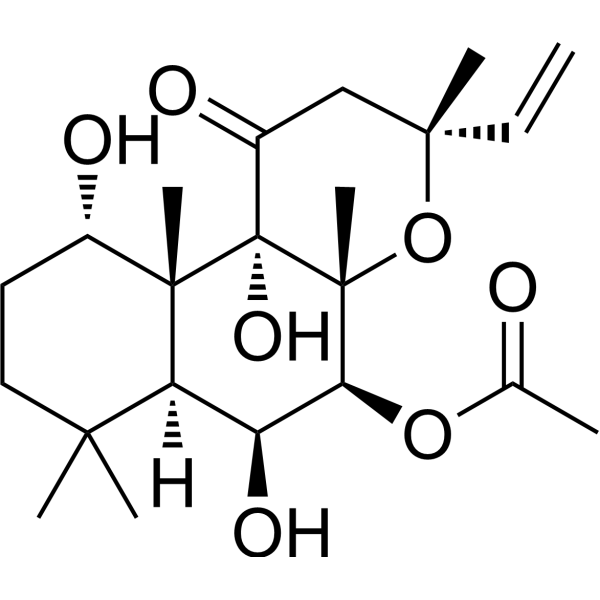
HY-15371
ForskolinAdenylate Cyclase Activator -
HY-K0301
Cell Counting Kit-8


Description & Advantages
PEI is a commonly used polymer carrier in gene transfection. It consists of cationic polymers and can introduce nucleic acids into eukaryotic cells. In polymer-based transfection, exogenous DNA forms complexes with cationic polymers that enter host cells by endocytosis.
MCE PEI Transfection Reagent is designed based on 25 kDa PEI. It is modified by introducing functional genes to enhance the binding ability of DNA, and reduced the cytotoxicity. In addition, the cell uptake and the endosome escape functions of PEI modified was enhanced significantly.
MCE PEI Transfection Reagent is high-efficiency, low-toxicity, strong-stability, and suitable for many cell types, such as HEK-293、HEK-293T、CHO-K1、COS-1、COS-7、NIH/3T3、Sf9、HepG2 and HeLa et, even some hard-to-transfect cells. It can also be applied to large-scale recombinant protein expression and virus production.


Protocols
1. Cell Preparation
Seed cells one day before transfection so that they are in good growth condition at the time of transfection. Optimize cell density according to the cell line.
| Parameter | Recommended starting condition |
|---|---|
| Cell density | Approximately 50%-80% confluence at transfection |
| Plasmid DNA | 1 μg |
| PEI Transfection Reagent | 2.5 μL |
2. Preparation of DNA/PEI Complexes
1. Dilute plasmid DNA and PEI Transfection Reagent separately in serum-free medium or another suitable serum-free diluent.
2. Mix gently and incubate each solution for approximately 5 min at room temperature.
3. Add the diluted PEI Transfection Reagent to the diluted DNA, mix gently, and incubate for approximately 15 min at room temperature to form transfection complexes.
3. Transfection
1. Add the DNA/PEI complexes dropwise to the cell culture medium and gently rock the vessel to distribute the complexes evenly.
2. Continue culture under normal cell-culture conditions.
3. Depending on cell type and experimental purpose, replace with fresh complete medium approximately 4-6 h after transfection, or leave the medium unchanged if the cells tolerate the transfection well.
4. Analyze target-gene expression approximately 24-48 h after transfection. Longer culture may be used for recombinant protein production or virus packaging according to the experimental design.
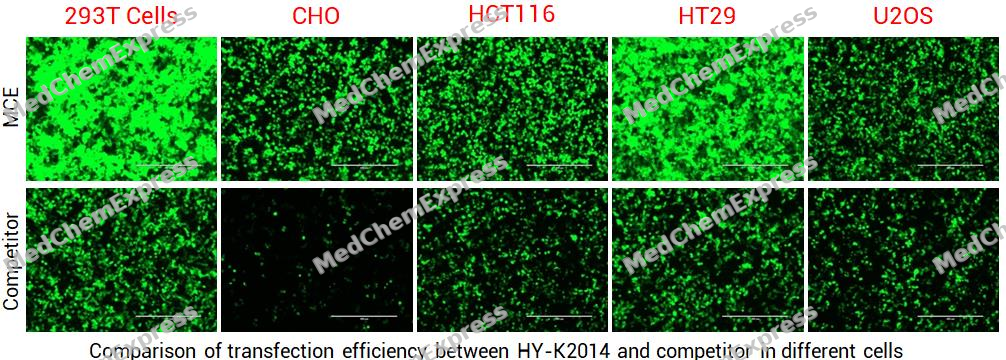
Note: In MCE validation, 1 μg GFP plasmid with 2.5 μL PEI Transfection Reagent showed good transfection performance. Optimize the DNA-to-reagent ratio for each cell type.


Publications
-
Journal Impact Factor
-
Most Recent
-
Cancer CellSingle-cell screens identify ADAM12 as a fibroblast checkpoint impeding anti-tumor immunity. [Abstract]2026 Feb 9;44(2):424-442.e14. PMID: 41544628
-
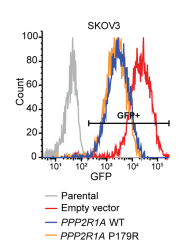
PEI Transfection Reagent purchased from MedChemExpress. Usage Cited in: Nature. 2025 Aug;644(8076):537-546. [Abstract]
hyBE4max-eGFP and sgRNA expressing plasmid (10 μg) were co-transfected into 6 cm dish using PEI Transfection Reagent. After 72 h, SKOV3 transduced with lentiviral vectors encoding PPP2R1A WT and P179R mutant were selected by sorting GFP positive cells.
-
Nat AgingActivation of AMPK by GLP-1R agonists mitigates Alzheimer-related phenotypes in transgenic mice. [Abstract]2025 Jun;5(6):1097-1113. PMID: 40394225
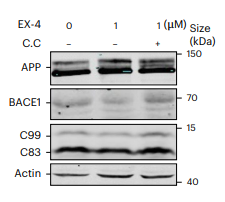
PEI Transfection Reagent purchased from MedChemExpress. Usage Cited in: Nat Aging. 2025 Jun;5(6):1097-1113. [Abstract]
Transfection was carried out using PEI Transfection Reagent for HEK cells. Swedish mutant APP stable cell line 20E2 was cultured and treated with exendin-4 with or without compound C to inhibit AMPK activity. The 20E2 cell line is a Swedish mutant APP695 stable HEK293 cell line cultured in complete DMEM with 50 µg/mL geneticin. For the treatment, HEK cells were transfected in a 6 cm master plate and then split into 4 × 35 mm plates 4 h after transfection, maintained overnight (16 h) before treatment.
-
Cell Mol ImmunolMacrophage-derived VISTA engages with LRIG1 and hinders gut epithelial repair in colitis. [Abstract]2025 Aug 29. PMID: 40883589
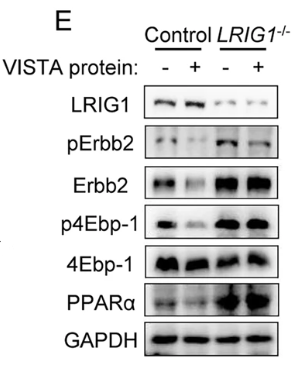
PEI Transfection Reagent purchased from MedChemExpress. Usage Cited in: Cell Mol Immunol. 2025 Aug 29. [Abstract]
Lenti-CRISPR viruses were generated via triple-plasmid transfection. Briefly, murine LRIG1 sgRNAs were designed with the Synthego CRISPR design tool. The oligos were synthesized, annealed, and cloned and inserted into the LentiCRISPR-LRIG1 vector, followed by Sanger sequencing verification. HEK293T cells were cotransfected with LentiCRISPR-LRIG1 or LentiCRISPR-Control along with the lentiviral second-generation helper plasmids psPAX2 and pCMV-VSV-G via PEI transfection reagent. The culture supernatants harvested at 48 h and 72 h posttransfection were filtered, concentrated with PEG8000 and finally frozen at −80 °C. For transduction, intestinal organoids at a low passage number and 2d $ost-passaging were incubated with pretreated lentivirus (LRIG1−/− or control) in culture medium containing polybrene. The suspension was centrifuged at 37 °C and 1000 ×g for 30 min and incubated at 37 °C for 4 h. After transduction, the organoids were cultured in medium supplemented with 1 μg/mL Puromycin for selection.
-
Cell Stem CellA combined enteric neuron-gastric tumor organoid reveals metabolic vulnerabilities in gastric cancer. [Abstract]2025 Oct 2;32(10):1595-1613.e10. PMID: 40902593
-
J Extracell VesiclesPlexinA1 (PLXNA1) as a novel scaffold protein for the engineering of extracellular vesicles. [Abstract]2024 Nov;13(11):e70012. PMID: 39508411
-
Nat Commun2026 Jan 7;17(1):163. PMID: 41501012
-
Mol CellRapid customization of base editors via machine learning-powered combinatorial mutagenesis. [Abstract]2026 May 21;86(10):1839-1855.e10. PMID: 41997156
-
J Transl MedJUN-ENPP1-cGAS-STING axis mediates immune evasion and tumor progression in bladder cancer. [Abstract]2025 Nov 4;23(1):1222. PMID: 41188900
-
Proc Natl Acad Sci U S A2026 May 5;123(18):e2531747123. PMID: 42048463
-
Int J Biol MacromolDauricine interferes with SARS-CoV-2 variants infection by blocking the interface between RBD and ACE2. [Abstract]2023 Oct 15;253(Pt 7):127344. PMID: 37848107
-
Int J Mol Sci2023 Dec 28;25(1):424. PMID: 38203595
-
Stem Cells IntThe Oncogenic Role of Serum Marker GDF15 in Promoting Colorectal Tumorigenesis via EMT and Stemness. [Abstract]2026 Feb 3:2026:4695395. PMID: 41648863
-
Exp Cell ResK542 acetylation promotes YTHDF2 binding to m6A-modified mRNAs and fosters colorectal cancer progression. [Abstract]2025 Jul 5;450(2):114667. PMID: 40623493
-
Exp Cell Res2024 Jun 1;439(1):114068. PMID: 38750717
-
VirologyIdentification of two conserved linear antigenic epitopes on the 2C protein of Senecavirus A. [Abstract]2025 Jun:607:110525. PMID: 40209476
-
HeliyonLeveraging RIBOTAC technology: Fluorescent RNase L probes for live-cell imaging and function analysis. [Abstract]2024 Dec 19;11(1):e41295. PMID: 39831163
Storage
-20°C, 1 year.
Avoid repetitive freeze-thaw cycles.


Components
| Components | HY-K2014-1 mL | HY-K2014-5 mL | HY-K2014-10 mL |
|---|---|---|---|
| PEI Transfection Reagent | 1 mL | 1 mL × 5 | 1 mL × 10 |


 Please enter the correct Lot Number