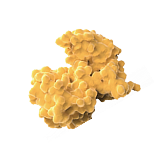
High-Affinity Iodoacetyl Agarose
Based on 1 publication(s) in Google Scholar
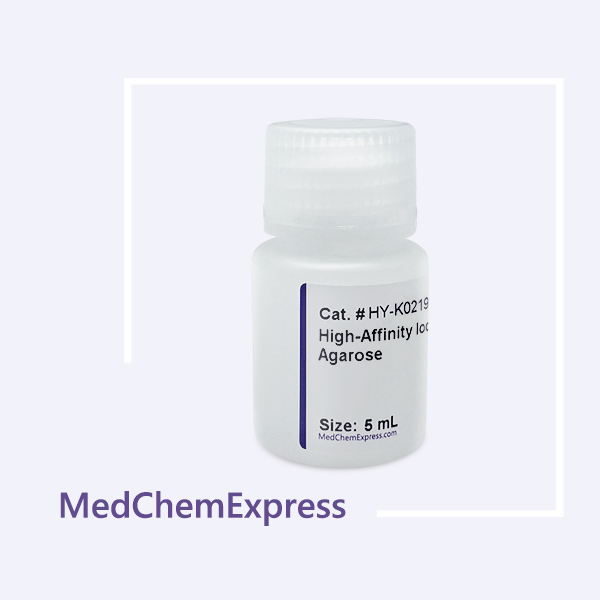
MCE High-Affinity Iodoacetyl Agarose, a 4% highly cross-linked agarose reagent coupled with a derivative of iodoacetic acid, is ideal for conjugating sulfhydryl-containing peptide or protein for subsequent affinity purification.
-
Storage :
Store at 2-8oC, and is stable for at least 2 years. Do not dry or freeze.

To place orders, for customer services and technical support, please contact: MedChemExpress USA
Tel: 609-228-6898 E-mail: [email protected] [email protected]





Description & Advantages
MCE High-Affinity Iodoacetyl Agarose, a 4% highly cross-linked agarose reagent coupled with a derivative of iodoacetic acid, reacts specifically with free sulfhydryls of sulfhydryl-containing peptides, proteins or other ligands and form stable thioether linkage. The agarose is ideal for conjugating sulfhydryl-containing peptide or protein for subsequent affinity purification. 1 mL of agarose can immobilize approximately 1 mg sulfhydryl-containing peptides of 7 amino-acids.
| Characteristics | |
|---|---|
| Composition | 4% cross-linked agarose |
| Mean Bead Diameter | 95 μm |
| pH Stability | pH 5-10 |
| Binding Capacity | > 3 mg Goat IgG/mL settled resin |
| Storage Solution | 1× PBS with 20% ethanol (pH 8.0) |
The specifications of the product correspond to the actual resin volume, with the resin content of 50%.


Protocol
1. Buffer Preparation:
| Buffer Type | Composition |
|---|---|
| Coupling Buffer | 50 mM Tris-HCl, 5 mM EDTA-Na, pH 8.5 |
| Blocking Buffer | 50 mM L-cysteine hydrochloride (HY-Y0337A) dissolved in coupling buffer |
| Storage Buffer | 1× PBS, pH 8.0, containing 20% ethanol |
| Binding/Wash Buffer | 1× PBS, pH 8.0 |
| Elution Buffer | 0.1 M glycine, pH 2-2.5 |
| Neutralization Buffer | 1 M Tris-HCl, pH 8.5 |
It is recommended to prepare the buffers using high-purity water and sterilize them by filtration through a 0.45 μm membrane after preparation.
2. Coupling of Thiol-Containing Samples:
(1) Sample Preparation: Dissolve the thiol-containing protein, peptide, or other biological ligand in coupling buffer to a final concentration of approximately 1 mg/mL.
(2) Column Packing: Rinse the bottom frit of the column with coupling buffer and ensure that no air bubbles remain on the frit. Close the bottom outlet and leave 1-2 cm of coupling buffer at the bottom of the column. Thoroughly resuspend the High-Affinity Iodoacetyl Agarose, transfer an appropriate amount into the column, and allow the resin to settle slowly at the bottom.
(3) Equilibration: Equilibrate the column with 3 column volumes of coupling buffer. Allow the buffer to flow slowly through the column at approximately 1 mL/min. Repeat this procedure at least twice.
(4) Coupling: Close the bottom cap, add the sample, and allow the solution to enter the packed bed. Close the top cap and place the column on a shaker. Incubate at room temperature for 30 min. After coupling, secure the column on a stand, remove the bottom cap, allow the solution to flow out, and let the resin settle at the bottom.
Note: Add approximately 1 mL of sample per 1 mL of agarose resin.
(5) Washing: Wash the column with 3 column volumes of coupling buffer at approximately 1 mL/min. Collect the flow-through, measure its OD280 value, and compare it with the OD280 value before coupling to evaluate coupling efficiency.
(6) Blocking: Close the bottom cap and add a volume of blocking buffer equal to the column volume. Close the top cap and place the column on a shaker. Incubate at room temperature for 30 min. After blocking, secure the column on a stand, remove the bottom cap, allow the solution to flow out, and let the resin settle at the bottom.
(7) Storage: If the column will be used immediately, proceed directly to the antibody purification procedure. If the column will not be used immediately, wash it with 3 column volumes of binding/wash buffer, add 1 column volume of storage buffer, and store at 2-8°C. Do not freeze.
3. Antibody Purification by Column Chromatography:
(1) Equilibration: Equilibrate the column with at least 5 column volumes of binding/wash buffer. Allow the buffer to flow slowly through the column and let the resin settle at the bottom.
(2) Antibody Binding: Add the antibody sample and allow it to flow slowly through the column at approximately 0.5 mL/min. Collect the flow-through. If necessary, reload or recirculate the sample to improve recovery.
(3) Washing: Wash the column with 30-50 column volumes of binding/wash buffer until the OD280 absorbance reaches a stable baseline. Use a flow rate of approximately 1.5 mL/min and collect the flow-through.
(4) Elution: After washing, elute the column with 5-10 column volumes of elution buffer. Protein elution may be monitored by measuring OD280. Use a flow rate of approximately 1 mL/min, collect the eluate, and immediately add neutralization buffer at approximately 1/10 of the eluate volume to adjust the pH.
(5) SDS-PAGE Analysis: Analyze the purified antibody samples, including the flow-through, wash, and elution fractions, together with the original sample by SDS-PAGE to evaluate purification performance.
4. Resin Regeneration and Storage:
Wash the resin with 5 column volumes of binding/wash buffer, add 1 column volume of storage buffer, and store at 2-8°C. Do not freeze.


Publications
-
Journal Impact Factor
-
Most Recent
Storage
Store at 2-8oC, and is stable for at least 2 years.
Do not dry or freeze.


Components
| Components | HY-K0219-5 mL | HY-K0219-10 mL | HY-K0219-50 mL |
|---|---|---|---|
| High-Affinity Iodoacetyl Agarose (Settled Resin) | 5 mL | 10 mL | 50 mL |


 Please enter the correct Lot Number