
1. Lipids
  2. Other Fatty Acyls

Other Fatty Acyls

Other Fatty Acyls (13):

Cat. No. Product Name CAS No. Purity Chemical Structure
  • HY-N8393
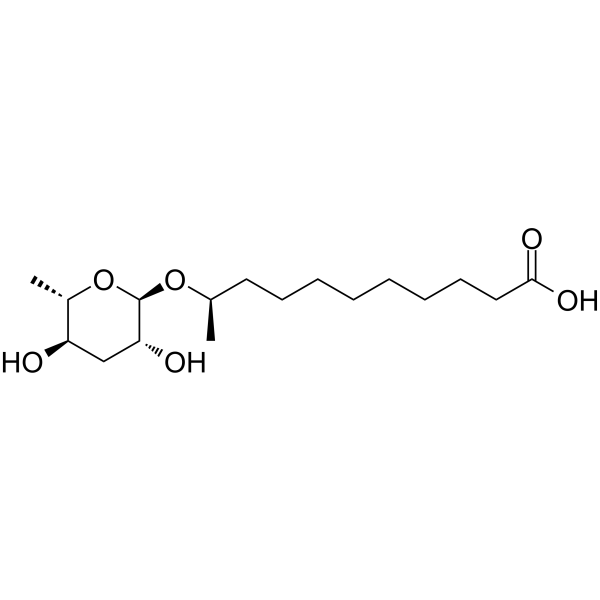
    Ascr#18 1355681-10-5 98.0%
    Ascr#18, an ascaroside, is a hormone of nematodes. Ascr#18 is expressed during nematode development. Ascr#18 increases resistance in Arabidopsis, tomato, potato and barley to viral, bacterial, oomycete, fungal and nematode infections.
    Ascr#18
  • HY-N6974
    Ascr#2 946524-24-9 98.0%
    Ascr#2 (Ascaroside C6) is an ascaroside isolated from Caenorhabditis elegans, potently promotes dauer formation, and also acts as a potent male attractant combined with Ascr#3 (HY-N6977) at low concentration.
    Ascr#2
  • HY-N6977
    Ascr#3 946524-26-1 98.37%
    Ascr#3 is a type of pheromone found in the beautiful nematode, and when mixed with ascr#2, it can act as a male attractant and also induce the formation of dauer (the dormant larval stage). Ascr#3 can counteract the effects caused by male-enriched Ascr#10.
    Ascr#3
  • HY-N9441
    Ascr#7 1139837-37-8 99.66%
    Ascr#7, an ascaroside, is a hormone of nematodes. Ascr#7 is expressed during nematode development. Ascarosides can induce formation of long-lived and highly stress resistant dauer larvae.
    Ascr#7
  • HY-N6978
    Ascr#5 1086696-26-5 98.0%
    Ascr#5 is a highly conserved ascaroside isolated from Caenorhabditis elegans.
    Ascr#5
  • HY-171722
    Ascr#10 1355681-08-1
    Ascr#10 (Asc-C9) is an orally active thermogenesis inducer and insecticide that can be obtained from Monochamus alternatus. Ascr#10 binds to the insect adipokinetic hormone (AKH) receptor (Ka=272 µM) and stimulates mitochondrial biogenesis via the PGC1α-UCP4 axis. Consequently, Ascr#10 induces UCP4-mediated uncoupled respiration, reduces the ATP/ADP ratio and accelerates lipid mobilization, thereby driving the thermogenesis process. Ascr#10 delays pupation and exerts specific chemotaxis toward dispersive fourth-stage pinewood nematode LIV larvae. Ascr#10 promotes cold acclimation of Monochamus alternatus larvae through metabolic inhibition and cryoprotectant accumulation, enhancing their survival rate under cold stress. Ascr#10 also induces browning of white adipose tissue and activates brown adipose tissue in mice, thereby helping the body resist cold and tumor growth. Ascr#10 can be widely applied to research related to pine wilt disease, lung tumors and cold stress.
    Ascr#10
  • HY-N6976
    Ascr#8 1172120-40-9 99.39%
    Ascr#8 is an dauer-inducing ascaroside isolated from Caenorhabditis elegans, synergizes with ascr#2 and ascr#3, and strongly enhances male attraction.
    Ascr#8
  • HY-N8392
    Ascr#9 1186217-42-4
    Ascr#9 is a small-molecule pheromone belonging to the ascaroside family, and it is widely present in nematodes. Ascr#9 promotes dispersal or elicits avoidance behavior in various nematode species (such as Caenorhabditis elegans and entomopathogenic nematodes), suggesting that individuals evacuate from adverse environments. Ascr#9 exhibits repellent potential in Meloidogyne incognita.
    Ascr#9
  • HY-110194
    Virodhamine TFA 1415264-56-0
    Virodhamine TFA is an endocannabinoid, it regulates neurotransmission by activating the cannabinoid (CB) receptors. Virodhamine is an antagonist of CB1 receptor and an agonist of CB2 receptor. Virodhamine TFA induces megakaryocytic differentiation by triggering MAPK signaling and ROS production. Virodhamine TFA can be used for the research of various neurological disorders such as Alzheimer's and Parkinson's diseases.
    Virodhamine TFA
  • HY-171721
    Ascr#14 1355681-47-8
    Ascr#14 (Asc-C8) is an ascaroside derivative that exhibits low activity in inducing the dauer (dormant larval) stage.
    Ascr#14
  • HY-171720
    Ascr#12 1355681-43-4
    Ascr#12 (Asc-C6) is an ascaroside derivative that exhibits extremely low activity in inducing the dauer (dormant larval) stage. Ascr#12 enhances the reproductive capacity of the invasive pine wood nematode.
    Ascr#12
  • HY-W172783
    N-Hydroxydecanamide 2259-85-0
    N-Hydroxydecanamide (Decanohydroxamic acid) is a component of an experimental iron ore flotation agent.
    N-Hydroxydecanamide
  • HY-142025
    Daumone 690991-47-0
    Daumone is a natural product secreted by Caenorhabditis elegans. Daumone can be used for aging and obesity research and the development of anti-nematode drugs.
    Daumone
