



Transmembrane Glycoprotein
Transmembrane Glycoprotein
Transmembrane glycoproteins are important components of cell membranes and are characterized by oligosaccharide chains covalently linked to polypeptide chains. Glycosylation sites are mainly located in their extracellular regions, achieved by N-linked glycosylation (linked to asparagine residues) or O-linked glycosylation (linked to serine or threonine residues). Sugar chains not only provide structural stability to proteins but also confer functional specificity. Many transmembrane glycoproteins are receptors, such as G protein-coupled receptors (GPCRs) and receptor tyrosine kinases (RTKs). Most (clusters of differentiation)CD molecules are also transmembrane glycoproteins expressed on the surface of antigen-presenting cells[1][2].
References:
- [1]. L Franco, et al. The transmembrane glycoprotein CD38 is a catalytically active transporter responsible for generation and influx of the second messenger cyclic ADP-ribose across membranes. FASEB J. 1998 Nov;12(14):1507-20. [Content Brief]
- [2]. Kumi Oshima, et al. SHPS-1, a multifunctional transmembrane glycoprotein. FEBS Lett. 2002 May 22;519(1-3):1-7. [Content Brief]
All Product Categories
-
Transmembrane Glycoprotein Inhibitors
(233)
View all products
-
Transmembrane Glycoprotein Agonists
(8)
View all products
-
Transmembrane Glycoprotein Antagonists
(7)
View all products
-
Transmembrane Glycoprotein Activators
(10)
View all products
-
Transmembrane Glycoprotein Modulators
(5)
View all products
-
Transmembrane Glycoprotein Ligands
(16)
View all products
-
Transmembrane Glycoprotein Related Products (379)
Related Products (379)

-
α-Galactosylceramide
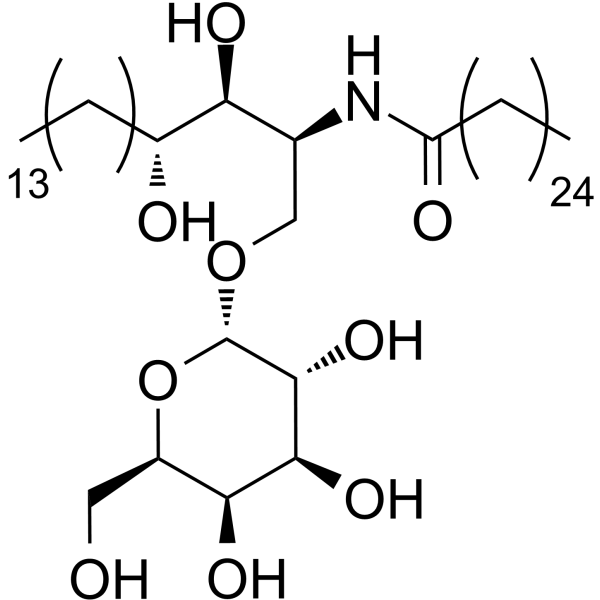 0 ImagesCat. No.: HY-102022CAS No.: 158021-47-7Synonyms: α-GalCer; KRN7000
-
Anti-Mouse/Human CD44 Antibody (IM7)
 0 ImagesCat. No.: HY-P99126Purity: 99.07%Anti-Mouse/Human CD44 Antibody (IM7) is an anti-huamn and mouse CD44 IgG2b monoclonal antibody that recognizes a conserved epitope outside the HA-binding domain of the CD44 molecule. Anti-Mouse/Human CD44 Antibody (IM7) exerts a potent anti-inflammatory effect by inducing the shedding of cell surface CD44, significantly improving symptoms in mice with rheumatoid arthritis without affecting relevant immune responses. Anti-Mouse/Human CD44 Antibody (IM7) can be used for researches on inflammation conditions and cancer such as arthritis and osteosarcoma.
-
Vandortuzumab
 0 ImagesCat. No.: HY-P990673Purity: 99%Synonyms: DSTP-3086S Antibody; RG-7450 AntibodyVandortuzumab (DSTP-3086S Antibody; RG-7450 Antibody) is a humanized anti-STEAP1 IgG1 antibody and antimitotic agent that can be conjugated with MMAE (HY-15162) to form the antibody-drug conjugate (ADC) Vandortuzumab vedotin. Vandortuzumab vedotin specifically binds to STEAP1 and drives internalization of the complex, releasing the MMAE (HY-15162) payload intracellularly. After binding to tubulin, MMAE inhibits cell division and induces cell death. Vandortuzumab exhibits antitumor activity in preclinical xenograft models of prostate cancer and can be used for research related to metastatic castration-resistant prostate cancer (mCRPC).
-
Gemtuzumab
 0 ImagesGemtuzumab is a monoclonal IgG4-κ antibody targeting CD33 antigen. Gemtuzumab affects cell necrosis by specifically targeting CD33 expressed on the surface of leukaemic cell blasts in acute myeloid leukemia (AML). Gemtuzumab can be used for synthesis of antibody-drug conjugate (ADC), Gemtuzumab ozogamicin (HY-109539). Gemtuzumab ozogamicin consists of a cytotoxic derivative of Calicheamicin (a cytotoxic antibiotic), and a monoclonal antibody. Gemtuzumab ozogamicin can be used for the research of acute myeloid leukemia. Recommend Isotype Controls: Human IgG4 (S228P) kappa, Isotype Control (HY-P99003).

-
Polatuzumab vedotin
 0 ImagesPolatuzumab vedotin is an antibody-drug conjugate targeting CD79b. It contains a humanized anti-CD79b IgG1 monoclonal antibody linked to monomethyl auristatin E (MMAE), a potent microtubule inhibitor. The antibody portion is Polatuzumab (HY-P99042), and the drug-linker conjugate for ADC is VcMMAE (HY-15575). Polatuzumab vedotin has the potential for the research of Large B-cell lymphomas (LBCL).
-
Tusamitamab
 0 ImagesSynonyms: SAR-408377; PF-08046050 Antibody; SAR445953 AntibodyTusamitamab is an IgG1 monoclonal antibody that targets CEACAM5. Tusamitamab can be used to synthesize ADC Tusamitamab ravtansine (SAR408701) (HY-P99542).
-
Anti-Mouse CD4 Antibody (GK1.5)
 0 ImagesCat. No.: HY-P990792Purity: 99%Anti-Mouse CD4 Antibody (GK1.5) is an anti-mouse CD4 IgG2b monoclonal antibody. Anti-Mouse CD4 Antibody (GK1.5) can significantly deplete CD4+ T cells. Anti-Mouse CD4 Antibody (GK1.5) can extend the survival rate of xenograft models. Anti-Mouse CD4 Antibody (GK1.5) can be used for research on immunology. The recommend isotype control of Anti-Mouse CD4 Antibody (GK1.5): Rat IgG2b kappa, Isotype Control (HY-P990682).
-
Elotuzumab
 0 ImagesSynonyms: HuLuc 63; PDL 063; BMS 901608Elotuzumab (HuLuc 63) is an IgG1 monoclonal antibody targeting the SLAMF7 receptor. Elotuzumab exerts antitumor activity by activating natural killer cells and inducing antibody-dependent cell-mediated cytotoxicity. Elotuzumab can be combined with Lenalidomide (HY-A0003), Dexamethasone (HY-14648), etc., for the research of tumors such as multiple myeloma.
-
Caplacizumab (His Tag)
 0 ImagesSynonyms: ALX-0681; ALX-0081Caplacizumab (His Tag) is a humanized anti-von Willebrand factor (vWF) nanobody. Caplacizumab (His Tag) inhibits the binding of vWF with platelet glycoprotein (GP) Ibα. Caplacizumab (His Tag) inhibits the vWF-mediated platelet adhesion and prevents further microthrombi formation. Caplacizumab (His Tag) can be used for the research of thrombotic thrombocytopenic purpura (TTP).
-
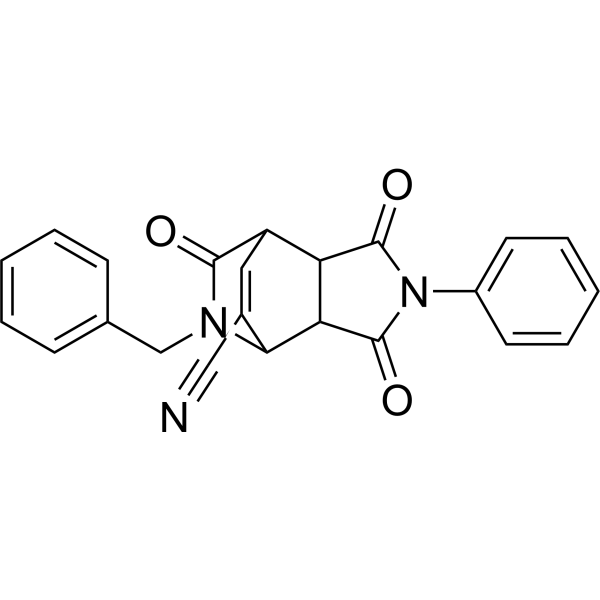
HA-CD44 interaction inhibitor 2
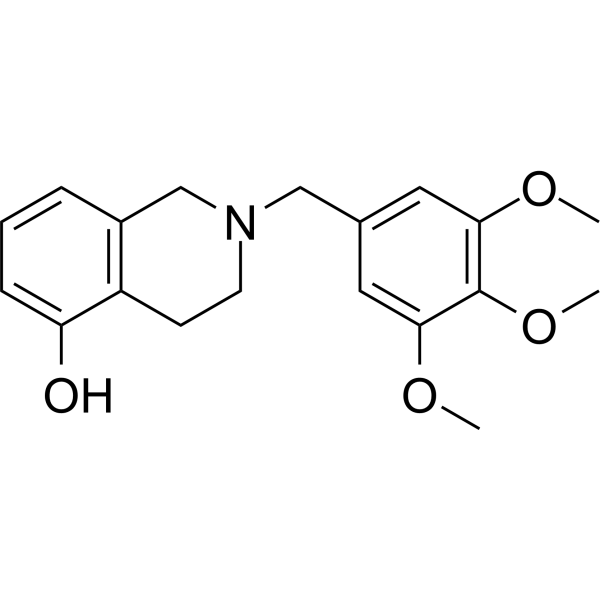 0 ImagesHA-CD44 interaction inhibitor 2 is a CD44 inhibitor that can inhibit the interaction between Hyaluronic acid (HA) (HY-B0633A) and CD44. HA-CD44 interaction inhibitor 2 acts as an antiproliferative agent against CD44+ cancer cells. HA-CD44 interaction inhibitor 2 can disrupt the integrity of cancer spheres and reduce cancer cell viability in a dose-dependent manner. HA-CD44 interaction inhibitor 2 is applicable for tumor research.
-
Precemtabart tocentecan
 0 ImagesSynonyms: Precem-TcT; M 9140Precemtabart tocentecan (Precem-TcT; M 9140) is an anti-CEACAM5 (carcinoembryonic antigen-related cell adhesion molecule 5) antibody-drug conjugate (ADC). Precemtabart tocentecan consists of a tumor-specific anti-CEACAM5 monoclonal antibody Precemtabart (HY-P990940), a highly hydrophilic and stable cleavable β-glucuronide linker, and a topoisomerase 1 inhibitor payload Exatecan (HY-13631), and the drug-linker conjugate for ADC is Mal-Gly-PAB-Exatecan-D-glucuronic acid (HY-153179). Precemtabart tocentecan inhibits the growth of CEACAM5-positive cancer cells. Precemtabart tocentecan exhibits significant antitumor activity in CEACAM5-expressing xenograft models. Precemtabart tocentecan can be used for the study of CEACAM5-expressing advanced solid tumors, especially mCRC.
-
Anti-Mouse CD8α Antibody (2.43)
 0 ImagesCat. No.: HY-P990790Purity: 98.78%Anti-Mouse CD8α Antibody (2.43) is an anti-mouse CD8α IgG2b monoclonal antibody. Anti-Mouse CD8α Antibody (2.43) can significantly deplete CD8+ T cells. Anti-Mouse CD8α Antibody (2.43) can prolong the survival time of liver cell transplantation. Anti-Mouse CD8α Antibody (2.43) can be used for research on immunology. The recommend isotype control of Anti-Mouse CD8α Antibody (2.43): Rat IgG2b kappa, Isotype Control (HY-P990682).

-
Gum arabic
 0 ImagesGum Arabic is an orally active complex branched polysaccharide. Gum Arabic can be isolated from the Acacia senegal tree. Gum Arabic upregulates the expression of maturation markers (CD86, CD40, and CD54), promotes ERK1/2 phosphorylation, and inhibits Apoptosis. Gum Arabic exhibits antimalarial effects against Plasmodium berghei ANKA. Gum Arabic exhibits hepatoprotective, renal, and cardiovascular protective activities. Gum Arabic improves obesity. Gum Arabic is commonly used as a stabilizer and thickener. Gum Arabic can be used in the research of brain tumor imaging.
-
Labetuzumab
 0 ImagesSynonyms: hMN14Labetuzumab is a humanised anti-carcinoembryonic antigen (CEA) monoclonal antibody that inhibits tumour growth and sensitises human medullary thyroid cancer xenografts to Dacarbazine chemotherapy.
-
Vadastuximab
 0 ImagesSynonyms: Anti-Human CD33 Recombinant AntibodyVadastuximab (Anti-Human CD33 Recombinant Antibody) is a humanized monoclonal antibody targeting CD33. Vadastuximab can be used to synthesize an ADC compound, Vadastuximab talirine.
-
Lirilumab
 0 ImagesCat. No.: HY-P99208CAS No.: 1000676-41-4Synonyms: IPH2102Lirilumab (IPH2102) is an anti-KIR monoclonal antibody, and shows antitumor activity. Lirilumab can be used in Leukemia, squamous cell carcinoma of the head and neck (SCCHN) research.



