



3D Bioprinting

3D bioprinting is an additive manufacturing technique. It employs computer-aided design (CAD) software to design intricate three-dimensional structures and utilizes this technique to fabricate cell-based scaffold structures. The essence of 3D bioprinting technology lies in the use of living cells, bioactive factors, and biomaterials as fundamental building blocks to design and manufacture bioactive artificial organs, implants, or three-dimensional cellular structures.Bioink, the scaffold material used in 3D bioprinting, simulates the extracellular matrix (ECM) environment to facilitate cell adhesion, proliferation, and differentiation post-printing.
MCE provides natural polymer hydrogels and organic synthetic polymer hydrogels. Based on the differences in crosslinking methods, they can be further classified into light- cured modified hydrogel and thermosensitive hydrogel.
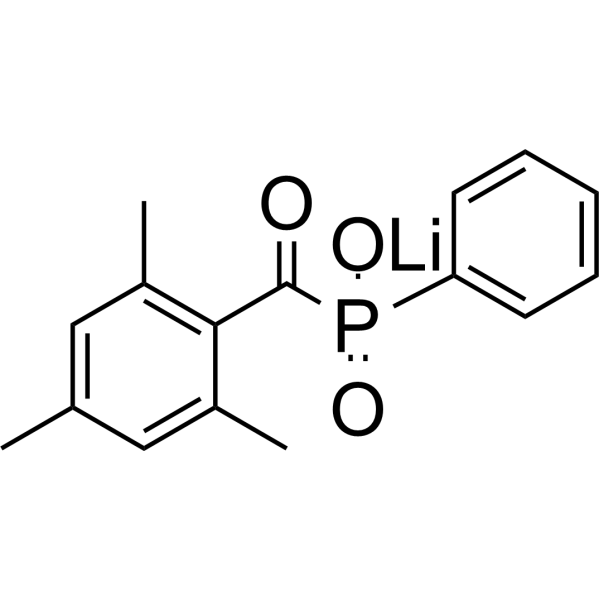
- Formula: C16H16LiO3P
- Molecular Weight: 294.22
LAP (Lithium phenyl-2,4,6-trimethylbenzoylphosphinate) is a free radical initiator. The free radicals produced by LAP under bioprinting conditions are potentially cytotoxic and mutagenic. In addition, the concentration of LAP affects the mechanical strength of 3D printed scaffolds. Generally, the concentration range of LAP used for curing is 0.05%-1%. The elastic modulus produced at a concentration of 0.1% is the highest, with enhanced mechanical properties and excellent biocompatibility.

- Formula: C12H16O4
- Molecular Weight: 224.25
I2959 is widely used as a photoinitiator for photochemical cross-linking of hydrogels, and the combination of I2959 and CMA hydrogel has been used as a bio-ink for biological 3D printing applications. In addition, I2959 has a high free radical generation efficiency and is cytotoxic to rapidly dividing cell lines.
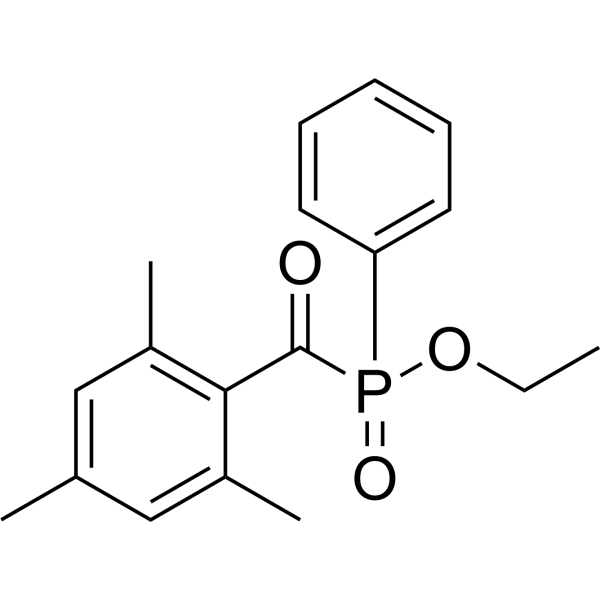
- Formula: C18H21O3P
- Molecular Weight: 316.33
TPO-L is a photoinitiator for the 3D printing of resin that promotes two-photon induced polymerization. The two-photon absorption cross-section spectrum of Lucirin TPO-L shows a maximum of 1.2 GM at 610 nm. Despite its small two-photon absorption cross-section, Lucirin TPO-L exhibits high polymerization quantum yields.

PLGA-PEG-PLGA (hydrogel) (LA:GA 7:1) is a biodegradable thermosensitive hydrogel product that can undergo phase transition at a specific temperature. PLGA-PEG-PLGA (hydrogel) (LA:GA 7:1) can be widely used in drug delivery systems, tissue engineering, wound dressings, and biosensors. The gelation temperature varies with concentration. The gelation temperature varies with the concentration; the higher the concentration, the lower the gelation temperature.

- Formula: (C2H4O)nC6H6O3
- Molecular Weight: 6000 (Approximately)
Poly(ethylene glycol) diacrylate (PEGDA) (MW 6000) is a versatile polymer material that is widely used as a building material for hydrogel scaffolds, especially in the fields of tissue engineering and regenerative medicine. Poly(ethylene glycol) diacrylate (MW 6000) can be used as a building material for wound dressing hydrogels.

- Molecular Weight: 300000 (Average)
Alginate Methacryloyl (MW 300000) is a methacryloyl alginate with potential for use as a tissue engineering scaffold and 3D printing ink. Alginate Methacryloyl (MW 300000) is biocompatible, non-immunogenic, has low toxicity and is capable of physical cross-linking with divalent cations such as calcium. Alginate Methacryloyl (MW 300000) needs to self-assemble into fibrous hydrogel under the action of photoinitiator LAP (HY-44076), and target bioactive adhesion sites, play an inherent supporting role for tissue cells and biodegradable activity.
Application: cell culture, biological 3D printing, tissue engineering, etc.

Red Fluorescent Gelatin Methacryloyl (Red Fluorescent GelMA) is methacryloyl gelatin (GelMA) with red fluorescence, which is obtained by "grafting" fluorescent molecules on GelMA. Red Fluorescent Gelatin Methacryloyl acts as a scaffold and can be used to engineer tissue analogs from the vasculature to cartilage and bone, allowing cells to proliferate and spread. GelMA, 60% methacrylation, Red Fluorescent needs to self-assemble into fibrous hydrogel under the action of photoinitiator LAP (HY-44076), and target bioactive adhesion sites, play an inherent supporting role for tissue cells and biodegradable activity.
Application: cell culture, biological 3D printing, tissue engineering, etc.

Gelatin Methacryloyl (GelMA), 90% methacrylation, blue fluorescent is methacrylated gelatin (GelMA) with blue fluorescence, which is obtained by "grafting" fluorescent molecules on GelMA. Gelatin Methacryloyl, 90% methacrylation, blue fluorescent has a scaffolding effect and can be used to design tissue analogs from vasculature to cartilage and bone, allowing cell proliferation and spreading. Gelatin Methacryloyl, 30% methacrylation, blue fluorescent needs to be self-assembled into fibrous hydrogels under the action of the photoinitiator LAP (HY-44076), and target bioactive adhesion sites, exert inherent support for tissue cells and biodegradation activity.
Application direction: cell culture, biological 3D printing, tissue engineering, etc.

GelMA (Gelatin Methacryloyl), 30% methacrylation, is a derivative obtained by the reaction of Methacrylic anhydride (MA) (HY-W017330) and gelatin. GelMA exhibits excellent biocompatibility, biodegradability, and moldability. GelMA can be photocrosslinked into hydrogels and can be used for research in regeneration of tissues, such as skin, tendon, bone, cartilage, blood vessel, and cardiovascular system. GelMA hydrogel also can be used for research on drug delivery, organ-on-a-chip, and biosensing.

GelMA (Gelatin Methacryloyl), 60% methacrylation, is a derivative obtained by the reaction of Methacrylic anhydride (MA) (HY-W017330) and gelatin. GelMA exhibits excellent biocompatibility, biodegradability, and moldability. GelMA can be photocrosslinked into hydrogels and can be used for research in regeneration of tissues, such as skin, tendon, bone, cartilage, blood vessel, and cardiovascular system. GelMA hydrogel also can be used for research on drug delivery, organ-on-a-chip, and biosensing.
Heparin Methacrylate (HepMA) is methacrylated heparin and is an ideal tissue engineering scaffold material and 3D printing bioink. Heparin Methacrylate needs to self-assemble into fibrous hydrogel under the action of photoinitiator LAP (HY-44076), and target bioactive adhesion sites, play an inherent supporting role for tissue cells and biodegradable activity.
Application: cell culture, biological 3D printing, tissue engineering, etc.
Polyether F127 Diacrylate (F127DA) is an acrylated polyethylene glycol-polypropylene glycol-polyethylene glycol triblock copolymer. Polyether F127 Diacrylate rapidly crosslinks and cures into a gel under ultraviolet or visible light with the action of a photoinitiator. Polyether F127 Diacrylate exhibits excellent thermogelation properties and favorable biosafety. Polyether F127 Diacrylate can upregulate the Integrin-FAK pathway, enhance collagen production, increase the protein and gene expression levels of COL-1/SCX, and promote fibroblastic differentiation of periodontal ligament stem cells. Polyether F127 Diacrylate promotes periodontal ligament regeneration and reduces abnormal healing in a rat model of delayed replanted teeth. Polyether F127 Diacrylate promotes functional osteochondral regeneration in a rat model of osteoarthritis. Polyether F127 Diacrylate supports adipose tissue survival, rendering it suitable for breast reconstruction applications. Polyether F127 Diacrylate can be used in studies related to periodontal ligament injury, breast defect and osteoarthritis.

Water Soluble Silk Fibroin is a silk protein with biocompatibility and biodegradability. Water Soluble Silk Fibroin can be used for 3D bioprinting.


- Formula: (C2H4O)nC6H6O3
- Molecular Weight: 3500.00 (Average)
Poly(ethylene glycol) diacrylate (MW 3500) (PEGDA (MW 3500)) is a derivative of polyethylene glycol. Poly(ethylene glycol) diacrylate (MW 3500) can be used in the formation of a cross-linked polymers.

GelMA (Gelatin Methacryloyl), 90% methacrylation, is a derivative obtained by the reaction of Methacrylic anhydride (MA) (HY-W017330) and gelatin. GelMA exhibits excellent biocompatibility, biodegradability, and moldability. GelMA can be photocrosslinked into hydrogels and can be used for research in regeneration of tissues, such as skin, tendon, bone, cartilage, blood vessel, and cardiovascular system. GelMA hydrogel also can be used for research on drug delivery, organ-on-a-chip, and biosensing.
- Molecular Weight: 400000.00
Hyaluronic acid Methacryloyl (MW 400 kDa) (HAMA (MW 400 kDa)) is a methacrylated hyaluronic acid with biocompatibility. Hyaluronic acid Methacryloyl (MW 400 kDa) also serves as a 3D printing hydrogel ink, featuring rapid photoresponsiveness, fast gelation speed and stable hydrogel performance. Hyaluronic acid Methacryloyl (MW 400 kDa) can rapidly initiate gelation with lithium phenyl-2,4,6-trimethylbenzoylphosphinate (LAP) under ultraviolet irradiation. Moreover, the combination of Hyaluronic acid Methacryloyl with tissue-specific extracellular matrix (ECM) materials (such as pancreatic extracellular matrix (pECM)) acts as an important source material for organoid culture.

PLGA-PEG-PLGA (hydrogel) (LA:GA 3:1) (20% solution) is a biodegradable thermosensitive hydrogel product that can undergo phase transition at a specific temperature. PLGA-PEG-PLGA (hydrogel) (LA:GA 3:1) (20% solution) can be widely used in drug delivery systems, tissue engineering, wound dressings, and biosensors. The gelation temperature varies with the concentration; the higher the concentration, the lower the gelation temperature.

- Molecular Weight: 800 (Average)
PCL-PEG-PCL diacrylate (MW 800) is an amphiphilic triblock copolymer composed of PEG and two polycaprolactones (PCL). PCL-PEG-PCL diacrylate (MW 800) can be cross-linked by free radical polymerization and/or photopolymerization to form a cross-linked hydrogel network.

- Formula: C5H9NO2
- Molecular Weight: 115.13
N-(2-Hydroxyethyl)acrylamide is an amphiphilic polymer that can be used to prepare hydrogels.



