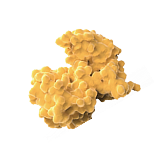
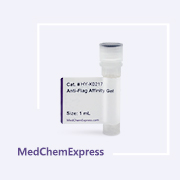
Anti-GFP Affinity Gel

Based on 1 Customer Validation
MCE Anti-GFP Affinity Gel can be used for the detection and purification of GFP, EGFP, their fusion-expressed proteins and IP assays.
-
Storage :
4℃,2 years. Do not dry or freeze.


To place orders, for customer services and technical support, please contact: MedChemExpress USA
Tel: 609-228-6898 E-mail: [email protected] [email protected]







Description & Advantages
Green Fluorescent Protein (GFP), derived from Aequorea Victoria, is comprised of 238 amino acids and has a molecular weight of 26.9 kDa. Its native fluorescent group emits a distinct green fluorescence when excited by ultraviolet or blue light, exhibiting stable fluorescent properties. GFP can be stably expressed in various cellular contexts without species, tissue, or unknown specificity constraints. As it is non-toxic to cells and easy to detect, GFP has been extensively utilized as a reporter gene in the fields of cell biology and molecular biology.
MCE Anti-GFP Affinity Gel is produced through the covalent coupling of high-quality GFP antibody with agarose. It boasts a high loading capacity, exceptional specificity, and stability. This gel can be used for the detection and purification of GFP, EGFP, and their fusion-expressed proteins. Moreover, it can be utilized for cimmunoprecipitation (IP) assays without binding to BFP-tagged proteins.
The product contains 0.5 mL of gel per 1 mL of total volume. Prior to use, ensure the gel is thoroughly resuspended and mixed before aspiration.
The specifications of the product correspond to the actual resin volume, with the resin content of 50%.


Protocol
Recommended Buffers (Not Provided)
| Buffer | Composition |
|---|---|
| Binding/Wash Buffer | 50 mM Tris, 0.15 M NaCl, pH 7.4 |
| Elution Buffer | 0.1 M glycine, pH 3.0 |
| Neutralization Buffer | 1 M Tris-HCl, pH 8.0 |
| Storage Buffer | PBS containing 0.02% (w/v) NaN3 |
Note: It is recommended to prepare all buffers using ultrapure water and sterilize them by filtration through a 0.45 μm or 0.22 μm membrane.
Protein Purification
Before sample loading, centrifuge the sample or filter it through a 0.22 μm or 0.45 μm membrane to reduce impurities and improve protein purification efficiency.
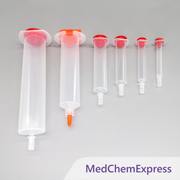
Medium-Pressure Chromatography Column Method
1. Column Packing: Pack the Anti-GFP Affinity Gel into a suitable chromatography column and connect the column to the chromatography system.
2. Column Equilibration: Equilibrate the column with 5 column volumes of binding/wash buffer. Repeat the equilibration procedure 2-3 times.
3. Sample Loading: Load the sample using a pump or sample loop and collect the flow-through. Repeated sample loading may improve binding efficiency.
Notes: a. Select an appropriate amount of gel according to the amount of protein and do not exceed the binding capacity of the column;
b. Increased sample viscosity or volume may cause increased back pressure in the chromatography column.
4. Washing: Wash the column with 10-20 column volumes of binding/wash buffer to remove nonspecifically adsorbed contaminating proteins. Collect the wash fractions until the UV absorbance baseline becomes stable.
5. Elution: Elute with 3-5 column volumes of elution buffer. Collect the eluate in separate fractions and immediately add neutralization buffer at 1/10 of the total eluate volume to neutralize the pH. The resulting sample may be used for subsequent functional analysis.
Note: The eluted protein may be stored at 4°C for a short period. For long-term storage, store it at -20°C.
6. Regeneration: Continue washing the column with 5-10 column volumes of elution buffer to completely elute residual protein and regenerate the resin. Then equilibrate the column to neutral pH using binding/wash buffer.
Note: After acidic elution, immediately equilibrate the resin with binding/wash buffer. Do not leave the Anti-GFP Affinity Gel in the elution buffer for more than 20 min.
7. Storage: Equilibrate the column with 5-10 column volumes of storage buffer, disconnect the column, and store it at 2-8°C.
Gravity-Flow Column Method
1. Column Packing: According to the amount of sample to be purified, transfer an appropriate volume of the Anti-GFP Affinity Gel suspension into a gravity-flow chromatography column and remove the storage solution.
2. Column Equilibration: Equilibrate the packed gravity-flow column with 5 column volumes of binding/wash buffer. Repeat the equilibration procedure 2-3 times.
3. Sample Loading: After adding the sample, allow it to remain in the column for at least 2 min to ensure sufficient contact between the sample and the gel. Collect the flow-through.
Note: Repeated sample loading may improve binding efficiency.
4. Washing: Wash the column with 10-15 column volumes of binding/wash buffer to remove nonspecifically adsorbed contaminating proteins. Collect the wash fractions.
5. Elution: Elute with 3-5 column volumes of elution buffer. Collect the eluate in separate fractions and immediately add neutralization buffer at 1/10 of the total eluate volume to neutralize the pH. The resulting sample may be used for subsequent functional analysis.
Note: The eluted protein may be stored at 4°C for a short period. For long-term storage, store it at -20°C.
6. Regeneration: Continue washing the column with 5-10 column volumes of elution buffer to completely elute residual protein and regenerate the resin. Then equilibrate the column to neutral pH using binding/wash buffer.
7. Storage: Equilibrate the column with 5 column volumes of storage buffer and store it at 2-8°C.
Centrifugation Method
1. Gel Pretreatment: According to the amount of sample to be purified, transfer an appropriate volume of the Anti-GFP Affinity Gel suspension into a centrifuge tube. Centrifuge at 5,000 × g for 1 min and discard the supernatant. Add 5 gel volumes of binding/wash buffer, centrifuge at 5,000 × g for 1 min, and discard the supernatant. Repeat the washing procedure 2-3 times.
2. Binding: Add the sample, close the centrifuge tube, and incubate at 4°C for 2-4 h or at 37°C for 0.5-2 h.
3. Washing: After incubation, centrifuge at 5,000 × g for 1 min and discard the supernatant. The supernatant may be retained as the flow-through fraction for electrophoretic analysis. Wash with 5 gel volumes of binding/wash buffer, centrifuge at 5,000 × g for 1 min, and discard the supernatant. Repeat the washing procedure 3-5 times.
4. Elution: Elute with 3-5 gel volumes of elution buffer and incubate at room temperature for 5 min. Centrifuge at 5,000 × g for 1 min, collect the supernatant in separate tubes, and immediately add neutralization buffer at 1/10 of the total eluate volume to neutralize the pH. The resulting sample may be used for subsequent functional analysis. The elution procedure may be repeated 2-3 times, with each supernatant collected separately.
Note: After acidic elution, immediately equilibrate the resin with binding/wash buffer. Do not leave the Anti-GFP Affinity Gel in the elution buffer for more than 20 min. The eluted protein may be stored at 4°C for a short period; for long-term storage, store it at -20°C.
5. Regeneration and Storage: Wash the gel with 5-10 gel volumes of binding/wash buffer, followed by 5-10 gel volumes of ddH2O. Finally, wash with 2 gel volumes of storage buffer and store at 2-8°C.
Immunoprecipitation
1. Gel Pretreatment:
1) Thoroughly resuspend the Anti-GFP Affinity Gel. Transfer 40 μL of the gel suspension, containing approximately 20 μL of settled gel, into a clean 1.5 mL centrifuge tube. Centrifuge at 5,000 × g for 1 min and discard the supernatant.
2) Add 500 μL of binding/wash buffer and mix thoroughly. Centrifuge at 5,000 × g for 1 min and discard the supernatant. Repeat the washing procedure 3-4 times.
2. Sample Binding:
1) Add 200-1,000 μL of sample to the washed gel. Mix thoroughly and incubate on a rotator at 4°C for 2 h. For improved binding efficiency, the sample may be incubated overnight.
2) Centrifuge at 5,000 × g for 1 min and transfer the supernatant to a new centrifuge tube. The supernatant may be used to determine whether residual GFP-tagged protein remains unbound.
3. Washing: Add 500 μL of binding/wash buffer to the separated gel and resuspend thoroughly. Centrifuge at 5,000 × g for 1 min and discard the supernatant. Repeat the washing procedure at least three times, or until the OD280 of the wash supernatant is below 0.05.
4. Elution: Two elution methods are provided. Select the appropriate method according to the experimental requirements.
1) Acidic Elution: Samples obtained using this method retain their original biological activity and are suitable for subsequent functional analysis. Add 50-100 μL of elution buffer to the washed gel and mix thoroughly. Incubate at room temperature for 5 min and centrifuge at 5,000 × g for 1 min. Collect the supernatant and immediately add neutralization buffer at 1/10 of the total eluate volume to neutralize the pH. The resulting sample may be used for subsequent functional analysis.
Note: The eluted protein may be stored at 4°C for a short period. For long-term storage, store it at -20°C.
2) Denaturing Elution: Samples obtained using this method are suitable for SDS-PAGE analysis. Add 20-50 μL of 2× SDS-PAGE Loading Buffer to the washed gel and mix thoroughly. Heat at 95°C for 5 min, centrifuge at 5,000 × g for 1 min, and collect the supernatant for SDS-PAGE analysis.
Note: Conventional SDS-PAGE Loading Buffer contains β-mercaptoethanol or DTT, which can dissociate the heavy and light chains of the antibody immobilized on the resin. In addition, SDS-containing Loading Buffer can denature the immobilized ligand. Therefore, the Anti-GFP Affinity Gel cannot be reused after denaturing elution.
Storage
4℃,2 years.
Do not dry or freeze.


Components
| Components | HY-K0229-1 mL | HY-K0229-5 mL | HY-K0229-10 mL |
|---|---|---|---|
| Anti-GFP Affinity Gel | 1 mL | 5 mL | 5 mL × 2 |


 Please enter the correct Lot Number