Protein Transfection Reagent
Based on 1 publication(s) in Google Scholar
MCE Protein Transfection Reagent is a cationic lipid mixture for complexation with proteins, peptides, antibodies and other biologically active molecules to allow their direct intracellular delivery.
-
Storage :
-20℃, 1 year
Avoid repeat freeze-thaw cycles


To place orders, for customer services and technical support, please contact: MedChemExpress USA
Tel: 609-228-6898 E-mail: [email protected] [email protected]





Description & Advantages
MCE Protein Transfection Reagent is a cationic lipid mixture for complexation with proteins, peptides, antibodies and other biologically active molecules to allow their direct intracellular delivery. Reagent protein complexes attach to negatively charged cell surfaces and either directly fuses with the membrane to deliver the captured protein into the cell or be endocytosed by the cell and then fuse with the endosome, releasing the captured protein into the cytoplasm.
Features of MCE Protein Transfection Reagent
1. Fast protein delivery: Optimum delivery in 3 to 12 h after incubation, with high transfection efficiency for primary cells and difficult-to-transfect cells.
2. High protein activity: Delivery complex is non-covalent, allowing proteins and peptides retain biological activity after delivery.
3. Versatility: Suitable for a wide range of cells, works with proteins, peptides and fluorescently labeled antibodies.
4. Low cytotoxic: It exhibits mild action and is biocompatible
5. Time-saving: Eliminates the need to isolate, clone and transfect gene sequences.


Protocol
1. Cell Preparation
Culture cells so that they are healthy and actively growing at transfection. In MCE validation, cell density was approximately 90%.
2. Preparation of Protein/Reagent Complexes
1. Dilute the protein, peptide, or antibody to be delivered in serum-free medium to an appropriate volume.
2. Dilute Protein Transfection Reagent separately in serum-free medium.
3. Add the diluted Protein Transfection Reagent to the protein solution, mix gently, and incubate for approximately 10-15 min at room temperature to form complexes.
3. Protein Transfection
1. Add the complexes evenly to the cell culture medium.
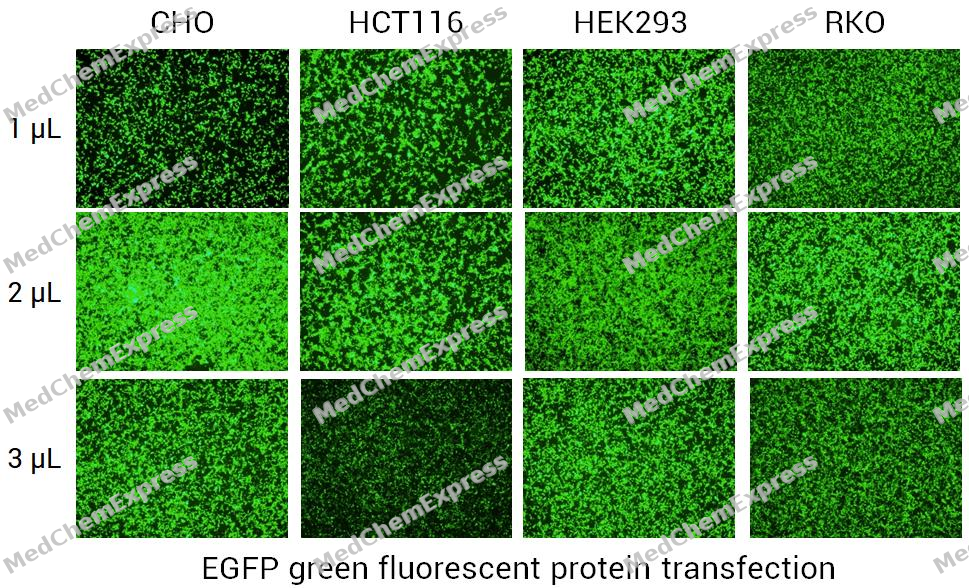
2. Incubate under normal culture conditions at 37°C. In MCE validation, 10 μg EGFP protein was combined with 1-3 μL Protein Transfection Reagent and analyzed 4 h after transfection.
3. Intracellular delivery can generally be evaluated approximately 3-12 h after transfection. Optimize protein amount and reagent dosage according to the cell type and protein properties.
Note: The protein should be well solubilized. Avoid high concentrations of salts, detergents, or other components that may interfere with lipid-complex formation.


Publications
-
Journal Impact Factor
-
Most Recent
Storage
-20℃, 1 year
Avoid repeat freeze-thaw cycles


Components
| Components | HY-K2016-0.3 mL |
|---|---|
| Protein Transfection Reagent | 0.3 mL |


 Please enter the correct Lot Number