HP PolyFast Transfection Reagent

Based on 1 Customer Validation
MCE HP PolyFast Transfection Reagent is a novel cationic polymer transfection reagent for DNA and RNA transfection.
-
Storage :
-20°C, 1 year. Avoid repeated freeze-thaw cycles.



To place orders, for customer services and technical support, please contact: MedChemExpress USA
Tel: 609-228-6898 E-mail: [email protected] [email protected]





Description & Advantages
MCE HP PolyFast Transfection Reagent is a novel cationic polymer transfection reagent for DNA and RNA transfection.
The transfection principle is as follows: The positively charged macromolecular polymers interact with the negatively charged phosphate groups of nucleic acids to form positively charged complexes, which then interact with the negatively charged proteoglycans on the cell surface. Through endocytosis, these complexes enter the cell and are subsequently released in the cytoplasm, achieving the transfection of exogenous nucleic acids.
Features of MCE HP PolyFast Transfection Reagent
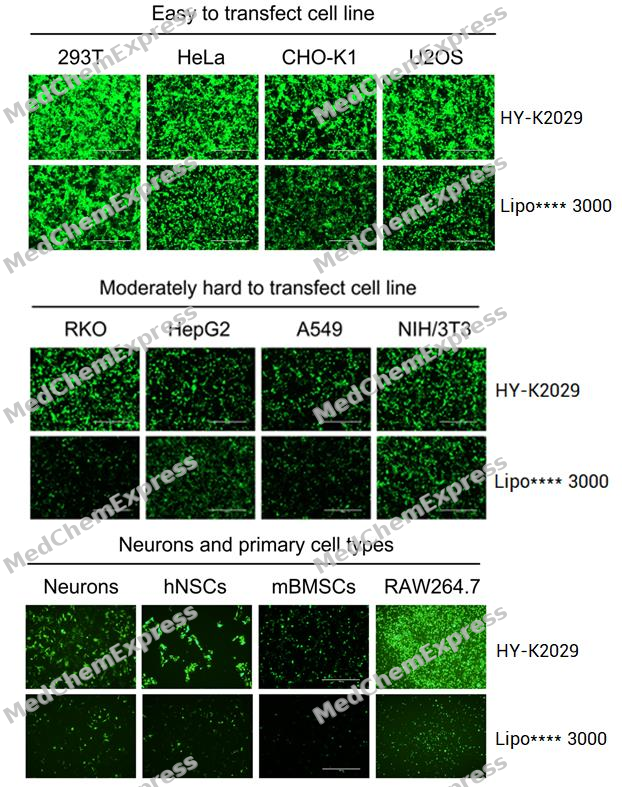
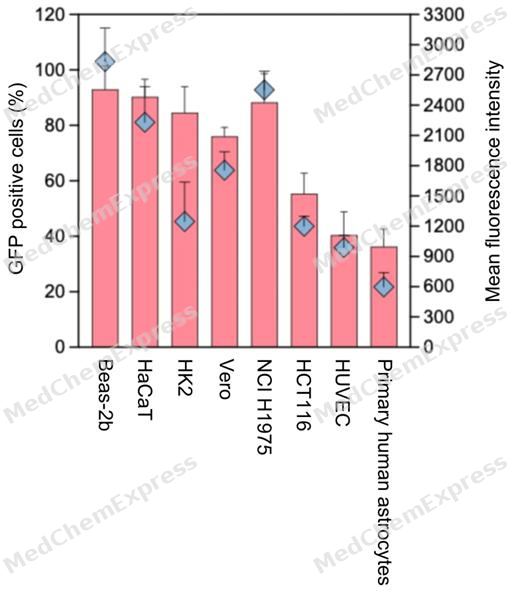
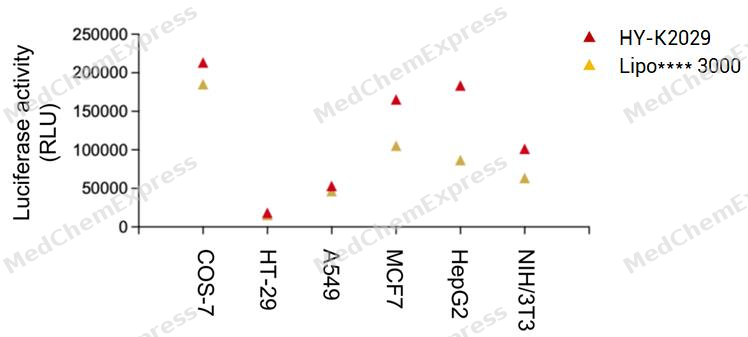
1. Wide applicability: Demonstrates excellent transfection efficiency for both common and difficult-to-transfect cells, as well as primary cells.
2. High transfection efficiency: The surface of the cationic polymer is modified with cell-penetrating peptides and endosomal escape enhancers, leading to superior transfection results.
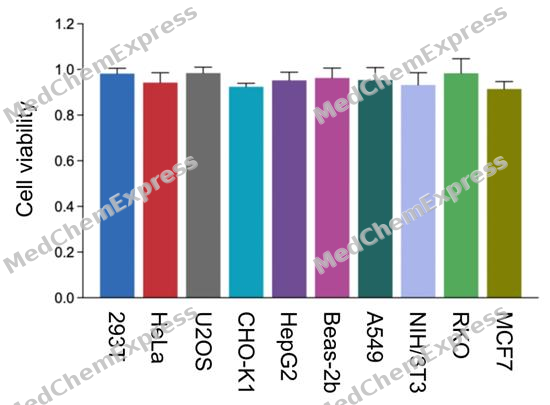
3. Low cytotoxicity: Effectively balances high transfection efficiency with cell viability, providing gentle action.
4. Optimized formulation: After optimization, the reagent can be directly added to the culture medium, with serum having on effect on transfection efficiency, reducing the damage caused by serum deprivation to the cells.
5. Simple operation: The experimental protocol is straightforward and fast, with stable and reliable results. There is no need to remove the complexes or replace the fresh culture medium after transfection.


Protocol
1) For adherent cells: Plate the cells digested with trypsin one day before transfection (0.5 - 1.5 × 10⁵ cells plated in a 24-well cluster plate), until the density reaches 50% for cell transfection.
2) Foe suspension cells: Plate the cells before transfection and suspend in fresh medium (1 - 3 × 10⁵ cells/500 μL medium).
Note: The viability and general health of cells prior to transfection significantly affect the transfection result. Cells should be at least 90% viable prior to transfection and have had sufficient time to recover from passaging.
2. Prepare Transfection Reagent complexes
1) Add 0.5 μg DNA to a 1.5 mL EP tube, and add 2 μL Transfection Reagent, mix gently and incubate for 3 min at room temperature.
Note: The optimal transfection conditions may vary depending on the cell type and culture conditions, and perform pre-experiment to find out the optimal transfection ratio. For 24-well plates, the recommended amount of DNA is 0.2 - 0.6 μg and the recommended amount of transfection reagent is 1 - 4 μL.
2) Add 100 μL reduced-serum medium (serum-free and antibiotic-free), mix gently and incubate for 30 min at room temperature.
3. Cell Transfection
Replace the cell medium with fresh, pre-warmed complete culture medium (500 μL per well) and add the transfection reagent-DNA complexes (100 μL) to each well. Mix gently and incubator for further culture.
Note: For suspension cell lines, PMA and/or PHA can be added optional 5 h after transfection to enhance the activity of the CMV promoter and promote gene expression. For Jurkat cells, adding PMA at a final concentration of 50 ng/mL and PHA at 1 μg/mL can improve the activity of the CMV promoter and gene expression. For K562 cells, adding only PMA can enhance the CMV promoter activity.
4. Analyze transfection efficiency
After incubation of 24 - 48 h, the transfection effect can be analyzed by fluorescence detection, Western Blot, ELISA, RT-PCR, flow cytometry, reporter gene, immunofluorescence staining and other methods according to the experimental needs.
Storage
-20°C, 1 year.
Avoid repeated freeze-thaw cycles.


Attention
1. To improve transfection efficiency, it is recommended to ues high-purity, sterile, non-polluting and endotoxin-free nucleic acids.
2. The viability and general health of cells prior to transfection significantly affect the transfection result. Cells should be at least 90% viable prior to transfection and have had sufficient time to recover from passaging.
3. The transfection experiment for different cell types requires different cell densities, and corresponding experimental conditions can be optimized as needed. Additionally, it is recommended to maintain consistent seeding conditions throughout the experiment to ensure reproducibility.
4. During transfection, the presence of antibiotics may lead to reduced transfection efficiency and cytotoxicity, and the addition of antibiotics to the transfection medium is not recommended.
5. Serum can affect the formation of transfection reagent-nucleic acid complexes, so it is recommended to use serum-free medium during the preparation of the complexes.
6. There are many factors affecting transfection efficiency, such as cell type, cell state and density, nucleic acid quality and concentration, ratio of transfection reagents to nucleic acids, etc. It is recommended to perform pre-experiment to find out the best transfection conditions first.
7. Certain components in special media may inhibit cationic polymer-mediated transfection, so it is necessary to test the compatibility of the special media with this product.
8. This product is for R&D use only, not for drug, household, or other uses.
9. For your safety and health, please wear a lab coat and disposable gloves to operate.


Components
| Components | HY-K2029-0.2 mL | HY-K2029-1 mL | HY-K2029-5 mL |
|---|---|---|---|
| HP PolyFast Transfection Reagent | 0.2 mL | 1 mL | 1 mL × 5 |


 Please enter the correct Lot Number