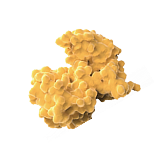
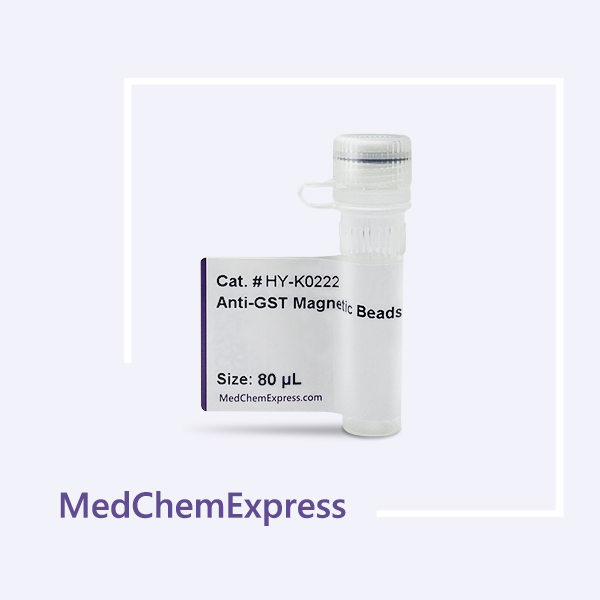
Anti-GST Magnetic Beads
Based on 25 publication(s) in Google Scholar
MCE Anti-GST Magnetic Beads are used for immunoprecipitation (IP) of specific GST-tagged proteins expressed in bacterial and mammalian cells and in vitro expression systems. The 1 mL is defined as the base specification. All larger sizes correspond to incremental volumes of this base.
-
Storage :
Stored at 4°C, and is stable for up to 2 years. Do not centrifuge, dry or freeze the magnetic beads.


To place orders, for customer services and technical support, please contact: MedChemExpress USA
Tel: 609-228-6898 E-mail: [email protected] [email protected]



-
HY-K0209
Anti-His Magnetic Beads -
HY-K0207
Anti-Flag Magnetic Beads -
HY-K0202
Protein A/G Magnetic Beads -
HY-K0201
Anti-HA Magnetic Beads -
HY-K0208
Streptavidin Magnetic Beads -

HY-K0234
Glutathione Magnetic Agarose Beads -
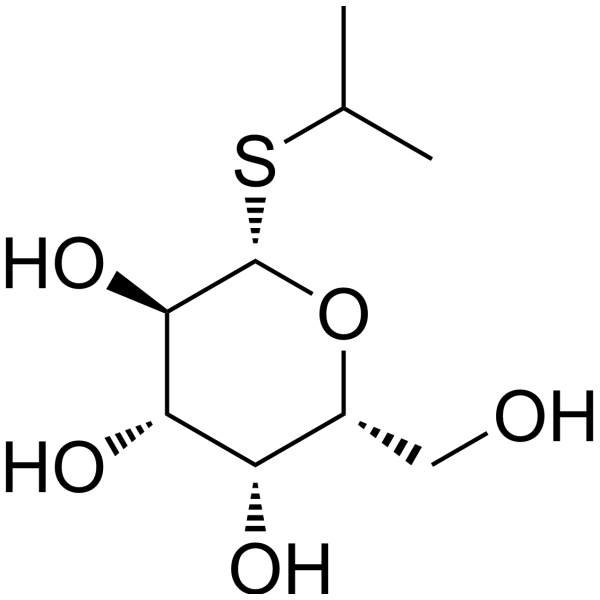
HY-15921
IPTG -
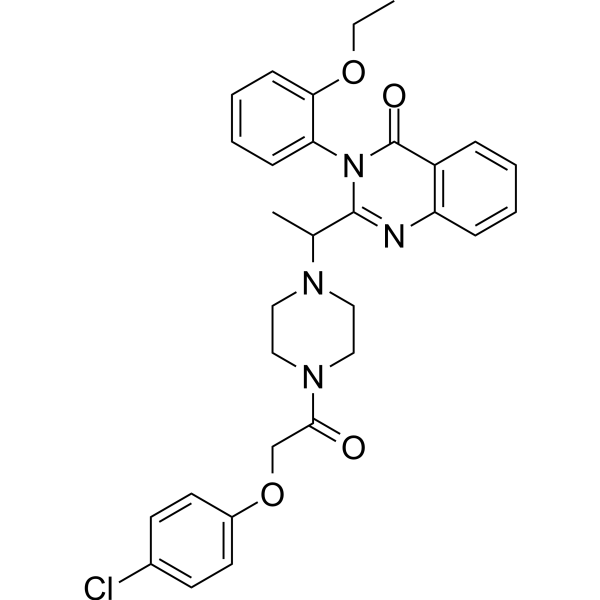
HY-15763
Erastin -
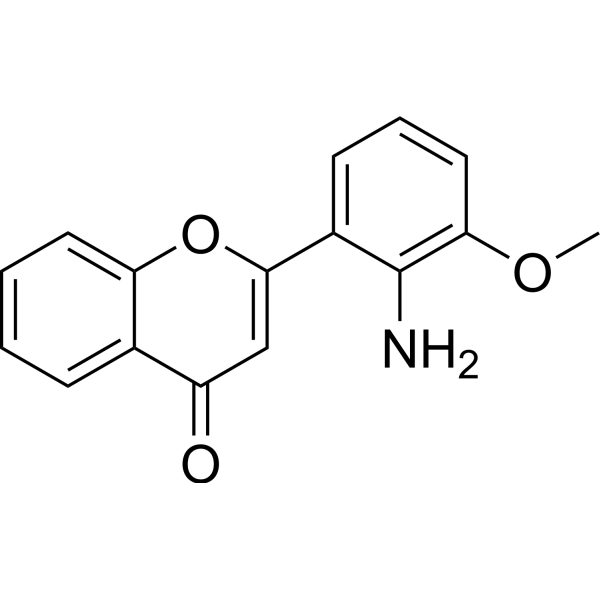
HY-12028
PD98059 -
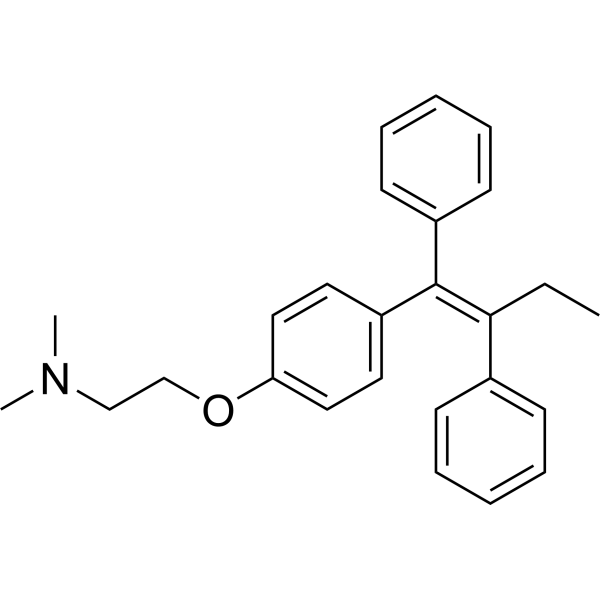
HY-13757A
Tamoxifen -
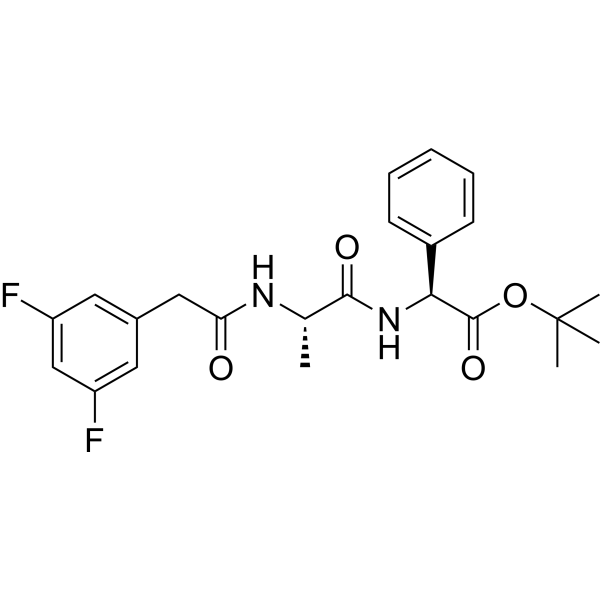
HY-13027
DAPT -

HY-K0246
Anti-GFP Magnetic Agarose Beads


Description & Advantages
MCE Anti-GST Magnetic Beads are based on amino magnetic beads, with 200 nm particle size, covalently coupled with high quality mouse IgG monoclonal antibody that recognizes the GST sequence. Anti-GST Magnetic Beads are used for immunoprecipitation (IP) of specific GST-tagged proteins expressed in bacterial and mammalian cells and in vitro expression systems. Magnetic beads are removed from the solution manually by using a magnetic stand or automatically by using an instrument. With high loading of GST-tagged protein and high specificity, Anti-GST Magnetic Beads are also suitable for Co-immunoprecipitation and purification of GST-tagged protein.
During immunoprecipitation, only a small amount of magnetic beads are needed, and the non-specific binding is low.
• Convenient and time saving.
• Low non-specific binding.
• Minimal sample loss.
• Protein binding capacity up to 0.6 mg/mL.
• Stable, one bottle solution.


Protocol
Recommended Buffers (Not Provided)
| Buffer | Composition |
|---|---|
| Wash Buffer | TBST: 50 mM Tris-HCl, 150 mM NaCl, 0.5% Tween-20, pH 7.4 |
| Elution Buffer | 0.1 M glycine, pH 2.5-3.1 |
| Neutralization Buffer | 1 M Tris-HCl, pH 8.0 |
1. Magnetic Bead Pretreatment
Thoroughly resuspend the Anti-GST Magnetic Beads. Transfer 20 μL of magnetic beads into a 1.5 mL EP tube, add 500 μL of wash buffer, and mix thoroughly. Place the tube on a magnetic stand for magnetic separation and discard the supernatant. Repeat the washing procedure twice.
2. Sample Binding
Add 500 μL of cell lysate to the pretreated magnetic beads and mix thoroughly. Incubate the mixture on a rotator for 2 h at room temperature or overnight at 4°C. After incubation, place the tube on a magnetic stand for magnetic separation and discard the supernatant.
Note: The magnetic beads may aggregate or form sheet-like clusters during the binding process. This is normal and does not affect the experimental results.
3. Washing
Add 500 μL of wash buffer to the separated magnetic beads and thoroughly resuspend the beads. Perform magnetic separation and discard the supernatant. Repeat the washing procedure three times, or until the OD280 of the wash supernatant is below 0.05.
Note: If the OD280 of the supernatant is higher than 0.05, increase the number of washing steps as appropriate.
4. Elution
Two elution methods for GST-tagged proteins are provided. Select the appropriate elution method according to the requirements of the subsequent analysis or experiment.
a. Denaturing Elution
Samples obtained using this method are suitable for SDS-PAGE analysis.
Separate the magnetic beads and discard the supernatant. Add 50 μL of 1× SDS-PAGE Loading Buffer to the magnetic beads and mix thoroughly. Heat the sample at 95°C for 5 min. Perform magnetic separation, transfer the supernatant to a new EP tube, and analyze the sample by SDS-PAGE.
b. Acidic Elution
Samples obtained using this method retain their original biological activity and are suitable for subsequent functional analysis.
Separate the magnetic beads and discard the supernatant. Add 50 μL of elution buffer to the magnetic beads, mix thoroughly, and incubate at room temperature for 10 min. Perform magnetic separation and transfer the supernatant to a new EP tube. Add 25 μL of neutralization buffer for every 50 μL of eluate to adjust the pH of the eluted sample to neutral. The resulting sample can be used for subsequent functional analysis.


Publications
-
Journal Impact Factor
-
Most Recent
-
Signal Transduct Target Ther2024 Sep 26;9(1):253. PMID: 39327432
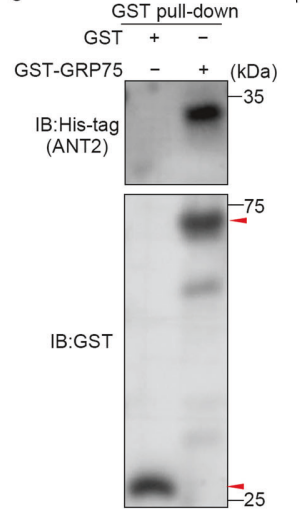
Anti-GST Magnetic Beads purchased from MedChemExpress. Usage Cited in: Signal Transduct Target Ther. 2024 Sep 26;9(1):253. [Abstract]
Immunoblotting with anti-GST antibodies was used to detect the binding of recombinant His-ANT2 to GST-GRP75.
-
Cancer CellPDGFRα+ITGA11+ fibroblasts foster early-stage cancer lymphovascular invasion and lymphatic metastasis via ITGA11-SELE interplay. [Abstract]2024 Apr 8;42(4):682-700.e12. PMID: 38428409
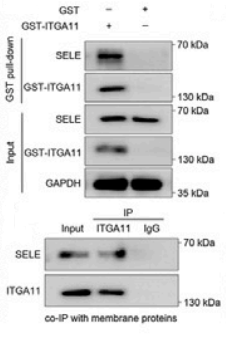
Anti-GST Magnetic Beads purchased from MedChemExpress. Usage Cited in: Cancer Cell. 2024 Apr 8;42(4):682-700.e12. [Abstract]
Heatmap showing the potential ITGA11 binding proteins from quantitative proteomics of GST pull-down.
-
Cell Host MicrobeBacteroides fragilis promotes chemoresistance in colorectal cancer, and its elimination by phage VA7 restores chemosensitivity. [Abstract]2025 Jun 11;33(6):941-956.e10. PMID: 40446807
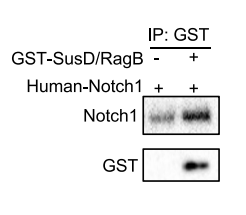
Anti-GST Magnetic Beads purchased from MedChemExpress. Usage Cited in: Cell Host Microbe. 2025 Jun 11;33(6):941-956.e10. [Abstract]
Recombinant human Notch1 can be pulled down by GST-SusD/RagB as determined by GST pull-down assay.
-
Cell Host MicrobePeptostreptococcus stomatis promotes colonic tumorigenesis and receptor tyrosine kinase inhibitor resistance by activating ERBB2-MAPK. [Abstract]2024 Aug 14;32(8):1365-1379.e10. PMID: 39059397
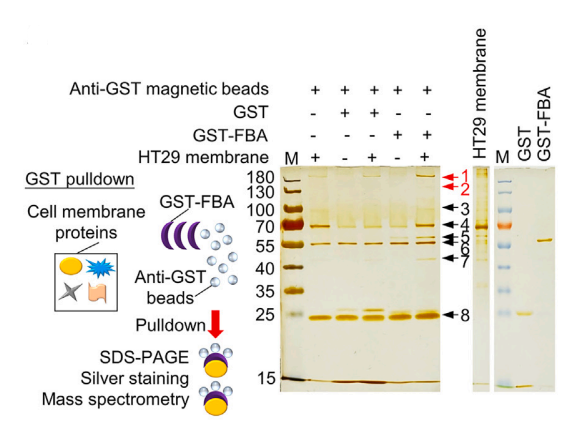
Anti-GST Magnetic Beads purchased from MedChemExpress. Usage Cited in: Cell Host Microbe. 2024 Aug 14;32(8):1365-1379.e10. [Abstract]
GST pull-down assay for identifying cell membrane receptors for FBA.
-
Cell Host MicrobeMycobacterium tuberculosis suppresses host DNA repair to boost its intracellular survival. [Abstract]2023 Nov 8;31(11):1820-1836.e10. PMID: 37848028
-
Nat Cell Biol2025 Apr;27(4):641-653. PMID: 40033101
-
Cell Death Dis2026 Mar 23;17(1):350. PMID: 41872158
-
Cell Death Dis2025 Nov 28;16(1):864. PMID: 41315219
-
Int J Biol Sci2026 Jan 1;22(2):1036-1052. PMID: 41522346
-
OncogeneUSP33 facilitates the ovarian cancer progression via deubiquitinating and stabilizing CBX2. [Abstract]2024 Oct;43(43):3170-3183. PMID: 39256572
-
OncogeneGSK3β and UCHL3 govern RIPK4 homeostasis via deubiquitination to enhance tumor metastasis in ovarian cancer. [Abstract]2024 Jun;43(25):1885-1899. PMID: 38664501
-
New PhytolPhosphorylation of the strawberry MADS-box CMB1 regulates ripening via the catabolism of abscisic acid. [Abstract]2025 May;246(4):1627-1646. PMID: 40172024
-
Stem Cell Rev RepHucMSCs-derived Exosomes Promote Lung Development in Premature Birth via Wnt5a/ROCK1 Axis. [Abstract]2025 Feb;21(2):520-535. PMID: 39565502
-
J Biol ChemSerine/threonine-protein kinase STK24 induces tumorigenesis by regulating the STAT3/VEGFA signaling pathway. [Abstract]2023 Mar;299(3):102961. PMID: 36720310
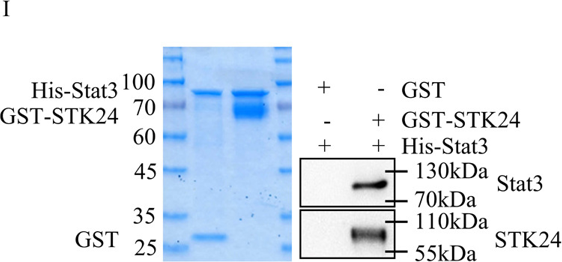
Anti-GST Magnetic Beads purchased from MedChemExpress. Usage Cited in: J Biol Chem. 2023 Mar;299(3):102961. [Abstract]
the direct binding of GST-STK24 and His-STAT3 was investigated by GST-pull down assays in HEK293T cells.
-
ChemMedChem2023 Aug 15;18(16):e202300272. PMID: 37269475
Storage
Stored at 4°C, and is stable for up to 2 years.
Do not centrifuge, dry or freeze the magnetic beads.


Components
| Components | HY-K0222- 1 mL | HY-K0222- 5 mL |
|---|---|---|
| Anti-GST Magnetic Beads | 1 mL | 1 mL × 5 |


 Please enter the correct Lot Number