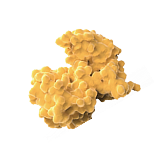
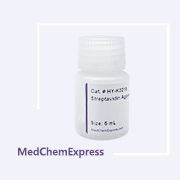
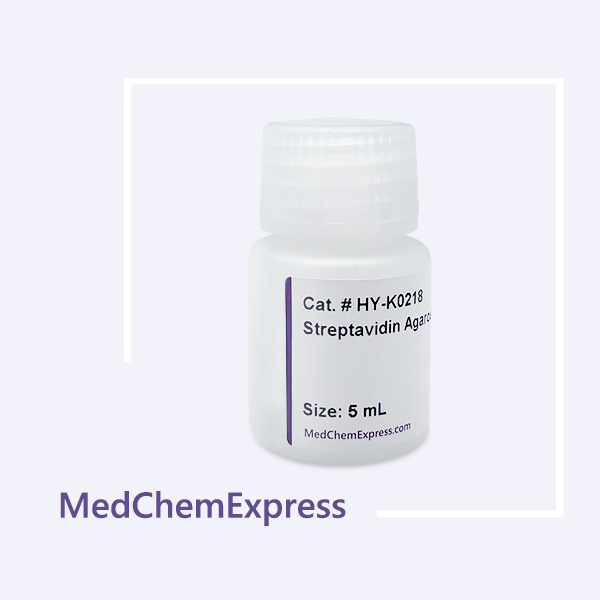
Streptavidin Agarose 6FF
Based on 13 publication(s) in Google Scholar
MCE Streptavidin Agarose 6FF, a 6% highly cross-linked agarose reagent coupled with recombinant streptavidin, is an affinity chromatography medium for separation and purification of biotinylated peptides, antibodies, lectins, etc. The total binding capacity of Streptavidin Agarose 6FF is more than 200 nmol of D-Biotin/mL settled resin.
-
Storage :
2-8°C, 2 years. Do not dry or freeze.

To place orders, for customer services and technical support, please contact: MedChemExpress USA
Tel: 609-228-6898 E-mail: [email protected] [email protected]



-
HY-K0208
Streptavidin Magnetic Beads -
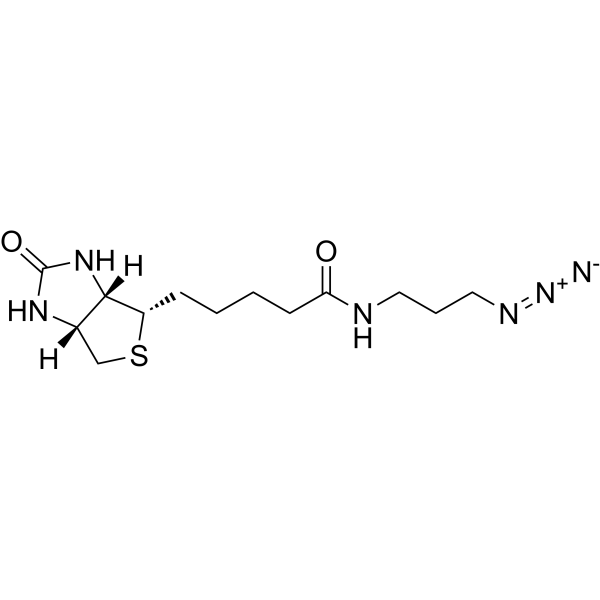
HY-129832
Biotin-azide -
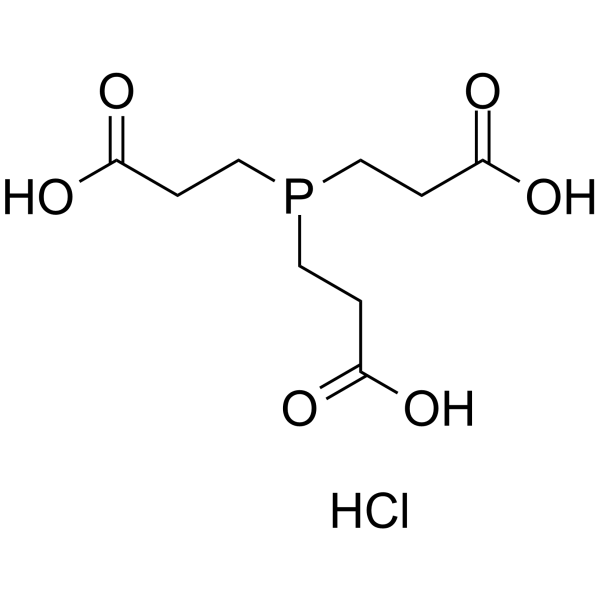
HY-W011500
TCEP hydrochloride -
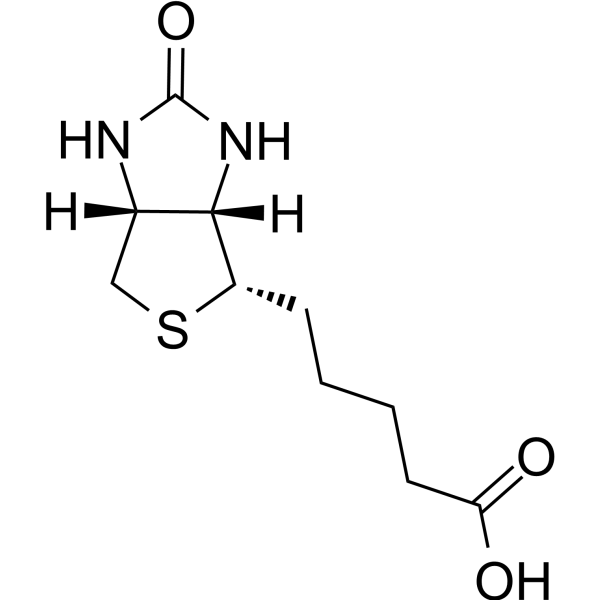
HY-B0511
Biotin -
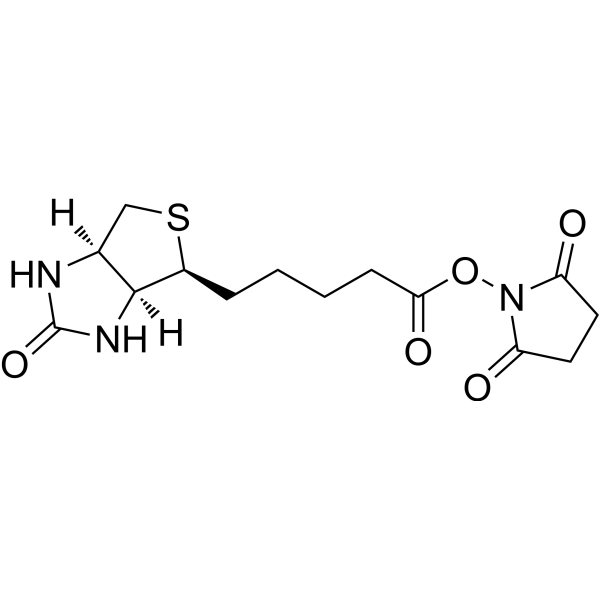
HY-D0802
Biotin NHS -
HY-K0010
Protease Inhibitor Cocktail (EDTA-Free, 100× in DMSO) -
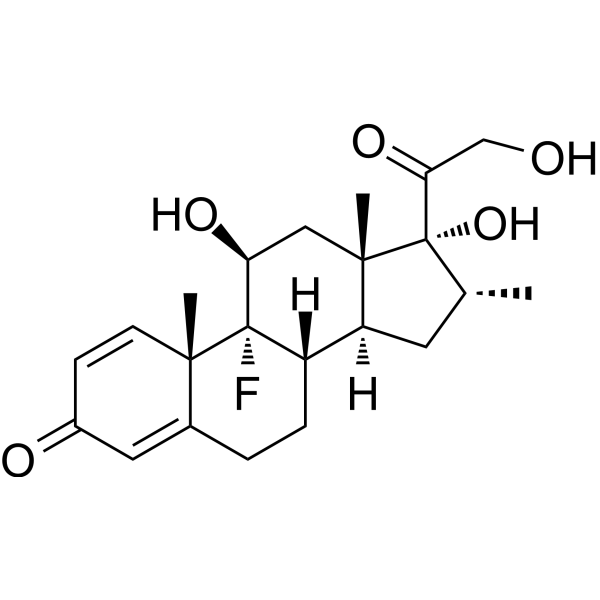
HY-14648
Dexamethasone -
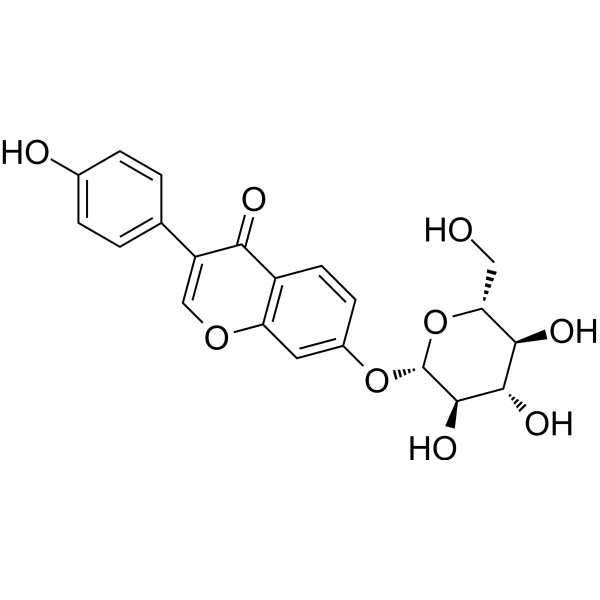
HY-N0018
Daidzin -
HY-K0210
Ni-NTA His-Tag Purification Agarose -
HY-136769
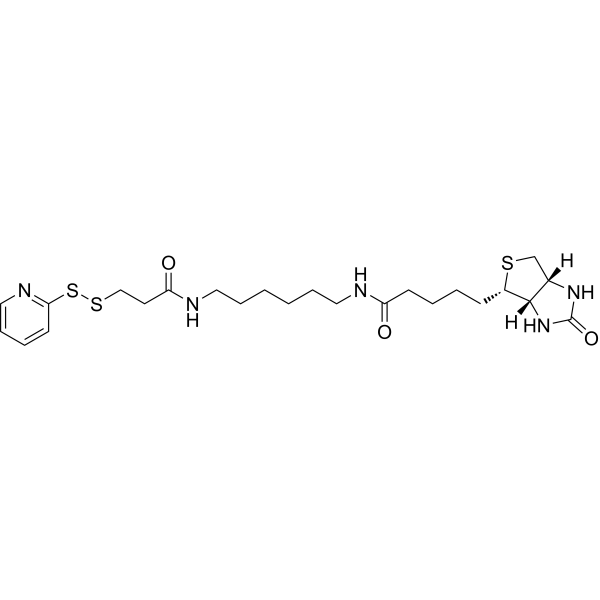
Biotin-HPDP -
HY-K0202
Protein A/G Magnetic Beads -
HY-K0011
Protease Inhibitor Cocktail, mini-Tablet (EDTA-Free)


Description & Advantages
Streptavidin, isolated from Streptomyces avidinii, binds 4 moles of biotin per mole of protein with an extremely high affinity. With no carbohydrate group and an isoelectric point of 6.5 (different from avidin), streptavidin has less nonspecific binding. Streptavidin has a strong affinity with biotin and needs to be eluted under denaturing conditions when purified. However, streptavidin has a relatively weak affinity for iminobiotin, which binds at pH 9.5-11.0 and elutes at pH 4.0 without the use of denaturing agents.
| Characteristics | |
|---|---|
| Composition | 6% cross-linked agarose |
| Ligand | Streptavidin |
| Bead Diameter | > 45-165 μm |
| Binding Capacity | > 200 nmol of D-Biotin/mL Settled Resin |
| Maximum Pressure | 0.3 MPa, 3 bar |
| pH stability range | 4.0-9.0 |
The specifications of the product correspond to the actual resin volume, with the resin content of 50%.


Protocol
1. Recommended Buffers (Not Provided)
| Purification Type | Buffer | Composition |
|---|---|---|
| Purification of Biotin or Biotinylated Substances | Equilibration/Wash Buffer | 20 mM NaH2PO4, 0.15 M NaCl, pH 7.4 |
| Elution Buffer | 8 M guanidine hydrochloride, pH 1.5 | |
| Purification of Iminobiotin-Tagged Substances | Equilibration/Wash Buffer | 50 mM ammonium carbonate, 0.5 M NaCl, pH 10.0 |
| Elution Buffer | 50 mM ammonium carbonate, 0.5 M NaCl, pH 4.0 |
Note: It is recommended to prepare the buffers using high-purity water and sterilize them by filtration through a 0.45 μm membrane after preparation.
2. Sample Preparation
1) Before loading the sample onto the column, centrifuge the sample or filter it through a 0.22 μm or 0.45 μm membrane to reduce impurities and prevent column clogging.
2) Before loading, dilute or dialyze samples such as serum, ascites, or cell culture medium against the equilibration/wash buffer to ensure that the sample solution has an appropriate ionic strength and pH.
3. Packing of Streptavidin Agarose 6FF
Before use, thoroughly resuspend and mix the Streptavidin Agarose 6FF before pipetting.
3.1 Packing a Gravity-Flow Column
Rinse the upper and lower column frits before using the gravity-flow column.
1) Select a gravity-flow chromatography column of an appropriate size and install the lower frit. Rinse the column and frit with ddH2O, and then close the bottom outlet.
2) Transfer an appropriate volume of the Streptavidin Agarose 6FF suspension into the gravity-flow column. Open the bottom outlet and allow the storage solution to drain completely.
Notes:
a) Monitor the flow rate of the storage solution and add additional Streptavidin Agarose 6FF to the column in time, if necessary.
b) Avoid the formation of gaps within the packed resin.
3) Add an appropriate volume of ddH2O to wash the resin. After the liquid in the column has drained completely, close the bottom outlet.
4) Install the pre-rinsed upper frit into the column.
Note: Avoid leaving gaps between the frit and the packed resin.
5) The packed gravity-flow column can be equilibrated directly with equilibration buffer. If the column will not be used immediately, add storage solution containing 20% ethanol in 1× PBS and store it at 2-8°C.
3.2 Packing a Medium-Pressure Chromatography Column
This product is also suitable for use with various medium-pressure chromatography columns. Before packing, calculate the cross-sectional area of the column according to the column radius, and calculate the required resin volume according to the desired packed-bed height using the following equation:
V = 1.15πr2h
V: Required resin volume, mL
1.15: Compression factor
r: Column radius, cm
h: Desired packed-bed height, cm
Note: The settled resin accounts for half of the total suspension volume. Therefore, the required suspension volume should be twice the calculated resin volume.
Pack the medium-pressure chromatography column according to the following procedure:
1) Rinse the column frit and connectors with ddH2O. Ensure that no air bubbles remain on the bottom frit, close the bottom outlet, and leave 1-2 cm of ddH2O at the bottom of the column.
2) Thoroughly mix the Streptavidin Agarose 6FF and carefully pour the suspension continuously into the chromatography column.
Note: Pouring the suspension along the column wall with the aid of a glass rod can reduce bubble formation.
3) If a reservoir is used, immediately fill both the chromatography column and reservoir with water. Position the flow adaptor on the surface of the suspension and connect it to the pump.
Note: Avoid introducing air bubbles into the flow adaptor or sample tubing.
4) Connect the chromatography column to the pump, open the bottom outlet, and start the pump at a flow rate of approximately 0.5-1 mL/min. The flow rate may be adjusted as appropriate. Initially allow the buffer to flow slowly through the column, and then gradually increase it to the final flow rate. This helps prevent hydraulic pressure from disturbing the packed bed and reduces uneven bed formation. Once the packed-bed height has stabilized, pass at least 3 packed-bed volumes of ddH2O through the column at the final packing flow rate. Mark the packed-bed height.
Notes:
a) If the recommended pressure or flow rate cannot be achieved, the maximum flow rate of the pump may be used to obtain satisfactory packing performance.
b) During chromatography, the buffer flow rate should not exceed 75% of the maximum packing flow rate.
5) Stop the pump and close the column outlet.
6) If a reservoir is used, remove the reservoir and place the flow adaptor into the chromatography column.
7) Push the flow adaptor down to the marked packed-bed height. Allow liquid from the column to enter the adaptor, and then tighten the adaptor connector.
8) Connect the packed chromatography column to the pump or chromatography system and equilibrate the column.
Note: The position of the flow adaptor may be readjusted as needed.
4. Sample Purification
Sample purification can be performed using the centrifugation method, gravity-flow column method, or medium-pressure chromatography column method.
4.1 Centrifugation Method
1) According to the amount of sample to be purified, transfer an appropriate volume of the Streptavidin Agarose 6FF suspension into a centrifuge tube. Centrifuge at 1,000 rpm for 1 min and discard the supernatant.
2) Add 5 settled-resin volumes of equilibration buffer, centrifuge at 1,000 rpm for 1 min, and discard the supernatant. Repeat the washing step twice.
3) Add the sample, close the centrifuge tube, and incubate at 4°C for 2-4 h or at 37°C for 0.5-2 h.
4) After incubation, centrifuge at 1,000 rpm for 1 min and discard the supernatant. The supernatant may be retained as the flow-through fraction for electrophoretic analysis.
5) Wash the resin with 5 settled-resin volumes of wash buffer. Centrifuge at 1,000 rpm for 1 min and discard the supernatant. Repeat the washing step 3-5 times.
Note: Avoid aspirating the resin when removing the supernatant. It is recommended to transfer the resin to a new EP tube during the washing procedure.
6) Elute with 3-5 settled-resin volumes of elution buffer. Incubate at room temperature for 5 min and centrifuge at 1,000 rpm for 1 min. The elution step may be repeated 2-3 times.
7) Wash the resin with 5-10 settled-resin volumes of equilibration buffer, followed by 5-10 settled-resin volumes of ddH2O. Finally, wash with 2 settled-resin volumes of 20% ethanol and store at 2-8°C.
4.2 Gravity-Flow Column Method
1) Column Equilibration: Equilibrate the packed Streptavidin Agarose 6FF gravity-flow column with 5 column volumes of equilibration buffer. Repeat the equilibration step 2-3 times.
2) Sample Loading: After adding the sample, allow it to remain in the column for at least 2 min to ensure sufficient contact between the sample and the resin. Collect the flow-through.
Note: Repeated sample loading can improve binding efficiency.
3) Washing: Wash the column with 10-15 column volumes of wash buffer to remove nonspecifically adsorbed contaminating proteins. Collect the wash fraction.
4) Elution: Elute with 5-10 column volumes of elution buffer. Collect the eluate in separate fractions, with each tube containing one column volume, and analyze each fraction separately. This helps ensure complete elution of the target protein while maintaining an appropriate protein concentration and purity.
5) Wash the resin with 5-10 column volumes of equilibration buffer, followed by 5-10 column volumes of ddH2O. Finally, wash with 2 column volumes of 20% ethanol and store at 2-8°C.
4.3 Medium-Pressure Chromatography Column Method
1) Fill the pump tubing with ddH2O. Remove the upper stopper, connect the chromatography column to the chromatography system, open the bottom outlet, connect the prepacked column to the system, and tighten the connection.
2) Wash the column with 3-5 column volumes of ddH2O.
3) Equilibrate the chromatography column with ≥5 column volumes of equilibration buffer.
4) Load the sample using a pump or sample loop.
Notes:
a) Do not exceed the binding capacity of the column.
b) Increased sample viscosity or volume may cause increased back pressure in the chromatography column.
5) Wash the column with ≥10-15 column volumes of wash buffer until the UV absorbance reaches a stable baseline.
6) Elute with 5-10 column volumes of elution buffer. The collected eluate contains the target protein.
7) Wash the resin with 5-10 column volumes of equilibration buffer, followed by 5-10 column volumes of ddH2O. Finally, wash with 2 column volumes of 20% ethanol and store at 2-8°C.
5. SDS-PAGE Analysis
Evaluate the purification efficiency by SDS-PAGE using the original sample, flow-through fraction, wash fraction, and elution fraction.
Note: Guanidine hydrochloride is highly charged and can neutralize the charge contributed by SDS. It may therefore affect the charge of proteins in the loading buffer and cause precipitation during electrophoresis. The samples may be treated by dialysis or salting-out. For dialysis, place the sample in a dialysis bag and use PBS as the dialysis buffer. Dialyze twice for 1 h each time. A dialysis-buffer volume 100 times the sample volume is recommended. To reduce protein precipitation caused by rapid changes in pH, 1 M Tris, pH 9.0, may be added to neutralize the sample.
6. Resin Cleaning
This product can be reused without regeneration. However, as nonspecifically bound proteins and protein aggregates accumulate, the binding capacity and flow rate of the resin may decrease significantly. The resin should therefore be cleaned according to the following methods:
| Cleaning Purpose | Cleaning Method |
|---|---|
| Removal of Precipitates or Denatured Substances | Wash with 2 column volumes of 0.1 M NaOH, 6 M guanidine hydrochloride, or 8 M urea, and then immediately wash with 5 column volumes of PBS, pH 7.4. |
| Removal of Nonspecifically Adsorbed Substances (Hydrophobic Adsorption) | Wash with 3-4 column volumes of 70% ethanol or 2 column volumes of 1% Triton X-100, and then immediately wash with 5 column volumes of PBS, pH 7.4. |


Publications
-
Journal Impact Factor
-
Most Recent
-
Acta Pharm Sin BInsights into SARS-CoV-2 replication control via targeting the host hijacking function of NSP12. [Abstract]2026 Jul;16(7):4410-4425. PMID: 42453420
-
PLoS PathogA novel SO2 probe inhibits lysophagy induced by Senecavirus A infection by promoting LAMP1 Cys375 sulfenylation. [Abstract]2026 Feb 5;22(2):e1013932. PMID: 41642933
-
J Biol ChemA conserved salt bridge network stabilizes the hepatic organic anion transporters OATP1B1 and OATP1B3. [Abstract]2026 Jan 28;302(3):111217. PMID: 41617032
Storage
2-8°C, 2 years.
Do not dry or freeze.


Components
| Components | HY-K0218A-5 mL | HY-K0218A-10 mL | HY-K0218A-50 mL |
|---|---|---|---|
| Streptavidin Agarose 6FF | 5 mL | 10 mL | 50 mL |


 Please enter the correct Lot Number