Human Colorectal Cancer Organoid Kit

Based on 1 Customer Validation
MCE Human Colorectal Cancer Organoid Kit contains Colorectal Cancer Organoid Basal Medium A, Colorectal Cancer Organoid Supplement B (50×), Colorectal Cancer Organoid Supplement C (250×). This product can be used to efficiently construct human colorectal cancer organoid.
-
Storage :
Basal Medium A : 4℃, 1 year. Shipping with blue ice. Supplement B (50×) & Supplement C (250×) : -20°C, 1 year. Avoid repeated freeze/thaw cycles. Shipping with dry ice.


To place orders, for customer services and technical support, please contact: MedChemExpress USA
Tel: 609-228-6898 E-mail: [email protected] [email protected]






Description & Advantages
MCE Human Colorectal Cancer Organoid Kit contains Colorectal Cancer Organoid Basal Medium A, Colorectal Cancer Organoid Supplement B (50×), Colorectal Cancer Organoid Supplement C (250×). This product can be used to efficiently construct human colorectal cancer organoid.
The organoid of colorectal cancer can highly simulate the tumor microenvironment of colorectal cancer, which facilitates the observation of the growth and proliferation of colorectal cancer cells and can be used to track the changes of tumor cells under the action of drugs and screen the efficacy and toxicity of drugs.


Protocol
1. Preparation of Complete Culture Medium for Colorectal Cancer
Prepare the complete organoid medium according to the components below, mix thoroughly, and keep on ice. Perform all steps under sterile conditions.
| Reagent | 10 mL | 20 mL | Final concentration |
|---|---|---|---|
| Colorectal Cancer Organoid Basal Medium A | 9.76 mL | 19.52 mL | 1× |
| Colorectal Cancer Organoid Culture Supplement B (50×) | 200 μL | 400 μL | 1× |
| Colorectal Cancer Organoid Culture Supplement C (250×) | 40 μL | 80 μL | 1× |
2. Extraction of Tumor Cells from Primary Tissues
a. Soak freshly extracted tumor tissue in pre-cooled primary tissue storage solution and store temporarily at 4°C.
b. Under aseptic conditions, rinse with Colorectal Cancer Organoid Basal Medium A or PBS and remove non-epithelial components such as fat or muscle.
c. Cut the tissue into pieces approximately 1-2 mm in diameter and transfer them to a 15 mL conical tube using a 1 mL pipette tip.
d. Add an appropriate amount of tumor tissue dissociation solution, with the volume not exceeding two-thirds of the conical tube. Incubate on a horizontal shaker at 37°C for 0.5-1 h until most tissue fragments can be aspirated with a 1 mL pipette tip.
e. Add FBS to a final concentration of 2% to terminate digestion and filter through a 100 μm cell strainer on ice.
f. Centrifuge at 250 × g for 3 min at 4°C and collect the cell pellet. If the pellet appears red, remove the supernatant, gently resuspend in 1-2 mL red blood cell lysis buffer, lyse for 1 min at room temperature, and centrifuge again at 250 × g for 3 min at 4°C.
g. Resuspend the pellet in an appropriate amount of Colorectal Cancer Organoid Basal Medium A, centrifuge at 250 × g for 3 min at 4°C, and repeat the wash 1-2 times.
3. Construction of Organoid
a. Keep the entire procedure on ice. Resuspend the collected tumor cells in MCE Basement Membrane Matrix at a recommended density of 4 × 10⁴ cells/100 μL. Use 100% Basement Membrane Matrix when possible. If dilution is required, keep the Basement Membrane Matrix-to-organoid-medium volume ratio > 2 : 1.
b. Using a pre-wetted 200 μL pipette tip, quickly dispense 25-35 μL of the matrix/cell suspension per well into a 24-well plate, avoiding bubbles. Incubate at 37°C with 5% CO2 for 15-30 min until gelled.
c. After gelation, slowly add 500 μL Colorectal Cancer Organoid Complete Medium along the wall of each well without disrupting the gel and continue incubation at 37°C with 5% CO2.
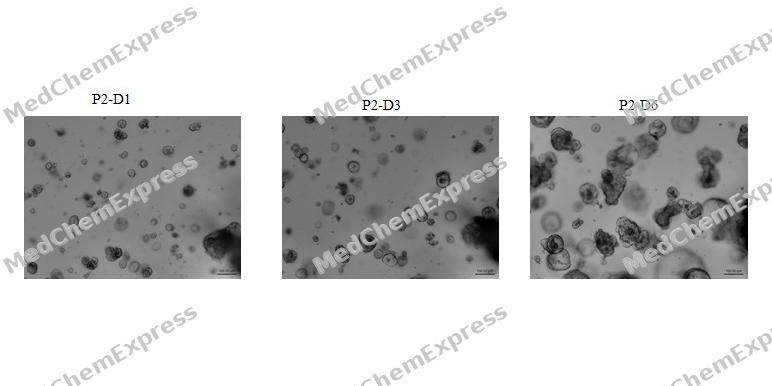
d. Replace 500 μL pre-warmed Colorectal Cancer Organoid Complete Medium every 3-4 days. Organoids are typically visible within 7-10 days.
4. Organoid Passages
a. When organoids reach >200 μm or become darkened, aspirate the upper medium and add 500 μL Colorectal Cancer Organoid Basal Medium A. Detach the well contents using a cell scraper or 1 mL pipette tip and transfer to a 1.5 mL tube.
b. Gently pipette until the organoids separate from the Basement Membrane Matrix. Centrifuge at 250-300 × g for 3 min at room temperature and collect the pellet.
c. Add 1 mL Colorectal Cancer Organoid Basal Medium A and gently pipette to disperse organoids into fragments. If dissociation is difficult, add 0.2-0.5 mL organoid dissociation solution and incubate at 37°C until clusters of approximately 10-50 cells are obtained. Limit digestion to ≤5 min and terminate with 5 mL Colorectal Cancer Organoid Basal Medium A.
d. Centrifuge at 250-300 × g for 3 min at room temperature, discard the supernatant, and wash 1-2 times with Colorectal Cancer Organoid Basal Medium A or PBS.
e. Resuspend on ice in Basement Membrane Matrix at 4 × 10⁴ cells/100 μL. If dilution is required, maintain a Basement Membrane Matrix-to-organoid-medium ratio > 2 : 1.
f. Dispense 25-35 μL per well into a 24-well plate using a pre-wetted 200 μL pipette tip, avoiding bubbles. Incubate at 37°C with 5% CO2 for 15-30 min until gelled.
g. Slowly add 500 μL Colorectal Cancer Organoid Complete Medium per well and continue culture.
h. Replace 500 μL pre-warmed Colorectal Cancer Organoid Complete Medium every 3-4 days.
Storage
Basal Medium A : 4℃, 1 year. Shipping with blue ice.
Supplement B (50×) & Supplement C (250×) : -20°C, 1 year. Avoid repeated freeze/thaw cycles. Shipping with dry ice.


Components
| Cat. No. | Components | HY-K6104-100 mL | HY-K6104-500 mL |
|---|---|---|---|
| HY-K6104-A | Human Colorectal Cancer Organoid Basal Medium A | 100 mL | 500 mL |
| HY-K6104-B | Human Colorectal Cancer Organoid Supplement B (50×) | 1 mL × 2 | 10 mL |
| HY-K6104-C | Human Colorectal Cancer Organoid Supplement C (250×) | 0.4 mL | 1 mL × 2 |


 Please enter the correct Lot Number