



Plasminogen/Plasmin
Plasmin, the proteolytically active form of plasminogen, utilizes fibrin contained within clots as a substrate for proteolysis, producing soluble products and thus maintaining the patency within the vascular system. The precursor to plasmin, plasminogen, serves as zymogen produced by the liver circulates throughout the endovascular network, and participates in the fibrinolytic pathway, serving as both a catalytic enzyme to initiate the process of fibrinolysis, as well as a substrate, which once cleaved to become plasmin, continues on the process of fibrinolysis at an accelerated rate.
All Product Categories
-
Plasminogen/Plasmin Related Products (15)
Related Products (15)

- 1
-
6-Aminocaproic acid
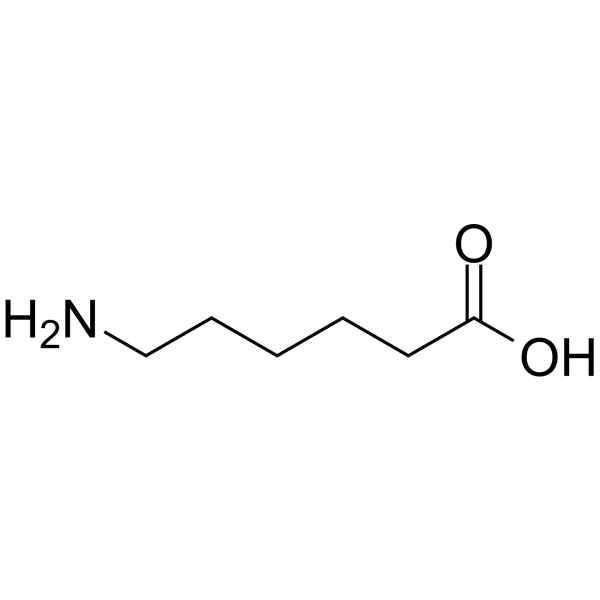 0 ImagesSynonyms: EACA; Epsilon-Amino-n-caproic Acid; 6-Aminohexanoic acid6-Aminocaproic acid (EACA), a monoamino carboxylic acid, is a potent and orally active inhibitor of plasmin and plasminogen. 6-Aminocaproic acid is a potent antifibrinolytic agent. 6-Aminocaproic acid prevents clot lysis through the competitive binding of lysine residues on plasminogen, inhibiting plasmin formation and reducing fibrinolysis. 6-Aminocaproic acid can be used for the research of bleeding disorders.
-
Tenecteplase
 0 ImagesCat. No.: HY-108845CAS No.: 191588-94-0Synonyms: TNK-tPATenecteplase (TNK-tPA) is a modified tissue plasminogen activator. Tenecteplase is a recombinant human tissue plasminogen activator (rt-PA) that has been bioengineered to produce mutations in three gene loci. Tenecteplase (TNK-tPA) can be used in the study of acute ischemic stroke.
-
Orniplabin
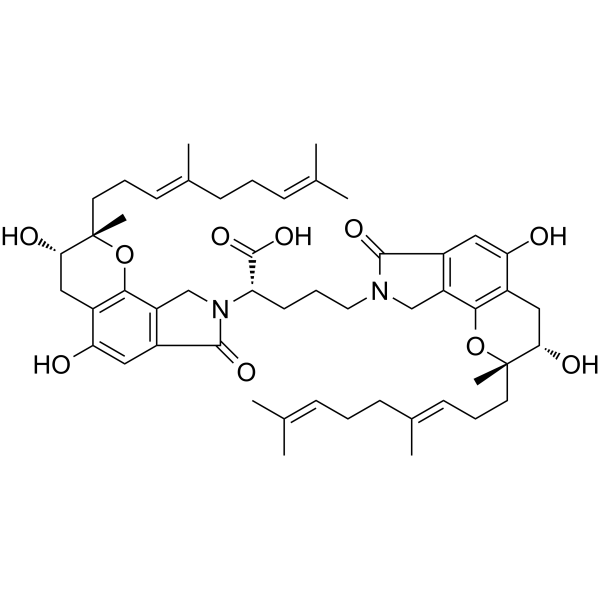 0 ImagesCat. No.: HY-122311CAS No.: 733805-92-0Synonyms: SMTP-7Orniplabin (SMTP-7) is a plasminogen modulator with a human EC50 of 65 μM. Orniplabin enhances activation of plasminogen by plasminogen activators and increases fibrin-binding of plasminogen. Orniplabin elevates plasma levels of plasmin-α2-antiplasmin complex in vivo. Orniplabin can be used for the research of pulmonary embolism, thrombotic stroke.
-
H-D-Val-Leu-Lys-AFC
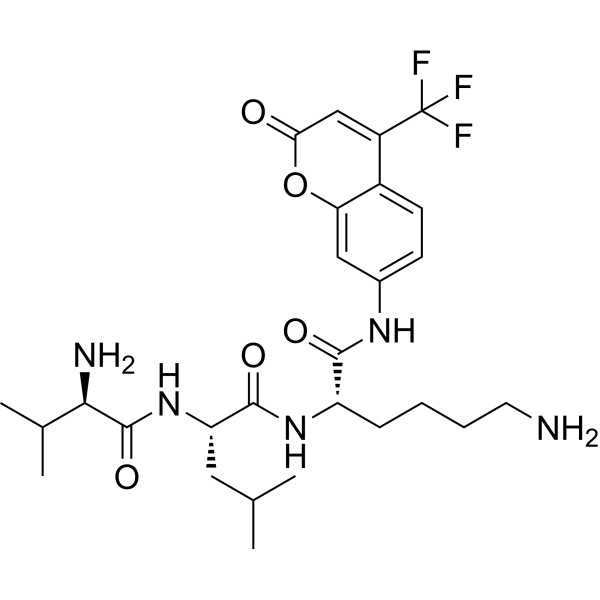 0 ImagesCat. No.: HY-P5356CAS No.: 97055-77-1Synonyms: Plasmin substrateH-D-Val-Leu-Lys-AFC (Plasmin substrate) is a plasmin-specific fluorescent substrate. H-D-Val-Leu-Lys-AFC can be cleaved to generate a fluorescent signal, which is used to determine plasmin activity. Abs/Em=380/500 nm.
-
D-Val-Gly-Arg-pNA acetate
 0 ImagesCat. No.: HY-P10005APurity: 99.90%D-Val-Gly-Arg-pNA acetate is a chromogenic substrate of TPA (tissue plasminogen activator). D-Val-Gly-Arg-pNA can be used to detect the amidolytic activity of TPA I and TPA II.
-
D-Val-Gly-Arg-pNA
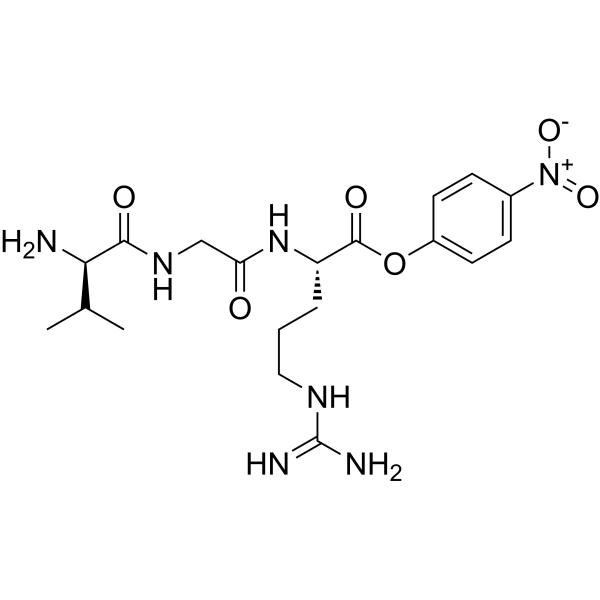 0 ImagesCat. No.: HY-P10005CAS No.: 80798-23-8D-Val-Gly-Arg-pNA is a chromogenic substrate of TPA (tissue plasminogen activator). D-Val-Gly-Arg-pNA can be used to detect the amidolytic activity of TPA I and TPA II.
-
JTV-803
 0 ImagesCat. No.: HY-187960CAS No.: 247131-06-2JTV-803 is a selective and competitive direct factor Xa (FXa) inhibitor with a Ki of 19 nM and an IC50 of 81 nM against human FXa, and its action is independent of antithrombin III (ATIII). JTV-803 exhibits significantly higher selectivity for human FXa than for thrombin, plasmin, and trypsin. JTV-803 produces sustained ex vivo anti-FXa inhibitory activity in vivo. JTV-803 prolongs aPTT and PT, prevents dialyzer thrombosis, and is cleared during dialysis. JTV-803 dose-dependently attenuates coagulation activation, maintains plasma ATIII activity, reduces glomerular fibrin deposition, and improves survival rate. JTV-803 can be used for research related to thrombosis and hemodialysis anticoagulation.
-
H-D-Val-Leu-Lys-AFC TFA
 0 ImagesCat. No.: HY-P5356APurity: 98.79%Synonyms: Plasmin substrate TFAH-D-Val-Leu-Lys-AFC TFA (Plasmin substrate TFA) is a plasmin-specific fluorescent substrate. H-D-Val-Leu-Lys-AFC TFA can be cleaved to generate a fluorescent signal, which is used to determine plasmin activity. Abs/Em=380/500 nm.
-
Pexamsiran sodium
 0 ImagesCat. No.: HY-185319APexamsiran sodium is a siRNA that inhibits plasminogen synthesis reducer, and can be use for the study of hereditary haemorrhagic telangiectasia.
-
2-O-(2,4,6-Trihydroxyphenyl)-6,6'-bieckol
 0 ImagesCat. No.: HY-N18088CAS No.: 89079-38-92-O-(2,4,6-Trihydroxyphenyl)-6,6'-bieckol is a bisphenol compound and a serine protease inhibitor. 2-O-(2,4,6-Trihydroxyphenyl)-6,6'-bieckol exhibits inhibitory activities against α2-macroglobulin, α2-plasmin inhibitor and plasmin, with corresponding IC50 values of 1.9 μg/mL, 0.7 μg/mL and 13 μg/mL.
-
KLK6-IN-1
 0 ImagesCat. No.: HY-182600CAS No.: 2370980-52-0KLK6-IN-1 is a reversible small‑molecule inhibitor of KLK6, KLK1, and plasmin. KLK6-IN-1 shows IC50 values of 1.57 μM (KLK6), 5.1 μM (KLK1), 7.4 μM (plasmin), and Ki values of 0.8 μM (KLK6), 2.4 μM (KLK1), 1.3 μM (plasmin). KLK6-IN-1 is highly selective for KLK6 and its proteolytic network. KLK6-IN-1 induces oligodendrocyte differentiation by promoting oligodendrocyte precursor cell maturation. KLK6-IN-1 can be used for the research of multiple sclerosis.
-
Pexamsiran
 0 ImagesCat. No.: HY-185319CAS No.: 3056860-75-1Pexamsiran is a siRNA that inhibits plasminogen synthesis, and can be use for the study of hereditary haemorrhagic telangiectasia.
-
PSI-112
 0 ImagesCat. No.: HY-182565CAS No.: 1854997-77-5PSI-112 is a YO-class μPlm inhibitor, with IC50 values of 0.38 μM, 1.48 μM and 0.37 μM against the wild-type, F587A mutant and K607A mutant, respectively. PSI-112 shows low affinity for uPA. PSI-112 can be used in cancer research.
-
Pefabloc PL
 0 ImagesCat. No.: HY-183860CAS No.: 2131171-67-8Pefabloc PL is a plasmin inhibitor with submicromolar-range inhibitory activity against the trypsin-like serine protease plasmin.
-
GYKI-14451 sulfate
 0 ImagesCat. No.: HY-111318CAS No.: 83861-29-4GYKI-14451 sulfate is an inhibitor of thrombin and plasmin. GYKI-14451 sulfate inhibits thrombin-fibrinogen and plasmin-fibrin reactions. GYKI-14451 sulfate inhibits fibrin clot lysis and prolongs fibrin clot lysis time in a dose-dependent manner. GYKI-14451 sulfate does not undergo N-terminal cyclization and spontaneous inactivation in neutral aqueous buffer. GYKI-14451 sulfate can be used in studies related to venous thrombosis and fibrinogen solidification.
- 1



