Annexin V-FITC/PI Apoptosis Detection Kit
Based on 87 publication(s) in Google Scholar
MCE Annexin V-FITC/PI Apoptosis Detection Kit provides a rapid and convenient method to detect cell apoptosis and necrosis. After staining, live cells show little or no fluorescence (Annexin V-/PI-), early apoptosis cells show green fluorescence(Annexin V+/PI-), late apoptosis cells and necrosis cells show red and green fluorescence (Annexin V+/PI+).
-
Storage :
-20°C, 1 year. Protect from light. Avoid repetitive freeze-thaw cycles.



To place orders, for customer services and technical support, please contact: MedChemExpress USA
Tel: 609-228-6898 E-mail: [email protected] [email protected]



-

HY-K0301
Cell Counting Kit-8 -

HY-K1071
Cell Cycle and Apoptosis Analysis Kit (PI staining) -

HY-B0215
Acetylcysteine -

HY-15763
Erastin -

HY-K0601
JC-1 Mitochondrial Membrane Potential Assay Kit -

HY-D1055
MitoSOX Red -
HY-15534
JC-1 -

HY-K0320
ROS Assay Kit -

HY-K0314
ATP Assay Kit -

HY-17394
Cisplatin -

HY-K1090
Cytotoxicity LDH Assay Kit -

HY-K0010
Protease Inhibitor Cocktail (EDTA-Free, 100× in DMSO)


Description & Advantages
MCE Annexin V-FITC/PI Apoptosis Detection Kit provides a rapid and convenient method to detect cell apoptosis and necrosis. In normal live cells, Phosphatidylserine (PS) is located on the cytoplasmic surface of the cell membrane. Upon initiation of apoptosis, PS translocates from the inner to the outer leaflet of the membrane. Annexin V is a 35-36 kDa Ca2+- dependent phospholipid-binding protein that has a high affinity for PS. Annexin V labeled with green fluorescent FITC can identify apoptotic cells by binding to PS exposed on the outer leaflet. Propidium Iodide (PI) is a cell-membrane impermeable dye to live cells and early apoptosis cells, but stains late apoptosis cells and necrosis cells with red fluorescence. After staining, live cells show little or no fluorescence (Annexin V-/PI-), early apoptosis cells show green fluorescence (Annexin V+/PI-), late apoptosis cells and necrosis cells show red and green fluorescence (Annexin V+/PI+).


Protocol
1. Collect 1-5 × 10⁵ cells.
For suspension cells: Centrifuge at 1000 g for 5 minutes and then discard the supernatant. Add 1 mL of pre-cooled PBS to resuspend the cells, centrifuge at 1000 g for 5 minutes and then discard the supernatant.
For adherent cells: Collect the cell culture medium. Wash cells with PBS and add trypsin to dissociate cells. Add the medium and gently suspend the cells to make a single-cell suspension. Centrifuge at 1000 g for 5 minutes and then discard the supernatant. Add 1 mL of pre-cooled PBS to resuspend the cells, centrifuge at 1000 g for 5 minutes and then discard the supernatant.
Note: It is recommended to use trypsin containing no EDTA.
2. Resuspend the cells in 195 μL of Binding Buffer.
3. Add 5 μL of Annexin V-FITC.
4. Add 10 μL of PI Stain.
5. Incubate the cells at room temperature for 10-20 minutes in the dark.
6. Detection by flow cytometer
6.1 Analyze Annexin-FITC binding by flow cytometer (Ex = 488 nm; Em = 525 nm) using FITC signal detector (usually FL1) and PI staining by the phycoerythrin emission signal detector (usually FL2 or FL3).
Note: It is recommended to perform three controls: a: cells with no Annexin-FITC or PI; b: cells with only Annexin-FITC; c: cells with only PI.
6.2 Detection by fluorescence microscope
Fluorescence microscopy: Centrifuge the stained cells at 1,000 g for 5 min, discard the supernatant. Gently resuspend the cell pellet in 50–100 μL of Binding Buffer. Prepare a cell smear and observe and analyze the fluorescence signal using a fluorescence microscope. If using a microplate for observation, gently resuspend the cell pellet in an appropriate volume of Binding Buffer according to the type of microplate used (e.g., 200 μL for a 24-well plate). Transfer the cell suspension to the microplate and observe and analyze the fluorescence signal using a fluorescence microscope.


Publications
-
Journal Impact Factor
-
Most Recent
-
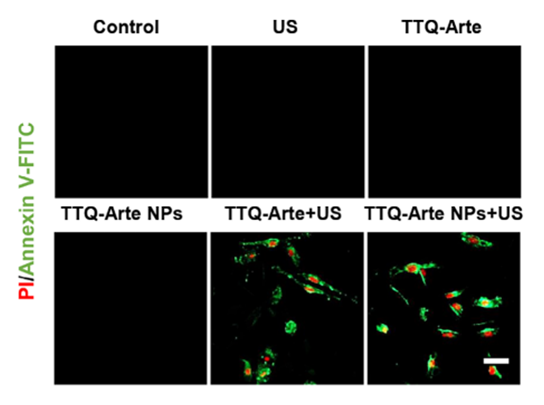
Annexin V-FITC/PI Apoptosis Detection Kit purchased from MedChemExpress. Usage Cited in: Adv Funct Mater. 2025 Jul 30.
Apoptosis fluorescence imaging of MDA-MB-231 cells after different treatments. Scale bar: 50 μm.
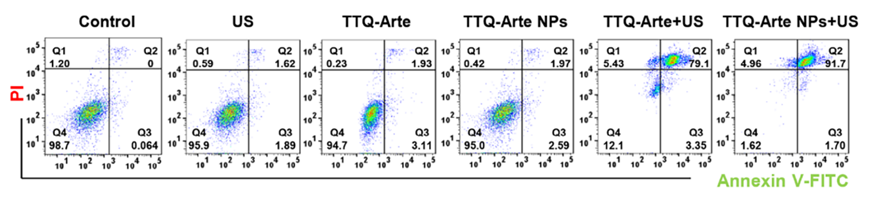
Annexin V-FITC/PI Apoptosis Detection Kit purchased from MedChemExpress. Usage Cited in: Adv Funct Mater. 2025 Jul 30.
Flow cytometry analysis of apoptosis in MDA-MB-231 cells after different treatments, with Annexin V-FITC fluorescence intensity on the x-axis and PI fluorescence intensity on the y-axis.
-
J Exp Clin Cancer ResOTULIN confers cisplatin resistance in osteosarcoma by mediating GPX4 protein homeostasis to evade the mitochondrial apoptotic pathway. [Abstract]2024 Dec 26;43(1):330. PMID: 39721999
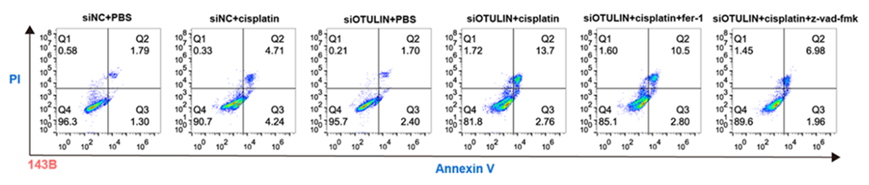
Annexin V-FITC/PI Apoptosis Detection Kit purchased from MedChemExpress. Usage Cited in: J Exp Clin Cancer Res. 2024 Dec 26;43(1):330. [Abstract]
Transfected 143B cells were pretreated with 10 μM fer-1 or Z-VAD-FMK for 1 h and then treated with cisplatin (10 μM) for 24 h; apoptosis levels were assessed by fow cytometry (n=3).
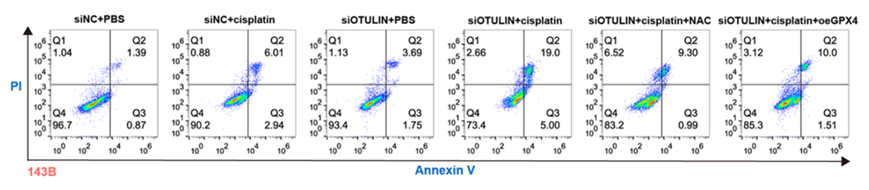
Annexin V-FITC/PI Apoptosis Detection Kit purchased from MedChemExpress. Usage Cited in: J Exp Clin Cancer Res. 2024 Dec 26;43(1):330. [Abstract]
Transfected 143B cells were pretreated with 10 μM NAC for 1 h and then treated with cisplatin (10 μM) for 24 h. Apoptosis levels were assessed via fow cytometry (n=3).
-
BiomaterialsExtracellular vesicles purified from serum-converted human platelet lysates offer strong protection after cardiac ischaemia/reperfusion injury. [Abstract]2024 Apr:306:122502. PMID: 38354518
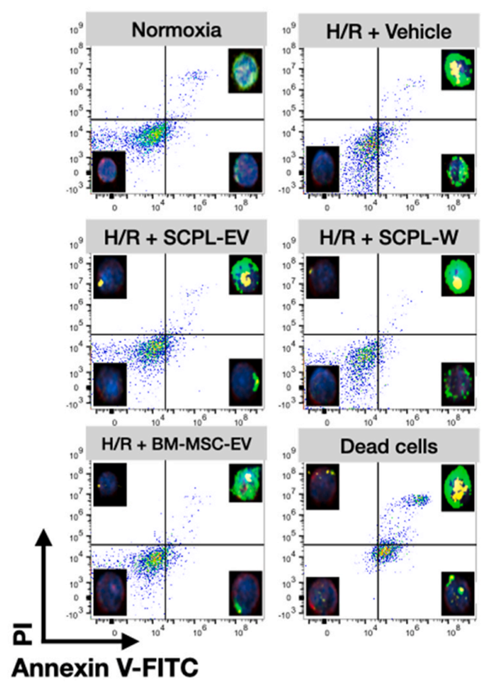
Annexin V-FITC/PI Apoptosis Detection Kit purchased from MedChemExpress. Usage Cited in: Biomaterials. 2024 Apr:306:122502. [Abstract]
Flow cytometric apoptosis analysis of 5/8H/R AC16 cells. The X axis shows Annexin-V-FITC and the Y axis shows PI. A representative cell image is shown for each quadrant.
-
Int J Biol MacromolUlva polysaccharide alleviates Parkinson's disease by regulating inflammation, oxidative damage, and gut microbiota. [Abstract]2025 Dec 28;339(Pt 1):149946. PMID: 41468939
-
J Med ChemDiscovery of Chromone Derivatives as Selective BLT1 Inhibitors for Alleviating Acute Lung Injury and Sepsis. [Abstract]2026 Feb 26;69(4):4361-4390. PMID: 41696851
-
Anal ChemA Novel Single-Molecule Fluorescence Lifetime Probe for Apoptosis Diagnosis Through Mitochondrial SO2 and DNA Co-Detection. [Abstract]2025 Aug 5;97(30):16439-16448. PMID: 40708524
-
J Med ChemDiscovery of Potent and Selective CDK4/6 Inhibitors for the Treatment of Chemotherapy-Induced Myelosuppression. [Abstract]2025 Jan 23;68(2):1446-1472. PMID: 39760276
-
CNS Neurosci TherRFWD2 Mitigates AD-Like Cognitive Impairments via the JNK-SGK1 Signaling Pathway in Mice. [Abstract]2026 Apr;32(4):e70860. PMID: 41954517
-
Mol Cell Proteomics2026 Apr 28:101573. PMID: 42061713
-
ACS Appl Nano MaterCholine Carboxylic Acid Ionic Liquid-stabilized Anisotropic Gold Nanoparticles for Photothermal Therapy. [Abstract]2024 Dec 13;7(23):26332-26343. PMID: 39935958
-
Clin Epigenetics2025 Jul 7;17(1):120. PMID: 40624511
-
Int J Mol SciBaicalin Inhibits FIPV Infection In Vitro by Modulating the PI3K-AKT Pathway and Apoptosis Pathway. [Abstract]2024 Sep 14;25(18):9930. PMID: 39337417
-
NanoscaleInfluence of microenvironmental viscosity on the cellular uptake of Fe3O4 nanoparticles and their anticancer effect. [Abstract]2026 May 28;18(20):10691-10702. PMID: 42047011
-
MoleculesMolecular Mechanisms Underlying the Anti-Tumor Activity of Lotus-Derived Alkaloids in Breast Cancer. [Abstract]2026 Mar 12;31(6):947. PMID: 41900047
-
Oncol ResMINDY1 Induces PD-L1 Deubiquitination to Promote Immune Escape in Hepatocellular Carcinoma by the Wnt/β-Catenin Pathway. [Abstract]2025 Oct 22;33(11):3583-3603. PMID: 41179305
-
Exp Cell ResLow extracellular pH enhances TRAIL-induced apoptosis by downregulating Mcl-1 expression. [Abstract]2025 Apr 1;447(1):114481. PMID: 40024506
-
Tissue Cell2023 Jun:82:102080. PMID: 36996719
-
Int J HyperthermiaThe efficacy of hyperthermia-based multimodal therapy is dependent on gatekeeper protein, BID. [Abstract]2025 Dec;42(1):2544017. PMID: 40787732
-
PLoS OneMitochondria-related genes as prognostic signature of endometrial cancer and the effect of MACC1 on tumor cells. [Abstract]2025 May 12;20(5):e0323002. PMID: 40354443
-
Biomol BiomedmiR-149-3p targeting TMPRSS4 regulates the sensitivity to cisplatin to inhibit the progression of lung cancer. [Abstract]2024 Dec 11;25(1):165-176. PMID: 39388706
-
Georg Thieme Verlag KG
Storage
-20°C, 1 year.
Protect from light.
Avoid repetitive freeze-thaw cycles.


Components
| Components | HY-K1073-20 T | HY-K1073-50 T | HY-K1073-100 T |
|---|---|---|---|
| Annexin V-FITC | 100 μL | 250 μL | 500 μL |
| Binding Buffer | 12 mL | 30 mL | 60 mL |
| PI Stain | 220 μL | 550 μL | 1.1 mL |


 Please enter the correct Lot Number