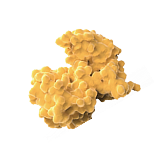
Basement Membrane Matrix
Based on 25 publication(s) in Google Scholar
MCE Basement Membrane Matrix is primarily composed of natural basement membrane matrix extracted from mouse tumors.This product is mainly used for studies of tumor invasion, angiogenesis and organoids culture while avoiding color interference in subsequent experiments.
-
Storage :
-20°C, 2 years. Avoid repeated freezing and thawing. Shipping with dry ice.





To place orders, for customer services and technical support, please contact: MedChemExpress USA
Tel: 609-228-6898 E-mail: [email protected] [email protected]



-

HY-K6001
Basement Membrane Matrix (Phenol Red) -

HY-K6004
Basement Membrane Matrix GFR -
HY-K6008
Basement Membrane Matrix HC -

HY-K6005
Basement Membrane Matrix HC (Phenol Red) -

HY-K6007
Basement Membrane Matrix for Organoid Culture -

HY-K6006
Basement Membrane Matrix IPSC-qualified -

HY-K6003
Basement Membrane Matrix GFR (Phenol Red) -
HY-K6009
Basement Membrane Matrix GFR&HC -

HY-Y0320
Dimethyl sulfoxide, meets analytical specification of Ch.P. -
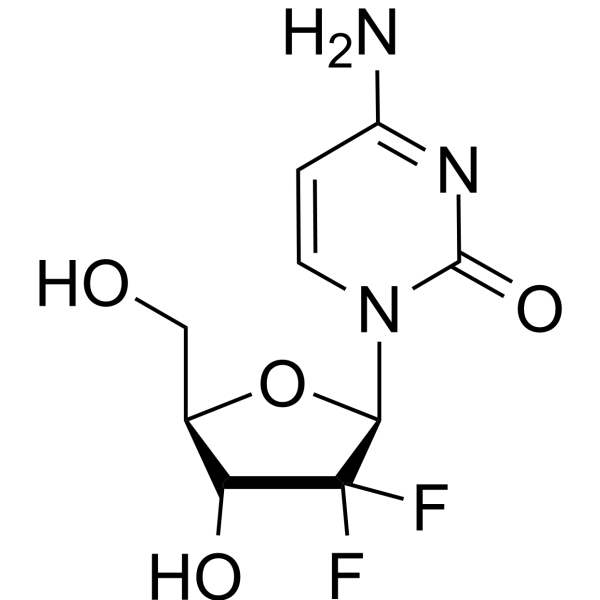
HY-17026
Gemcitabine -
HY-13948
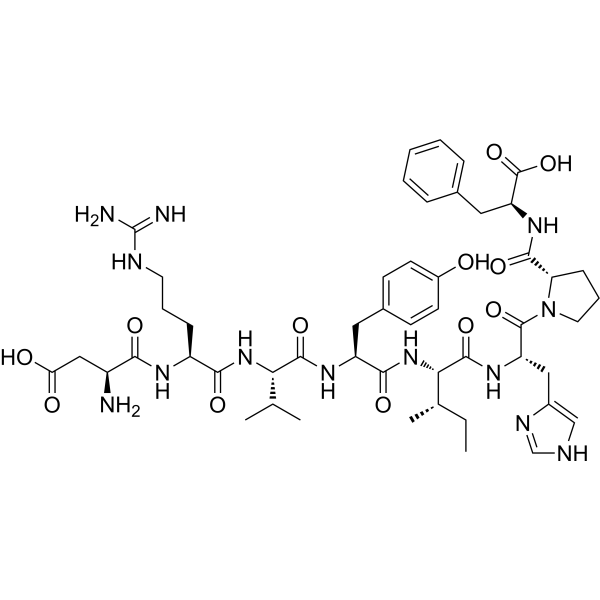
Angiotensin II human


Description & Advantages
MCE Basement Membrane Matrix is a natural basement membrane matrix extracted from mouse tumors and is composed mainly of various growth factors and extracellular matrix components. The main extracellular matrix components are: Laminin, Col-IV, Entactin, Heparan sulphate proteoglycans, etc. The main growth factor components are: insulin-like growth factor (IGF-1), transforming growth factor beta (TGF-β), vascular endothelial growth factor (VEGF), epidermal growth factor (EGF), fibroblast growth factor (bFGF), etc. The concentration of each component in MCE basement membrane matrix conforms to the standard type range.
MCE Basement Membrane Matrix is suitable for studies of tumor invasion, angiogenesis and organoids culture while avoiding color interference in subsequent experiments.


Protocol
Recommended Application Methods
| Application Method | Primary Function | Common Applications |
|---|---|---|
| Thin Gel | Forms an approximately 0.5 mm gel layer | Primary cell culture, cell migration and invasion assays |
| Thin Coating | Does not form a gel; forms an ECM coating layer only | Primary cell culture, iPSC culture, and cell adhesion assays |
| Thick Gel | Forms a 1-2 mm three-dimensional gel structure | Angiogenesis assays and aortic ring assays |
| Gel Embedding | Cells are completely embedded within the matrix | Organoid culture and tumor spheroid invasion assays |
Preparation Before Experiment
• Slight variations in protein concentration may occur between different batches. Please refer to the corresponding Certificate of Analysis (COA) for specific information.
• To achieve optimal experimental reproducibility, it is recommended to calculate the required volume based on the actual protein concentration and dilute the matrix using pre-chilled serum-free medium.
• Maintain low temperature conditions (ice bath or 4°C) throughout the entire procedure to prevent premature gelation of the basement membrane matrix.


Publications
-
Journal Impact Factor
-
Most Recent
-
J Hazard MaterPrenatal arsenic exposure disrupts placental angiogenesis by altering Pdgfb promoter epigenetic modification. [Abstract]2025 Aug 15:494:138736. PMID: 40440895
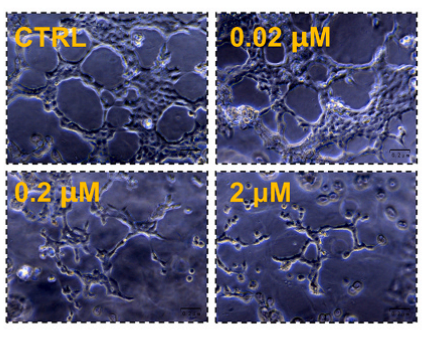
Basement Membrane Matrix purchased from MedChemExpress. Usage Cited in: J Hazard Mater. 2025 Aug 15:494:138736. [Abstract]
Representative images: thHTR8/SVneo cells were treated with different concentrations of NaAsO2 (0.02, 0.2, 2 μM) for 12 days.
-
Oncol ResMINDY1 Induces PD-L1 Deubiquitination to Promote Immune Escape in Hepatocellular Carcinoma by the Wnt/β-Catenin Pathway. [Abstract]2025 Oct 22;33(11):3583-3603. PMID: 41179305
-
FASEB JSREBP-1-mediated lipogenesis confers resistance to ferroptosis and improves endothelial injury. [Abstract]2024 Jul 15;38(13):e23806. PMID: 38970404
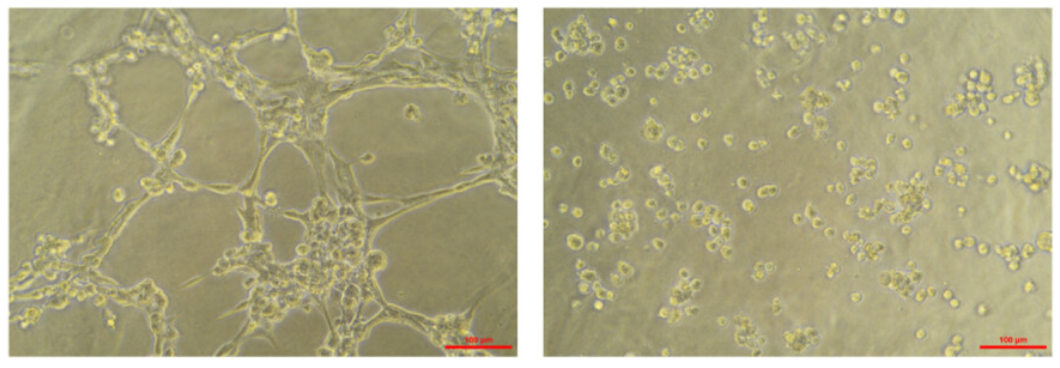
Basement Membrane Matrix purchased from MedChemExpress. Usage Cited in: FASEB J. 2024 Jul 15;38(13):e23806. [Abstract]
Tube formation capacity was assessed by tube formation assay after ox-LDL treatment.
Storage
-20°C, 2 years.
Avoid repeated freezing and thawing.
Shipping with dry ice.


Components
| Components | HY-K6002-1 mL | HY-K6002-5 mL | HY-K6002-10 mL |
|---|---|---|---|
| Basement Membrane Matrix | 1 mL | 5 mL | 10 mL |


 Please enter the correct Lot Number