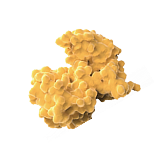
Oligo (dT)30 Magnetic Beads
Based on 1 publication(s) in Google Scholar
MCE Oligo (dT)30 Magnetic Beads are designed for the rapid isolation of highly purified, intact mRNA from eukaryotic total RNA or directly from crude extracts of cells, plant and animal tissues.
-
Storage :
4℃, 3 years. Do not freeze.

To place orders, for customer services and technical support, please contact: MedChemExpress USA
Tel: 609-228-6898 E-mail: [email protected] [email protected]



-
HY-K0208
Streptavidin Magnetic Beads -
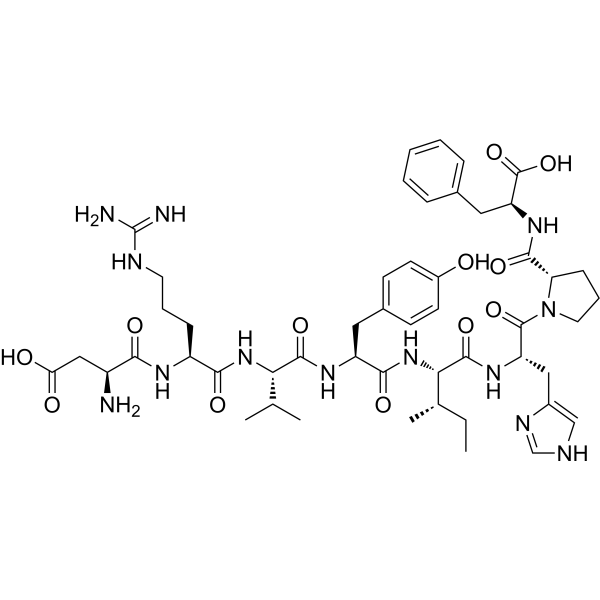
HY-13948
Angiotensin II human -
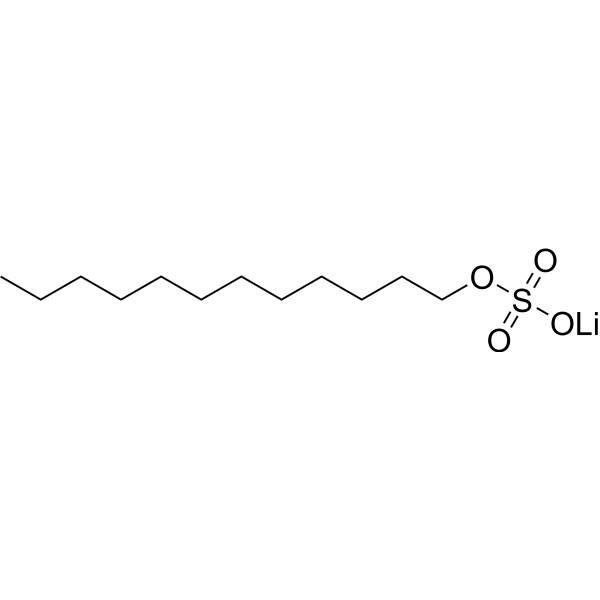
HY-W099535
Lithium dodecyl sulfate -
HY-K0201
Anti-HA Magnetic Beads -

HY-K0222
Anti-GST Magnetic Beads -
HY-K0010
Protease Inhibitor Cocktail (EDTA-Free, 100× in DMSO) -
HY-K0207
Anti-Flag Magnetic Beads -
HY-K0201A
Anti-HA Magnetic Beads (1 μm) -

HY-K0237
Anti-HA Magnetic Agarose Beads


Description & Advantages
MCE Oligo (dT)30 Magnetic Beads are designed for the rapid isolation of highly purified, intact mRNA from eukaryotic total RNA or directly from crude extracts of cells, plant and animal tissues. The use of MCE Oligo (dT)30 Magnetic Beads relies on base-pairing between the poly A tail of messenger RNA and the oligo dT sequences bound to the surface of the beads. The isolated mRNA can be used directly in most downstream applications in molecular biology: RT-PCR, solid-phase cDNA library construction, S1 nuclease analysis, ribonuclease protection assay, primer extension, dot and slot hybridization, in vitro translation experiments, RACE, subtractive hybridization, northern analysis, gene cloning, and gene expression analysis, etc.


Protocol
Recommended Reagents (Not Provided)
| Reagent | Composition |
|---|---|
| Binding Buffer | 20 mM Tris-HCl, pH 7.5, 1.0 M LiCl, 2 mM EDTA |
| Lysis/Binding Buffer |
100 mM Tris-HCl, pH 7.5, 500 mM LiCl, 10 mM EDTA, 1% LiDS, and 5 mM dithiothreitol (DTT) If visible precipitates are present, allow the buffer to return to room temperature and mix thoroughly. |
| Washing Buffer A | 10 mM Tris-HCl, pH 7.5, 0.15 M LiCl, 1 mM EDTA, 0.1% LiDS |
| Washing Buffer B | 10 mM Tris-HCl, 0.15 M LiCl, 1 mM EDTA, pH 7.5 |
Magnetic Bead Pretreatment
Thoroughly resuspend the magnetic beads. Transfer 100 μL of magnetic beads into a 1.5 mL EP tube, add 1 mL of Binding Buffer, and resuspend the beads. Perform magnetic separation and discard the supernatant. Repeat this procedure 3-4 times. Finally, add 1 mL of Binding Buffer, resuspend the beads, and keep them ready for use.
RNA Extraction from Animal/Plant Tissues or Cells (For Reference Only)
1. Sample Pretreatment
1.1 Animal/Plant Tissues
Collect an appropriate amount of tissue and grind it thoroughly in liquid nitrogen. Transfer the ground tissue to a new EP tube. Add 1 mL of Lysis/Binding Buffer per 20-50 mg of animal tissue or per 100 mg of plant tissue. Homogenize thoroughly and incubate on a rotator at room temperature for 5 min. Centrifuge at 14,000 rpm for 5 min at room temperature and collect the supernatant. The supernatant may be used for subsequent mRNA purification or stored at -80°C.
Note: During lysis, repeatedly pipette the sample through a 1 mL syringe needle or pipette tip to shear genomic DNA and reduce the viscosity of the solution.
1.2 Cell Suspensions
Centrifuge the cell suspension at 4,000 rpm for 5 min at room temperature. Discard the supernatant and retain the cell pellet. Add 1 mL of Lysis/Binding Buffer per 1-4 × 10⁶ cells and pipette several times to ensure complete cell lysis. Centrifuge at 14,000 rpm for 5 min at room temperature and collect the supernatant. The supernatant may be used for subsequent mRNA purification or stored at -80°C.
Note: During lysis, repeatedly pipette the sample through a 1 mL syringe needle or pipette tip to shear genomic DNA and reduce the viscosity of the solution.
2. mRNA Extraction
2.1 Resuspend the pretreated magnetic beads, perform magnetic separation, and discard the supernatant.
2.2 Add the lysate to the magnetic beads and vortex for 3-5 min. Perform magnetic separation and discard the supernatant.
2.3 Wash the magnetic beads sequentially with 1 mL of Washing Buffer A and 1 mL of Washing Buffer B. Perform magnetic separation and discard the supernatant. Repeat the washing procedure 3-4 times to remove potential contaminants.
2.4 If the magnetic bead-mRNA complex will be used in a downstream enzymatic reaction, such as solid-phase cDNA synthesis, wash once with 500 μL of Washing Buffer B and then once with the appropriate enzyme reaction buffer before proceeding with downstream analysis.
2.5 To elute mRNA from the magnetic beads, add 10-20 μL of 10 mM Tris-HCl and incubate at 75-80°C for 2 min. After magnetic separation, immediately transfer the supernatant to a new RNase-free EP tube.
Purification of mRNA from Total RNA (For Reference Only)
The following procedure is described using 200 μg of total RNA as an example.
1. Mix 100 μL of sample containing 200 μg of total RNA with 100 μL of Binding Buffer.
Note: Total RNA may be diluted to 200 μg/100 μL using DEPC-treated sterile water or 10 mM Tris-HCl, pH 7.5.
2. Incubate at 65°C for 2 min and immediately place the sample on ice.
3. Mix the resulting 200 μL reaction solution with 100 μL of pretreated magnetic beads. Incubate on a rotator at room temperature for 5 min. Perform magnetic separation and discard the supernatant.
4. Wash the magnetic beads sequentially with 1 mL of Washing Buffer A and 1 mL of Washing Buffer B. Perform magnetic separation and discard the supernatant. Repeat the washing procedure 3-4 times to remove potential contaminants.
5. If the magnetic bead-mRNA complex will be used in a downstream enzymatic reaction, such as solid-phase cDNA synthesis, wash once with 500 μL of Washing Buffer B and then once with the appropriate enzyme reaction buffer before proceeding with downstream analysis.
6. To elute mRNA from the magnetic beads, add 10-20 μL of 10 mM Tris-HCl and incubate at 75-80°C for 2 min. After magnetic separation, immediately transfer the supernatant to a new RNase-free EP tube.


Publications
-
Journal Impact Factor
-
Most Recent
Storage
4℃, 3 years.
Do not freeze.


Components
| Components | HY-K0228-1 mL | HY-K0228-5 mL | HY-K0228-10 mL |
|---|---|---|---|
| Oligo (dT)30 Magnetic Beads | 1 mL | 5 mL | 10 mL |


 Please enter the correct Lot Number