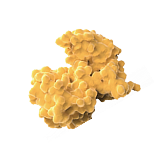
Mouse Intestinal Organoid Kit

Based on 1 Customer Validation
MCE Mouse Intestinal Organoid Kit contains Mouse Intestinal Organoid Basal Medium A, Mouse Intestinal Organoid Supplement B (50×), Mouse Intestinal Organoid Supplement C (250×) and EDTA. This product can be used to efficiently construct mouse intestinal organoid.
-
Storage :
Basal Medium A : 4°C, 1 year. Shipping with blue ice. Supplement B (50×) & Supplement C (250×) : -20°C, 1 year. Avoid repeated freeze/thaw cycles. Shipping with dry a ice. Supplement D : Room temperature, 1 year. Shipping with blue ice.


To place orders, for customer services and technical support, please contact: MedChemExpress USA
Tel: 609-228-6898 E-mail: [email protected] [email protected]





Description & Advantages
MCE Mouse Intestinal Organoid Kit contains Mouse Intestinal Organoid Basal Medium A, Mouse Intestinal Organoid Supplement B (50×), Mouse Intestinal Organoid Supplement C (250×) and EDTA. This product can be used to efficiently construct mouse intestinal organoid.
Mouse intestinal organoids derived from primary tissue possess the ability to self-renew and mimic the characteristics of real intestine tissue. Mouse intestinal organoids can be applied to study intestine development, disease mechanisms, and drug screening.


Protocols
1. Preparation of Complete Mouse Intestinal Organoid Medium
Combine Mouse Intestinal Organoid Basal Medium A with Organoid Culture Supplement B (50×), Organoid Culture Supplement C (250×) at their corresponding working concentrations, mix thoroughly, and keep on ice.
2. Isolation of Small intestine Crypts
a. Collect fresh small intestine tissue and rinse repeatedly with pre-cooled PBS to remove luminal contents and residual blood.
b. Open the tissue longitudinally, cut into small pieces, and wash repeatedly with PBS until the supernatant is largely clear.
c. Prepare an EDTA working solution from the EDTA stock supplied with the kit and incubate the tissue to loosen epithelial crypts from the surrounding tissue.
d. Remove the EDTA solution, add pre-cooled PBS, and release crypts by vigorous shaking or gentle pipetting.
e. Remove large tissue fragments using an appropriate cell strainer and centrifuge at 250-300 × g for 3-5 min to collect the crypt pellet.
f. Wash the crypts 1-2 times with Mouse Intestinal Organoid Basal Medium A and evaluate crypt integrity and quantity microscopically.
3. Construction of Organoid
a. Keep the procedure on ice and resuspend the crypts in MCE Basement Membrane Matrix, distributing them evenly.
b. Using a pre-wetted 200 μL pipette tip, dispense approximately 25-35 μL per well into a 24-well plate and avoid bubbles.
c. Incubate at 37°C with 5% CO2 for 15-30 min until gelled, then slowly add 500 μL Mouse Intestinal Organoid Complete Medium per well.
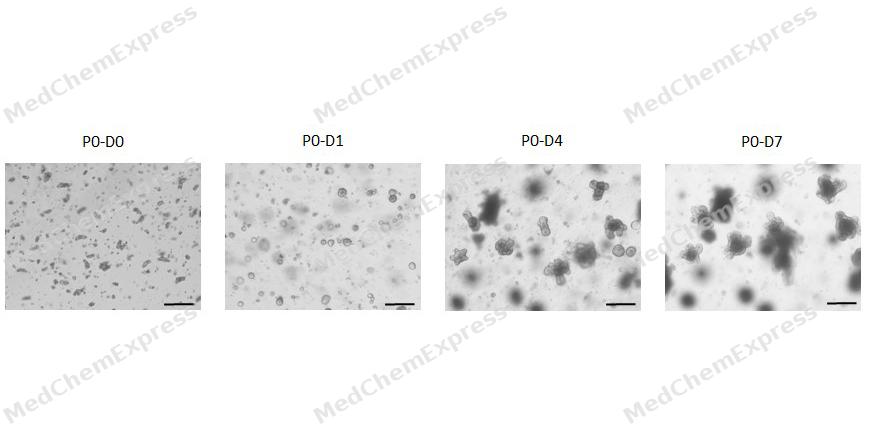
d. Replace with fresh complete medium every 2-3 days and monitor crypt budding and organoid expansion.
4. Organoid Passaging
a. When organoids enlarge, show extensive budding, or become overly dense, aspirate the medium, add an appropriate amount of Mouse Intestinal Organoid Basal Medium A, and detach the matrix/organoids from the well.
b. Mechanically pipette organoids into smaller clusters. If needed, briefly use organoid dissociation solution and avoid excessive digestion to single cells.
c. Centrifuge at 250-300 × g for 3-5 min, discard the supernatant, and wash with Mouse Intestinal Organoid Basal Medium A.
d. Re-embed on ice in Basement Membrane Matrix, dispense 25-35 μL per well, gel at 37°C, add 500 μL Mouse Intestinal Organoid Complete Medium, and continue culture.
Storage
Basal Medium A : 4°C, 1 year. Shipping with blue ice.
Supplement B (50×) & Supplement C (250×) : -20°C, 1 year. Avoid repeated freeze/thaw cycles. Shipping with dry a ice.
Supplement D : Room temperature, 1 year. Shipping with blue ice.


Component
| Cat. No. | Components | HY-K6119-100 mL | HY-K6119-500 mL |
|---|---|---|---|
| HY-K6119-A | Mouse Intestinal Organoid Basal Medium A | 100 mL | 500 mL |
| HY-K6119-B | Mouse Intestinal Organoid Supplement B (50x) | 1 mL×2 | 10 mL |
| HY-K6119-C | Mouse Intestinal Organoid Supplement C (250x) | 0.4 mL | 1 mL×2 |
| HY-K6119-D | EDTA (0.5 M, pH 8.0) | 0.2 mL | 1 mL |


 Please enter the correct Lot Number