RIPA Lysis Buffer (Strong)
Based on 268 publication(s) in Google Scholar
MCE RIPA Lysis Buffer is one of the most reliable buffers used to lyse cells from both cultured cells and tissues.
-
Storage :
Stored at -20°C, and is stable for up to 12 months.



To place orders, for customer services and technical support, please contact: MedChemExpress USA
Tel: 609-228-6898 E-mail: [email protected] [email protected]



-

HY-K0010
Protease Inhibitor Cocktail (EDTA-Free, 100× in DMSO) -

HY-K0022
Phosphatase Inhibitor Cocktail Ⅱ (100× in ddH2O) -

HY-K0021
Phosphatase Inhibitor Cocktail I (100× in DMSO) -
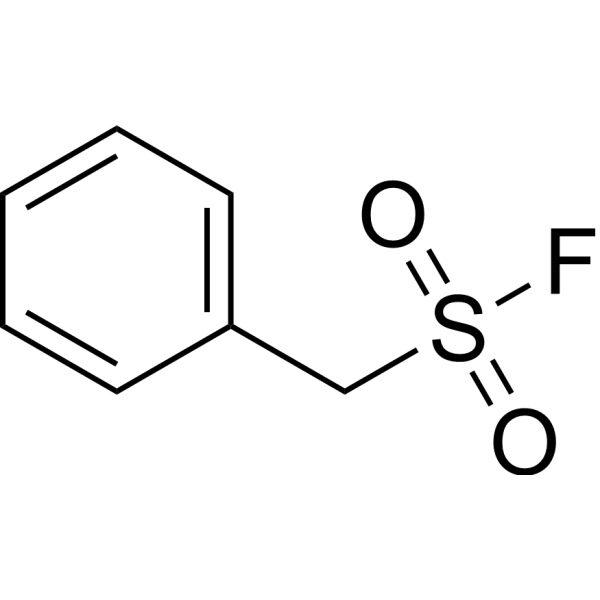
HY-B0496
PMSFCathepsin Inhibitor -

HY-K0013
Protease and Phosphatase Inhibitor Cocktail (EDTA-Free, 10× in ddH2O) -

HY-K0023
Phosphatase Inhibitor Cocktail Ⅲ (100× in DMSO) -
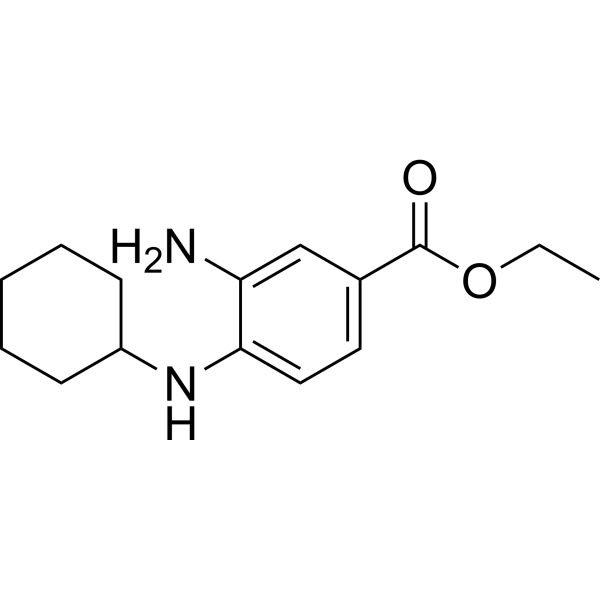
HY-100579
Ferrostatin-1Ferroptosis Inhibitor -

HY-K1005
Ultra High Sensitivity ECL Kit -

HY-Y0320
Dimethyl sulfoxide, meets analytical specification of Ch.P.Aprotic Solvent -
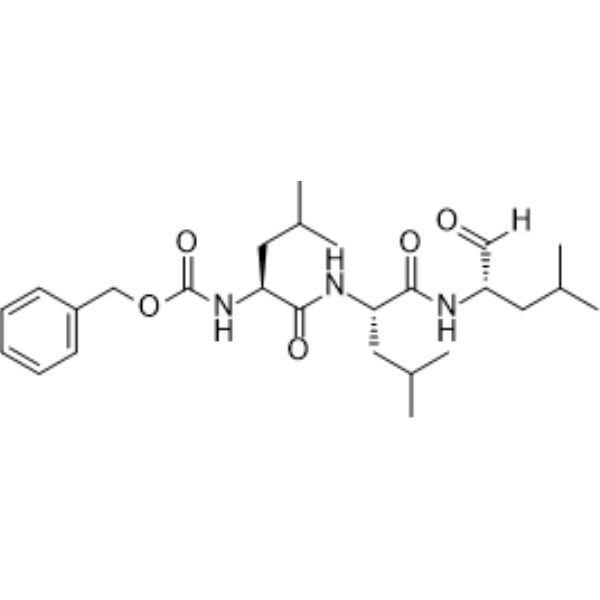
HY-13259
MG-132Proteasome Inhibitor -

HY-K1100
SDS-PAGE Sample Loading Buffer (4×) -

HY-K1002
NP-40 Lysis Buffer


Description & Advantages
MCE RIPA (Radio-Immunoprecipitation Assay) Lysis Buffer (Strong) is a widely used lysis and wash buffer for reporter assays, protein kinase assays, immunoassays and protein purification.
RIPA Lysis Buffer (Strong) consists of 50 mM Tris (pH 7.4), 150 mM NaCl, 1% Triton X-100, 1% sodium deoxycholate, 0.1% SDS, and general protease and phosphatase inhibitors (e.g., sodium orthovanadate, sodium fluoride, EDTA). If desired, add MCE Protease Inhibitor Cocktail (HY-K0010) and MCE Phosphatase Inhibitor Cocktails (e.g., HY-K0021, HY-K0022, and HY-K0023).


Protocols
1. Procedure for Cultured Cells
1.1 Pipette proper volume of RIPA Lysis Buffer and mix thoroughly. Add Protease Inhibitor Cocktail to lysis buffer to prevent proteolysis. Add Phosphatase Inhibitor Cocktails to maintain phosphorylation status of proteins as needed. Incubate on ice for subsequent use.
1.2 For adherent cells: Carefully remove culture medium from adherent cells. Wash cells twice with cold wash solution, such as PBS, normal saline or serum-free culture medium, to remove residual medium. Add proper volume of cold RIPA Lysis Buffer, then stroke with pipette until the buffer immerses cells completely. Incubate on ice and shake slightly for 5-10 minutes.
For suspension cultured cells: Collect cells into a centrifuge tube. Centrifuge samples at 500 g for 5 minutes and discard the supernatants. Wash cells twice with cold wash solution, such as PBS, normal saline or serum-free culture medium, to remove residual medium. Add proper volume of cold RIPA Lysis Buffer, then stroke with pipette until the buffer immerses cells completely. Incubate on ice and shake slightly for 5-10 minutes.
Note: Generally, use 1 mL of RIPA Lysis Buffer for 0.5-5 × 10⁶ cells. The volume of added RIPA Lysis Buffercan be adjusted proportionally.
1.3 After lysis, centrifuge at 14,000 g for 5 minutes at 4°C. Transfer the supernatants to a new tube for further analysis. Aliquot and freeze in liquid nitrogen and stored at -80°C for future use. Avoid multiple freeze/thaw cycles.
2. Procedure for Tissue Lysis
2.1 Pipette proper volume of RIPA Lysis Buffer and mix thoroughly. Add Protease Inhibitor Cocktail to lysis buffer to prevent proteolysis. Add Phosphatase Inhibitor Cocktails to maintain phosphorylation status of proteins as needed. Incubate on ice for subsequent use.
2.2 Cut tissue sample into small pieces on ice quickly to minimize protein degradation.
2.3 Add 150-250 μL cold RIPA Lysis Buffer per 20 mg of tissue sample and homogenize using electric homogenizer. Add more Lysis buffer if tissue is not completely lysed.
2.4 Transfer complete homogenized sample into a centrifuge tube. Incubate on ice and shake slightly for 5-10 minutes.
2.5 After lysis, centrifuge at 14,000 g for 5 minutes at 4°C. Transfer the supernatants to a new tube for further analysis. Aliquot and freeze in liquid nitrogen and stored at -80°C for future use. Avoid multiple freeze/thaw cycles.
Note: 20 mg of frozen mouse liver tissues may yield 15-25 mg/mL protein.


Publications
-
Journal Impact Factor
-
Most Recent
-
Cell Metab2025 Dec 29:S1550-4131(25)00530-3. PMID: 41468885
-
Nat CommunAR+TREM2+ macrophage induced pathogenic immunosuppression promotes prostate cancer progression. [Abstract]2025 Jul 29;16(1):6964. PMID: 40730555
-
Nat CommunAstrocyte-secreted cues promote neural maturation and augment activity in human forebrain organoids. [Abstract]2025 Mar 23;16(1):2845. PMID: 40122897
-
Nat CommunMitochondrial rewiring with small-molecule drug-free nanoassemblies unleashes anticancer immunity. [Abstract]2024 Sep 3;15(1):7664. PMID: 39227567
-
Adv Sci (Weinh)Chronotoxici-Plate Containing Droplet-Engineered Rhythmic Liver Organoids for Drug Toxicity Evaluation. [Abstract]2024 Jul;11(28):e2305925. PMID: 38720476
-
Cell Death DifferVps34 sustains Treg cell survival and function via regulating intracellular redox homeostasis. [Abstract]2024 Nov;31(11):1519-1533. PMID: 39117783
-
Int J Biol SciFangchinoline Activates cGAS-STING to Promote Antitumor Immunity without Pathological Inflammation. [Abstract]2026 May 18;22(10):5444-5458. PMID: 42212320
-
Cell Commun Signal2025 Mar 8;23(1):126. PMID: 40057764
-
OncogeneUSP33 facilitates the ovarian cancer progression via deubiquitinating and stabilizing CBX2. [Abstract]2024 Oct;43(43):3170-3183. PMID: 39256572
-
OncogeneGSK3β and UCHL3 govern RIPK4 homeostasis via deubiquitination to enhance tumor metastasis in ovarian cancer. [Abstract]2024 Jun;43(25):1885-1899. PMID: 38664501
-
Int J SurgPulsatile Flow Increases METTL14-induced m6A modification and attenuates septic cardiomyopathy: an experimental study. [Abstract]2024 Jul 1;110(7):4103-4115. PMID: 38549224
-
Int J Biol MacromolDTL promotes pancreatic cancer progression through ubiquitin-mediated degradation of SMAD4. [Abstract]2025 Dec;333(Pt 2):148692. PMID: 41203163
-
Free Radic Biol MedRole of ferroptosis mediated by abnormal membrane structure in DEHP-induced reproductive injury. [Abstract]2025 Apr 28:235:150-161. PMID: 40306442
-
ACS Appl Mater Interfaces2025 Oct 1;17(39):54525-54536. PMID: 40956250
-
Cell RepICP22-defined condensates mediate RNAPII deubiquitylation by UL36 and promote HSV-1 transcription. [Abstract]2024 Oct 8;43(10):114792. PMID: 39383039
-
J Agric Food ChemStructures, Biosynthesis, and Bioactivity of Oligomycins from the Marine-Derived Streptomyces sp. FXY-T5. [Abstract]2024 Jan 17;72(2):1082-1095. PMID: 38169320
-
Inflamm Res2024 Nov;73(11):1961-1979. PMID: 39292271
-
J Inflamm (Lond)2025 Jan 24;22(1):4. PMID: 39856697
-
Commun BiolHomodimerized cytoplasmic domain of PD-L1 regulates its complex glycosylation in living cells. [Abstract]2022 Aug 30;5(1):887. PMID: 36042378
-
Int J Mol Sci2024 Jan 18;25(2):1160. PMID: 38256233
-
Toxicology2024 Nov 10:509:153996. PMID: 39532264
-
Sci RepNovel fatty acid metabolism risk score model for guiding treatment in endometrial endometrioid cancer. [Abstract]2026 Mar 19;16(1):14223. PMID: 41857120
-
Am J PatholSCG2 Transcriptionally Activated by SP1 Promotes Nasal Epithelial Cell Proliferation and Epithelial Mesenchymal Transition. [Abstract]2025 Sep 12:S0002-9440(25)00333-5. PMID: 40946800
-
Mol Cell Biochem2025 Feb;480(2):1183-1195. PMID: 38896202
-
Poult SciUnderstanding the impact of glycolysis and oxidative stress on residual feed intake in slow-growing chicken. [Abstract]2025 Sep 10;104(11):105816. PMID: 40961768
-
Neurochem Res2023 Sep;48(9):2826-2834. PMID: 37148458
-
FASEB JXPD Regulates MIAT/miR-29a-3p/COL4A1 Axis to Impede Hepatocellular Carcinoma Development. [Abstract]2025 May 31;39(10):e70611. PMID: 40372289
-
FASEB JBrown adipose tissue-derived exosomes improve polycystic ovary syndrome in mice via STAT3/GPX4 signaling pathway. [Abstract]2024 Sep 30;38(18):e70062. PMID: 39305125
-
J NutrBile Acid Supplementation Reduced Hepatic Lipid Deposition and Modulated Bile Acid Metabolism and the Gut Microbiota in Weaned Piglets. [Abstract]2025 Nov 14:S0022-3166(25)00705-9. PMID: 41242434
-
Microbiol Spectr2026 Jun 2;14(6):e0160825. PMID: 41995456
-
J VirolPorcine epidemic diarrhea virus manipulates IMPDH-dependent nucleotide biosynthesis to facilitate replication. [Abstract]2026 Feb 17;100(2):e0173625. PMID: 41511083
-
J VirolRecent H9N2 avian influenza virus lost hemagglutination activity due to a K141N substitution in hemagglutinin. [Abstract]2024 Apr 16;98(4):e0024824. PMID: 38466094
-
J ImmunolThe IL-33/ST2 Axis Promotes Primary Sjögren's Syndrome by Enhancing Salivary Epithelial Cell Activation and Type 1 Immune Response. [Abstract]2022 Jun 15;208(12):2652-2662. PMID: 35649629
-
Cell CycleOverexpression of circARF3 mitigates TNF-α-induced inflammatory damage by up-regulating miR-125b. [Abstract]2020 Jun;19(11):1253-1264. PMID: 32329660
-
EndocrinologyWnt5a Regulates Junctional Function of Sertoli cells Through PCP-mediated Effects on mTORC1 and mTORC2. [Abstract]2021 Oct 1;162(10):bqab149. PMID: 34338758
-
ACS Chem BiolLi-BrU-seq: A Low-Input and Simplified Metabolic Labeling Method for Nascent RNA Sequencing. [Abstract]2026 Mar 20;21(3):601-612. PMID: 41773915
-
Chem Biol Drug DesIsoquercetin Ameliorates Osteoarthritis via Nrf2/NF-κB Axis: An In Vitro and In Vivo Study. [Abstract]2024 Sep;104(3):e14620. PMID: 39251394
-
Mol Biol Rep2024 Aug 8;51(1):895. PMID: 39115693
-
BMC NephrolCalycosin ameliorates albuminuria in nephrotic syndrome by targeting Notch1/Snail pathway. [Abstract]2025 Apr 18;26(1):198. PMID: 40251522
-
Hum CellRobo4 inhibits neovascularization in oxygen-induced retinopathy by regulating ARF6 and VEGF. [Abstract]2025 Aug 8;38(5):140. PMID: 40778968
-
Clin Exp Pharmacol Physiol2021 Feb;48(2):250-259. PMID: 33048369
-
J Pediatr Urol2023 Oct;19(5):581.e1-581.e6. PMID: 37246119
-
Exp Ther Med2022 Jun 30;24(3):546. PMID: 35978916
-
Physiol RepCirc_0089761 accelerates colorectal cancer metastasis and immune escape via miR-27b-3p/PD-L1 axis. [Abstract]2024 Nov;12(23):e70137. PMID: 39632246
-
Genes Genomics2021 Aug;43(8):947-959. PMID: 34061329
-
Biol Pharm Bull2022;45(11):1653-1659. PMID: 36328501
-
bioRxivStress-Survival Pathway Profiling Reveals MCM10 as a Candidate Biomarker of Hispanic Colorectal Cancer Disparities. [Abstract]2026 Jan 7:2026.01.06.698057. PMID: 41542574
-
Environ Toxicol2022 Jul;37(7):1629-1641. PMID: 35258167
Storage
Stored at -20°C, and is stable for up to 12 months.


 Please enter the correct Lot Number