



Constipation
-
Constipation (16)

- 1
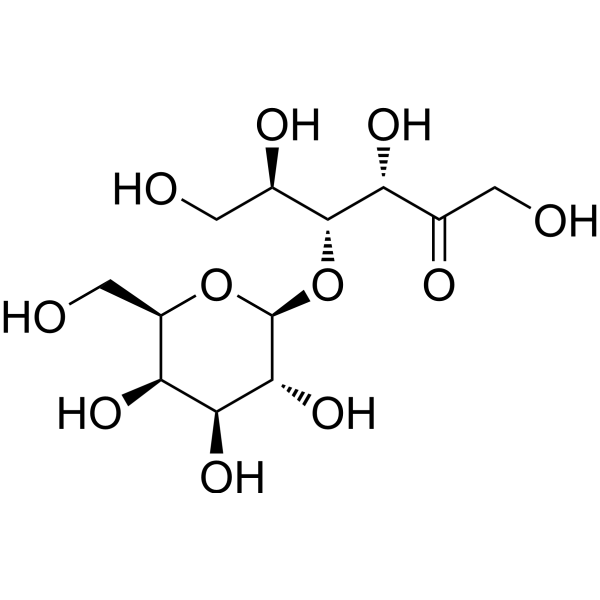
- Formule: C12H22O11
- Masse moléculaire: 342.30
Lactulose is an orally active galactose-fructose disaccharide. Lactulose suppresses upregulation of TNF-α and IL-6. Lactulose decreases the degree of DNA damage. Lactulose exhibits many of the properties of other oligosaccharides, including increasing the numbers of Bifidobacteria in feces. Lactulose restores the structure and composition of the intestinal microbiota, mitigates inflammation, and suppresses inflammatory tumorigenesis in mice with colitis-associated cancer. Lactulose can be used in the research of constipation.
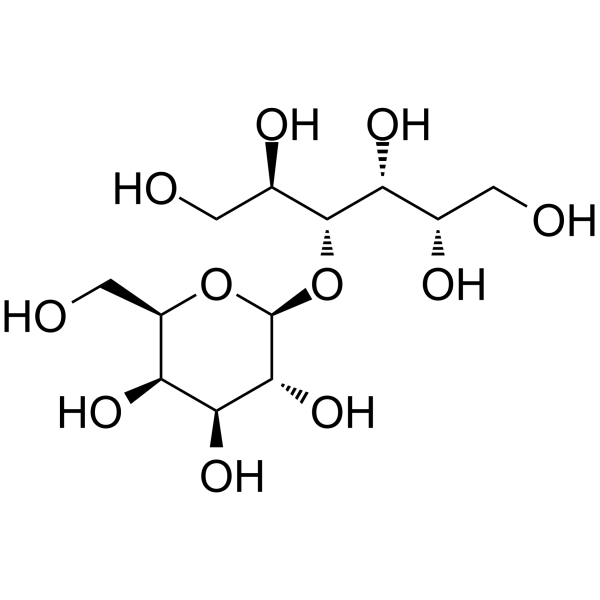
- Formule: C12H24O11
- Masse moléculaire: 344.31
Lactitol (D-Lactitol) is a non-absorbable disaccharide and Bacterial regulator. Lactitol reduces the populations of Bacteroides, Clostridium, coliforms and Eubacterium, while increasing the populations of Lactobacillus and Streptococcus. Lactitol can be used in the research of portosystemic encephalopathy and chronic constipation.

- Formule: C20H32O5
- Masse moléculaire: 352.47
13,14-Dihydro-15-keto-PGE2 participates in Bifidobacterium animalis F1-7 to alleviate opioid-induced constipation by 5-HT pathway.
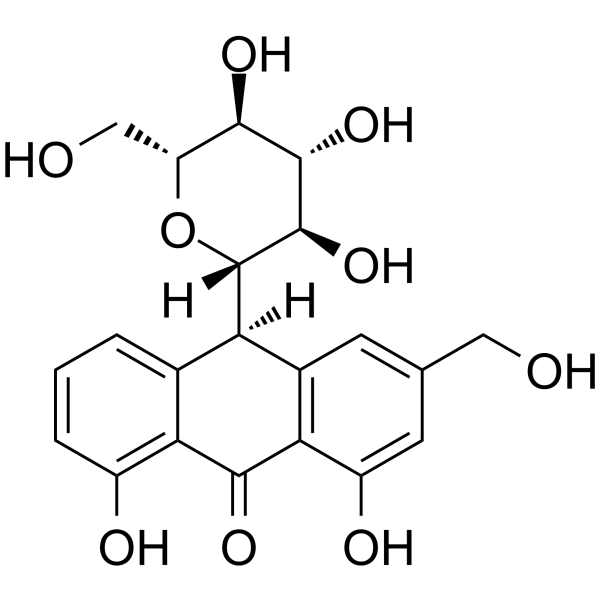
- Formule: C21H22O9
- Masse moléculaire: 418.39
Aloin B (Isobarbaloin) is an orally active SARS-CoV-2 papain-like protease (PLpro) inhibitor with an IC50 of 16.08 μM (hydrolytic activity) and 17.51 μM (deubiquitinase activity). Aloin B is metabolized by rat intestinal flora into aloe-emodin-9-anthrone to exert laxative effects. Aloin B inhibits TPA (HY-18739)-induced ear edema, putrescine elevation, and tumor promotion in mouse skin. Aloin B can be used in research related to anti-inflammation, tumor promotion inhibition, coronavirus disease 2019 (COVID-19) and constipation.
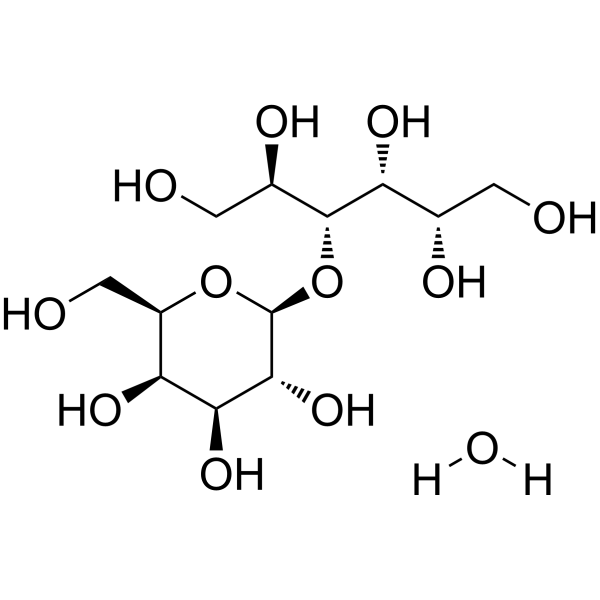
- Formule: C12H26O12
- Masse moléculaire: 362.33
Lactitol monohydrate (D-Lactitol monohydrate) is a non-absorbable disaccharide and Bacterial regulator. Lactitol monohydrate reduces the populations of Bacteroides, Clostridium, coliforms and Eubacterium, while increasing the populations of Lactobacillus and Streptococcus. Lactitol monohydrate can be used in the research of portosystemic encephalopathy and chronic constipation.

- Formule: C23H23N5O4
- Masse moléculaire: 433.47
M1R modulator-1 is an orally effective positive allosteric modulator of muscarinic M1R, with an IP value of 0.88 nM. M1R modulator-1 can be used in constipation-related research.

- Formule: C21H29N5O
- Masse moléculaire: 367.49
KF20274 is an orally active adenosine A1 receptor antagonist. KF20274 increases the fecal pellet output in rats, and does not affect small intestinal propulsion or gastric emptying at defecation-increasing doses. KF20274 does not induce diarrhea at defecation-increasing doses. KF20274 can be used for the research of constipation.

- Formule: C21H31ClN4O5
- Masse moléculaire: 454.95
Minesapride (DSP-6952 free base) is an orally active, selective 5-HT4 receptor partial agonist. Minesapride enhances gastrointestinal motility, colonic transit and defecation function, and inhibits visceral hypersensitivity. Minesapride does not inhibit/induce cytochrome P450 isozymes, has no significant affinity for hERG, and does not trigger the risk of cardiac ischemia via coronary vasoconstriction. Minesapride can be used in research related to constipation-predominant irritable bowel syndrome, chronic constipation, atonic constipation, spastic constipation, functional constipation and functional dyspepsia.
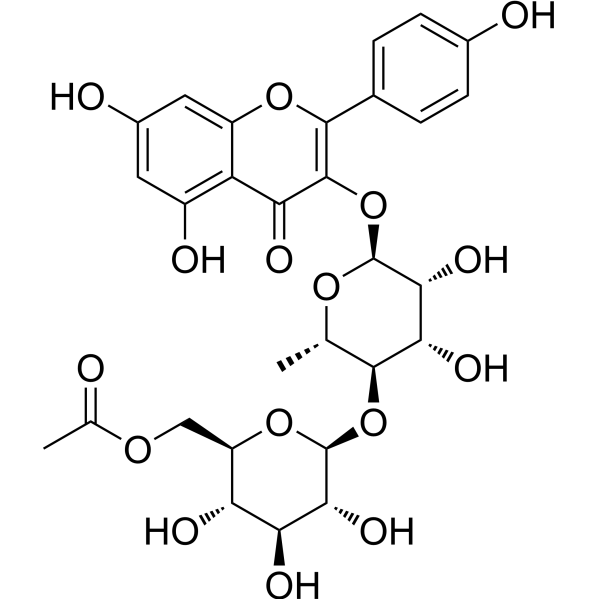
- Formule: C29H32O16
- Masse moléculaire: 636.55
Multiflorin A is an orally active active ingredient of traditional herbal laxative, Pruni semen. Multiflorin A inhibits aromatase enzyme activity with an IC50 of 15.5 μM. Multiflorin A also inhibits quinone reductase 2 (QR2) and COX-2 enzyme. Multiflorin A has purgative activity and reduces postprandial blood glucose in mice. Multiflorin A modulates intestinal glucose transporters, tight junction proteins, and aquaporins, reshapes gut microbiota, and alters faecal metabolites. Multiflorin A can be used for the research of constipation and diabetes.
Liquid Paraffin is a petroleum-derived mixture of saturated hydrocarbons and an orally active fecal lubricant. Liquid Paraffin is widely used in studies of constipation and fecal incontinence in children through its lubricating effect and the osmotic effect generated by its conversion to hydroxy fatty acids. Liquid Paraffin has high safety, is non-carcinogenic, and does not affect fat-soluble vitamin levels with long-term use. Liquid Paraffin does not cause abdominal pain or electrolyte disorders, but may lead to lipoid pneumonia and granulomas caused by rectal administration. Liquid Paraffin can also be used as a phase change material for thermal energy storage, or combined with nanoparticles to form a protective boundary film to reduce mechanical wear.

- Formule: C23H31NO5S
- Masse moléculaire: 433.56
Methylgerambullone is a constitutional isomer of Methylisogerambullone. Methylgerambullone can be isolated from the methanolic leaf extract of Glycosmis angustifolia. Methylgerambullone shows the relaxatory effect on guinea-pig isolated ileum precontracted with Acetylcholine.

- Formule: C21H32BrClN4O5
- Masse moléculaire: 535.86
Minesapride hydrobromide (DSP-6952 hydrobromide) is an orally active, selective 5-HT4 receptor partial agonist. Minesapride hydrobromide enhances gastrointestinal motility, colonic transit and defecation function, and inhibits visceral hypersensitivity. Minesapride hydrobromide does not inhibit/induce cytochrome P450 isozymes, has no significant affinity for hERG, and does not trigger the risk of cardiac ischemia via coronary vasoconstriction. Minesapride hydrobromide can be used in research related to constipation-predominant irritable bowel syndrome, chronic constipation, atonic constipation, spastic constipation, functional constipation and functional dyspepsia.

- Formule: C12H26O12
- Masse moléculaire: 362.33
Lactitol (monohydrate) (Standard) is the analytical standard of Lactitol monohydrate (HY-B1389). This product is intended for research and analytical applications. Lactitol monohydrate (D-Lactitol monohydrate) is a non-absorbable disaccharide and Bacterial regulator. Lactitol monohydrate reduces the populations of Bacteroides, Clostridium, coliforms and Eubacterium, while increasing the populations of Lactobacillus and Streptococcus. Lactitol monohydrate can be used in the research of portosystemic encephalopathy and chronic constipation.

- Formule: C20H17BrO5
- Masse moléculaire: 417.26
DRAinh-A250 is an orally active inhibitor of mouse and human SLC26A3 (DRA). DRAinh-A250 inhibits SLC26A3-mediated anion transport, blocks colonic fluid absorption, reduces luminal fluid alkalization in the distal colonic loops of mice, and alleviates Loperamide (HY-156131)-induced constipation in wild-type and cystic fibrosis mice. DRAinh-A250 can be used in the research of constipation and cystic fibrosis-related constipation.

- Formule: C42H38O20
- Masse moléculaire: 862.74
Sennoside is an orally active apoptosis inducer and stimulant laxative, found in Senna (Cassia angustifolia). Sennoside induces overexpression of wild-type p53 and p21/WAF as part of pathways mediating colonic epithelial cell apoptosis. Sennoside stimulates colonic peristalsis, reverses net water, sodium, chloride absorption to secretion and enhances potassium and calcium secretion. Sennoside increases paracellular permeability to small molecules, accelerates colon transit and softens fecal pellets. Sennoside can be used for the research of constipation, melanosis coli, and colorectal cancer.

- Formule: C12H24O11
- Masse moléculaire: 344.31
Lactitol (Standard) is the analytical standard of Lactitol (HY-N7104). This product is intended for research and analytical applications. Lactitol (D-Lactitol) is a non-absorbable disaccharide and Bacterial regulator. Lactitol reduces the populations of Bacteroides, Clostridium, coliforms and Eubacterium, while increasing the populations of Lactobacillus and Streptococcus. Lactitol can be used in the research of portosystemic encephalopathy and chronic constipation.
- 1



