



Liquid Paraffin
Based on 1 publication(s) in Google Scholar
Liquid Paraffin is a petroleum-derived mixture of saturated hydrocarbons and an orally active fecal lubricant. Liquid Paraffin is widely used in studies of constipation and fecal incontinence in children through its lubricating effect and the osmotic effect generated by its conversion to hydroxy fatty acids. Liquid Paraffin has high safety, is non-carcinogenic, and does not affect fat-soluble vitamin levels with long-term use. Liquid Paraffin does not cause abdominal pain or electrolyte disorders, but may lead to lipoid pneumonia and granulomas caused by rectal administration. Liquid Paraffin can also be used as a phase change material for thermal energy storage, or combined with nanoparticles to form a protective boundary film to reduce mechanical wear.
Nos produits utilisent uniquement pour la recherche. Nous ne vendons pas aux patients.
- CAS No.: 8012-95-1
-
Stockage:Pure form -20°C, 3 years , 4°C, 2 years ; In solvent -80°C, 6 months , -20°C, 1 month

To place orders, for customer services and technical support, please contact: MedChemExpress USA
Tel: 609-228-6898 E-mail: [email protected] [email protected]


-
 Activité biologique
-
Chemical Information
- Pureté et documentation
- Références
-
 Help & FAQs


-
HY-139411
White mineral oilMineral Oil -
HY-154636A
Light Liquid ParaffinPharmaceutical Excipient -
HY-Y0320
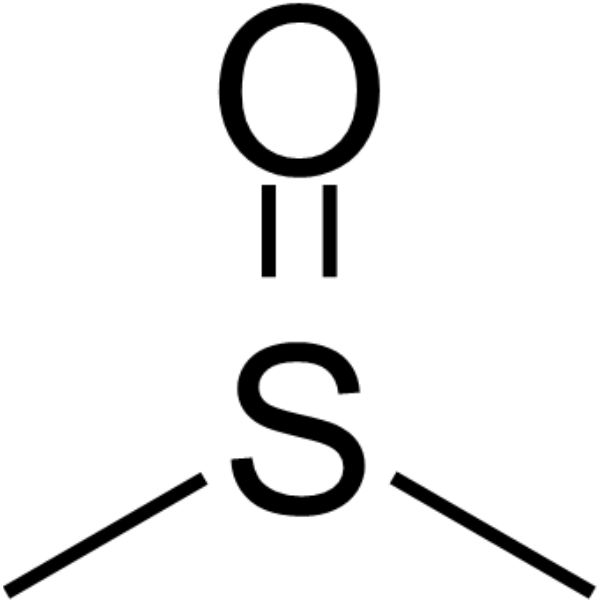
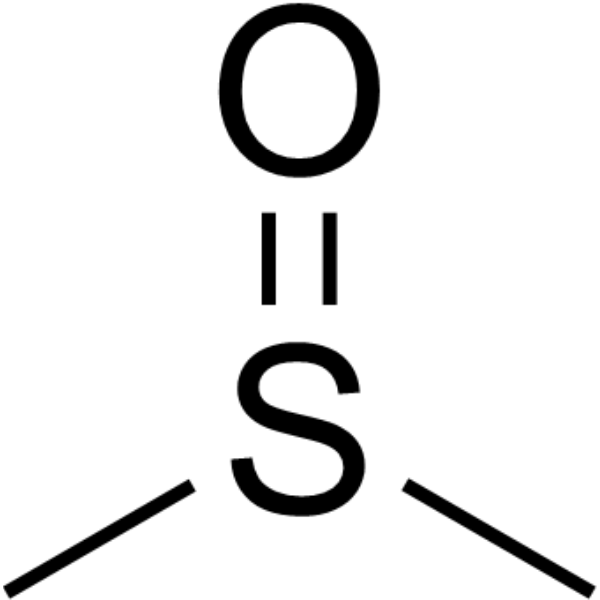
Dimethyl sulfoxide, meets analytical specification of Ch.P.Aprotic Solvent -
HY-Y0320C
Dimethyl sulfoxideAprotic Solvent -
HY-B1659
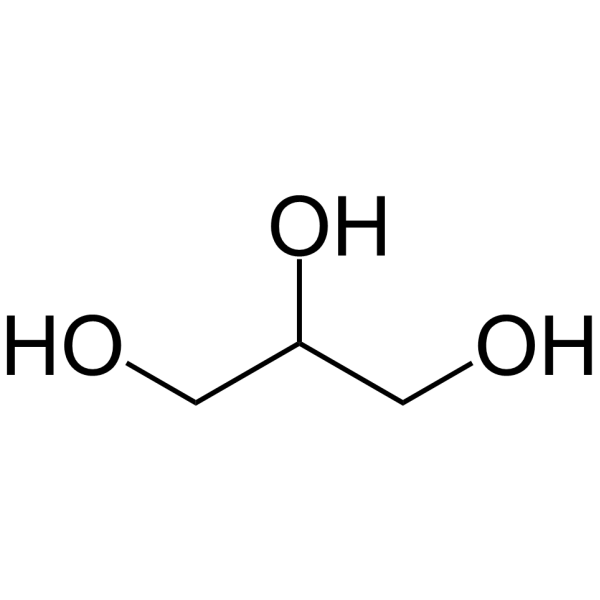
GlycerolEndogenous Metabolite -

HY-Y0320D
Dimethyl sulfoxide, cryoprotectant vitrification agentBiochemical Assay Reagent -
HY-N0830
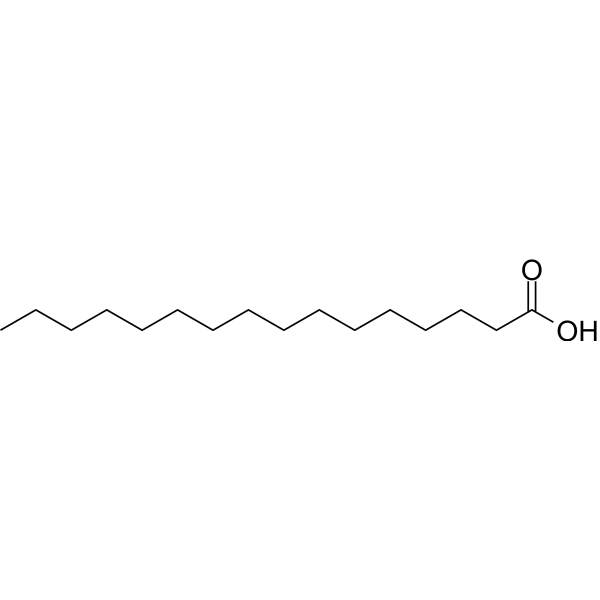
Palmitic acidEndogenous Metabolite
Publications Citing Use of MedChemExpress (MCE) Liquid Paraffin
More

Activité biologique
Description
Cellular Effect
|
Cell Line

|
Type | Value | Description | References |
|---|---|---|---|---|
| HL-60 | IC50 |
40 μM
Compound: Delphinidin
|
Antiproliferative activity against human HL60 cells after 48 hrs by MTS assay
Antiproliferative activity against human HL60 cells after 48 hrs by MTS assay
|
[PMID: 20801663] |
| HL-60 | IC50 |
80 μM
Compound: Delphinidin
|
Antiproliferative activity against human HL60 cells after 24 hrs by MTS assay
Antiproliferative activity against human HL60 cells after 24 hrs by MTS assay
|
[PMID: 20801663] |
In Vitro
When Liquid Paraffin is compounded with EHA-TiO2 nanoparticles, its load-carrying capacity, anti-wear property and friction-reducing property are all improved; among them, the maximum non-seizure load of the pure base oil is 400 N[2].
Liquid Paraffin can be used as a base raw material for lubricating oils, with properties including low sulfur content, undetectable acidity, and specific viscosity values at 50°C and 100°C[3].
Liquid paraffin (containing 4 wt.% GNPs) remains stable for at least 1.5 h after preparation, but its long-term stability is reduced compared with suspensions containing smaller-sized carbon nanomaterials (visible precipitation occurs 1 day after preparation)[5].
MedChemExpress (MCE) has not independently confirmed the accuracy of these methods. They are for reference only.
In Vivo
Liquid Paraffin (i.e., pharmaceutical liquid paraffin formulation) shows no carcinogenic activity in dogs following dietary intake during subchronic study periods[1].
MedChemExpress (MCE) has not independently confirmed the accuracy of these methods. They are for reference only.


Chemical Information
-
CAS No. 8012-95-1
-
Appearance Liquid (Density: 0.875-0.905 g/cm3)
-
Color Colorless to light yellow
-
SMILES
[Liquid Paraffin]
-
Livraison
Room temperature in continental US; may vary elsewhere.
-
Stockage
Pure form -20°C 3 years 4°C 2 years In solvent -80°C 6 months -20°C 1 month


Publications (1)
-
Journal Impact Factor
-
Most Recent
-
ACS Nano
Topology Outweighs Stiffness: Self-Reinforced Cell Mechanotransduction via Multiaxial Curvature Engineering of Ultrasoft Hydrogels. [Abstract]2026 Mar 10;20(9):7679-7692. PMID: 41733433


Pureté et documentation
-
Fiche technique (269 KB)
-
SDS (418 KB)
- English - EN (418 KB)
- Français - FR (418 KB)
- Deutsch - DE (418 KB)
- Norwegian - NO (418 KB)
- Español - ES (418 KB)
- Swedish - SV (418 KB)
- Italian - IT (418 KB)
- Korean - KR (418 KB)
- Portuguese - PT (418 KB)
-
Instruction de manipulation (2659 KB)
Références

Calculators
Concentration (start) × Volume (start) = Concentration (final) × Volume (final)


Liquid Paraffin Related Classifications
HY-154636 Related Classifications
 Powered by Bioz