Basement Membrane Matrix HC
Based on 2 publication(s) in Google Scholar
MCE High-Concentration Basement Membrane Matrix (Phenol Red-Free) is primarily composed of natural basement membrane matrix extracted from mouse tumors. It is rich in extracellular matrix components and various naturally occurring growth factors, and is mainly used for the establishment of animal models and 3D tumor models.
-
Storage :
-20°C, 2 years. Avoid repeated freezing and thawing. Shipping with dry ice.



To place orders, for customer services and technical support, please contact: MedChemExpress USA
Tel: 609-228-6898 E-mail: [email protected] [email protected]



-

HY-K6002
Basement Membrane Matrix -

HY-K6004
Basement Membrane Matrix GFR -

HY-K6005
Basement Membrane Matrix HC (Phenol Red) -

HY-K6007
Basement Membrane Matrix for Organoid Culture -

HY-K6001
Basement Membrane Matrix (Phenol Red) -

HY-K6003
Basement Membrane Matrix GFR (Phenol Red) -

HY-K6009
Basement Membrane Matrix GFR&HC -
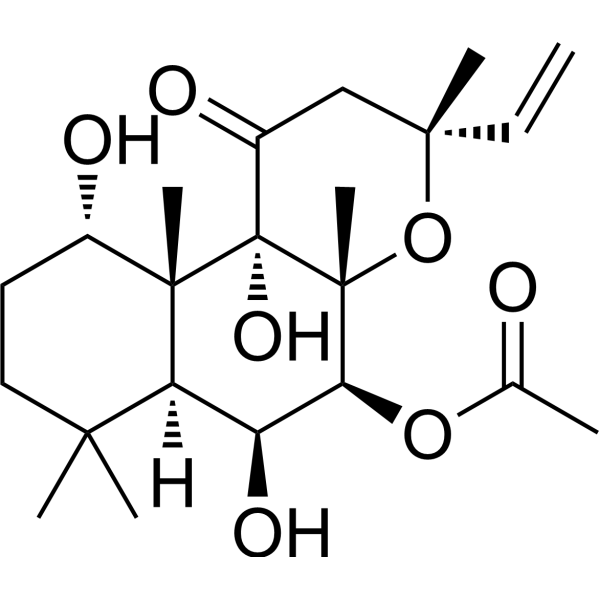
HY-15371
Forskolin -

HY-K6006
Basement Membrane Matrix IPSC-qualified -

HY-P99175
KWAR 23 -
HY-K0207
Anti-Flag Magnetic Beads -

HY-K0301
Cell Counting Kit-8


Description & Advantages
Basement membrane matrix is a natural basement membrane preparation extracted from mouse tumor tissue rich in extracellular matrix (ECM) proteins. It can mimic the in vivo cellular growth microenvironment and provide structural support for cells. It contains abundant extracellular matrix components, including laminin, type IV collagen (Collagen IV), entactin, and heparan sulfate proteoglycans (HSPGs). It also contains a variety of naturally occurring growth factors, including insulin-like growth factor-1 (IGF-1), transforming growth factor-β (TGF-β), vascular endothelial growth factor (VEGF), epidermal growth factor (EGF), and basic fibroblast growth factor (bFGF).
MCE High-Concentration Basement Membrane Matrix has a higher protein concentration and greater gel strength than standard basement membrane matrix, providing a more stable three-dimensional supporting structure. It is suitable for the establishment of in vivo models and provides cells with a microenvironment that more closely resembles physiological conditions for cell growth, differentiation, and tissue formation, thereby enabling more accurate simulation of in vivo conditions and improving the physiological relevance and reliability of experimental results. The phenol red-free formulation can effectively minimize potential interference from phenol red and is suitable for experiments that are sensitive to background signals or require reduced color interference.


Protocol
Recommended Application Methods
MCE Basement Membrane Matrix HC can be used in the following two application methods.
| Application Method | Primary Function | Common Applications |
|---|---|---|
| Thick Gel | Forms a 1-2 mm three-dimensional gel structure | Angiogenesis assays and aortic ring assays |
| Gel Embedding | Cells are completely embedded within the matrix, providing an in vivo-like three-dimensional microenvironment to promote cell survival, growth, and invasion | Subcutaneous xenograft models |
Preparation Before Experiment
• Slight variations in protein concentration may occur between different batches. Please refer to the corresponding Certificate of Analysis (COA) for specific information.
• To achieve optimal experimental reproducibility, it is recommended to calculate the required volume based on the actual protein concentration and dilute the matrix using pre-chilled serum-free medium.
• Maintain low temperature conditions (ice bath or 4°C) throughout the entire procedure to prevent premature gelation of the basement membrane matrix.


Publications
-
Journal Impact Factor
-
Most Recent
-
Cancer Biol MedVAMP2/SNAP25 promotes the aggressive progression of head and neck cancer by regulating the fate of multivesicular bodies. [Abstract]2026 May 12:j.issn.2095-3941.2025.0522. PMID: 42125990
Storage
-20°C, 2 years.
Avoid repeated freezing and thawing.
Shipping with dry ice.


Components
| Components | HY-K6008-1 mL | HY-K6008-5 mL | HY-K6008-10 mL |
|---|---|---|---|
| Basement Membrane Matrix HC | 1 mL | 5 mL | 10 mL |


 Please enter the correct Lot Number