



Immunodeficiency Disease
-
Immunodeficiency Disease (20)

- 1
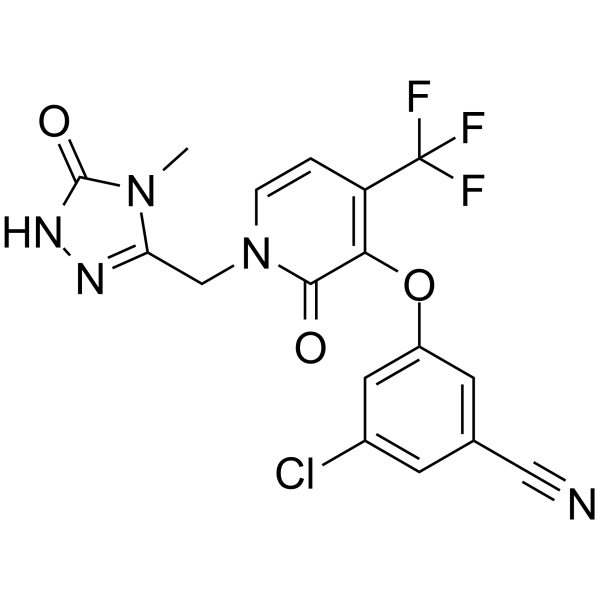
- Formula: C17H11ClF3N5O3
- Molecular Weight: 425.75
Doravirine (MK-1439) is a highly specific HIV-1 nonnucleoside reverse transcriptase inhibitor with IC50s of 4.5 nM, 5.5 nM and 6.1 nM against the wild type and K103N and Y181C reverse transcriptase mutants, respectively.
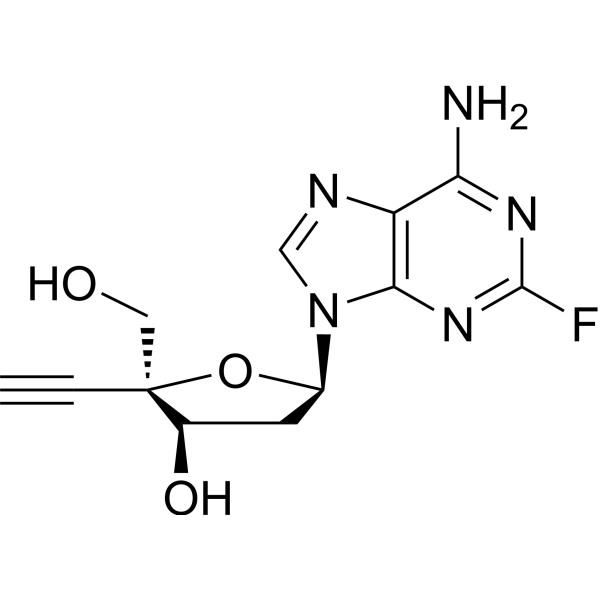
- Formula: C12H12FN5O3
- Molecular Weight: 293.25
Islatravir (MK-8591) is a potent anti-HIV-1 agent, acting as a nucleoside reverse transcriptase inhibitor, with EC50s of 0.068 nM, 3.1 nM and 0.15 nM for HIV-1 (WT), HIV-1 (M184V), HIV-1 (MDR), respectively. Islatravir is a click chemistry reagent, it contains an Alkyne group and can undergo copper-catalyzed azide-alkyne cycloaddition (CuAAc) with molecules containing Azide groups.

- Formula: C12H19N3O7S
- Molecular Weight: 349.36
S-Acetylglutathione is a glutathione derivative and intracellular glutathione supplement that bypasses glutathione synthetase deficiency through intracellular thioesterase conversion, exhibits higher blood stability than glutathione, and selectively induces apoptosis in lymphoma and malignant cells by inducing oxidative stress (apoptosis). S-Acetylglutathione can be used in research on glutathione synthetase deficiency, herpes simplex virus type 1 infection, murine AIDS, lymphoma, and malignant tumors.

- Formula: C16H20ClN3S
- Molecular Weight: 321.87

- Formula: C31H23N7O2
- Molecular Weight: 525.56
NNRT-IN-17 is a non-nucleoside HIV-1 Reverse Transcriptase inhibitor with an IC50 of 0.095 μM. NNRT-IN-17 exerts its inhibitory effect by binding to the NNRTI binding pocket and adjacent sites, and exhibits antiviral activity against wild-type and multiple NNRTI-resistant mutant strains. NNRT-IN-17 can be used for the study of HIV-1 infection (AIDS).

- Formula: C9H14N4O
- Molecular Weight: 194.23
Azimexon (BM 12.531) is an orally active immunomodulator with radioprotective and antitumor activities. Azimexon prolongs survival in multiple mouse models, enhances immunity and hematopoiesis, and alleviates radiation injury and tumor metastasis. Azimexon causes reversible hemolytic anemia in rats and dogs, and exerts therapeutic activity against adjuvant-induced arthritis in rats. Azimexon can be used for the research of lung carcinoma, leukemia, multiple myeloma, lung tumor, arthritis, breast cancer and AIDS‑related complex.

- Formula: C18H14N2O3
- Molecular Weight: 306.32

- Formula: C21H25N5O
- Molecular Weight: 363.47
U 88204 is a potent HIV-1 reverse transcriptase (RT) inhibitor with an IC50 of 0.25 μM. U 88204 blocks HIV-1 replication in infected cells. U 88204 can be used for the research on HIV-infection and of acquired immunodeficiency syndrome (AIDs).

- Formula: C30H43N4O6P
- Molecular Weight: 586.66
PAC-Phe-Val is a potent HIV-1 protease inhibitor with an IC50 value of 33.10 nM. PAC-Phe-Val forms stable and strong interactions with critical active site residues, contributing to its high inhibitory potency. PAC-Phe-Val can be used for HIV/AIDS research.

- Formula: C22H29N5O5S
- Molecular Weight: 475.56
Atevirdine (U 87201E) mesylate is a nonnucleoside reverse transcriptase (NNRT) inhibitor. Atevirdine mesylate can inhibit human immunodeficiency virus type 1 (HIV-1) with an IC50 of 0.06-1.6 μM. Atevirdine mesylate shows highly synergistic effects against Zidovudine/Didanosine-resistant clinical isolates of HIV-1 companied with Zidovudine (HY-17413)/Didanosine (Hy-B0249). Atevirdine mesylate can be used for the research of AIDS.

- Formula: C37H64O11
- Molecular Weight: 684.90
Kijimicin is a polyether ionophore antibiotic originally discovered in Actinomadura sp. MI215-NF3. inhibits HIV-1 replication and reduces the infectivity of progeny viral particles. Kijimicin exhibits inhibitory activity against intracellular T. gondii (IC50 = 45.6 nM), extracellular parasites (IC50 = 216.6 pM) and C. parvum (IC50 = 7.7 nM), and controls acute T. gondii infection in mice. Kijimicin can be used for research on HIV, toxoplasmosis, cryptosporidiosis, and bacterial infections.

- Formula: C36H45N5O7S
- Molecular Weight: 691.84

- Formula: C34H51N5O5
- Molecular Weight: 609.81
U 92163 is an HIV-2 protease inhibitor. It is a synthetic peptidomimetic transition-state analog. U 92163 binds in an extended conformation along the length of the enzyme's binding cleft, and forms hydrogen bonds with the catalytic aspartate pair and other protease residues to block enzyme activity. U 92163 can be used in research on acquired immunodeficiency syndrome (AIDS).

- Formula: C39H56N6O10
- Molecular Weight: 768.90
Rpi-856 C is an Aspartic protease inhibitor, with an IC50 of 5.5 nM against HIV-1 protease, 9.2 nM against HTLV-I protease, 2.0 μM against Cathepsin D, and 4.8 μM against Pepsin. Rpi-856 C is produced by the Streptomyces strain AL-322. Rpi-856 C does not inhibit chymosin, trypsin, chymotrypsin, papain, bromelain, thermolysin, prolyl endopeptidase, carboxypeptidase A or carboxypeptidase B. Rpi-856 C can be used in the research of acquired immunodeficiency syndrome (AIDS) and related diseases, as well as HIV infection.

- Formula: C43H61N7O13
- Molecular Weight: 883.98
Rpi-856 A is a competitive inhibitor of HIV-1 protease and HTLV-I protease, with an IC50 of 37 nM against HIV-1 protease and an IC50 of 27 nM against HTLV-I protease. Rpi-856 A inhibits Pepsin with an IC50 of 1.9 μM. Rpi-856 A does not inhibit chymosin, trypsin, chymotrypsin, papain, bromelain, thermolysin, prolyl endopeptidase, carboxypeptidase A or carboxypeptidase B. Rpi-856 A can be used in the research of acquired immunodeficiency syndrome (AIDS) and related diseases, as well as HIV infection.

- Formula: C17H16Br2N2O2
- Molecular Weight: 440.14
R-95845 is a non-nucleoside HIV-1 reverse transcriptase (RT) inhibitor. R-95845 is specific to HIV-1 RT and acts as a functionally non-competitive inhibitor with respect to nucleotide incorporation. R-95845 binds to the non-nucleoside inhibitor binding pocket of HIV-1 RT in a butterfly-like conformation, forms hydrogen bonds with Tyr 188 and Val 189, and engages in hydrophobic interactions with surrounding residues. R-95845 can be used in studies related to HIV-1 infection and acquired immunodeficiency syndrome.

- Formula: C40H45N5O7S2
- Molecular Weight: 771.94

- Formula: C37H63NaO11
- Molecular Weight: 706.88
Kijimicin sodium is a polyether ionophore antibiotic originally discovered in Actinomadura sp. MI215-NF3. Kijimicin sodium inhibits HIV-1 replication and reduces the infectivity of progeny viral particles. Kijimicin sodium exhibits inhibitory activity against intracellular T. gondii (IC50 = 45.6 nM), extracellular parasites (IC50 = 216.6 pM) and C. parvum (IC50 = 7.7 nM), and controls acute T. gondii infection in mice. Kijimicin sodium can be used for research on HIV, toxoplasmosis, cryptosporidiosis, and bacterial infections.

- Formula: C28H37NO4S
- Molecular Weight: 483.66
CI-1029 is a HIV-1 protease inhibitor with a human IC50 of 0.11 nM. CI-1029 inhibits both wild-type and mutant HIV proteases, and exhibits antiviral activity against HIV and multiple drug-resistant HIV strains, with an EC50 of 6.31 μM in the presence of 30% human serum. CI-1029 can be used in studies related to HIV infection and acquired immunodeficiency syndrome (AIDS).

- Formula: C12H12FN5O3
- Molecular Weight: 293.25
Islatravir (Standard) is the analytical standard of Islatravir (HY-104012). This product is intended for research and analytical applications. Islatravir (MK-8591) is a potent anti-HIV-1 agent, acting as a nucleoside reverse transcriptase inhibitor, with EC50s of 0.068 nM, 3.1 nM and 0.15 nM for HIV-1 (WT), HIV-1 (M184V), HIV-1 (MDR), respectively. Islatravir is a click chemistry reagent, it contains an Alkyne group and can undergo copper-catalyzed azide-alkyne cycloaddition (CuAAc) with molecules containing Azide groups.
- 1



