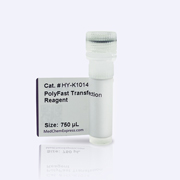
PolyFast Transfection Reagent
Based on 43 publication(s) in Google Scholar
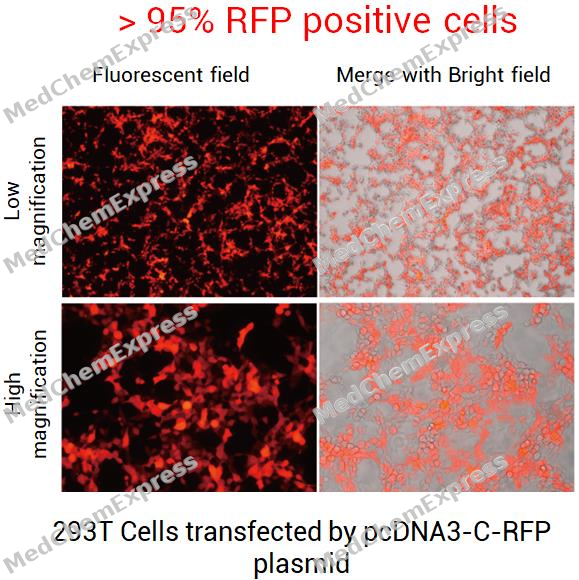
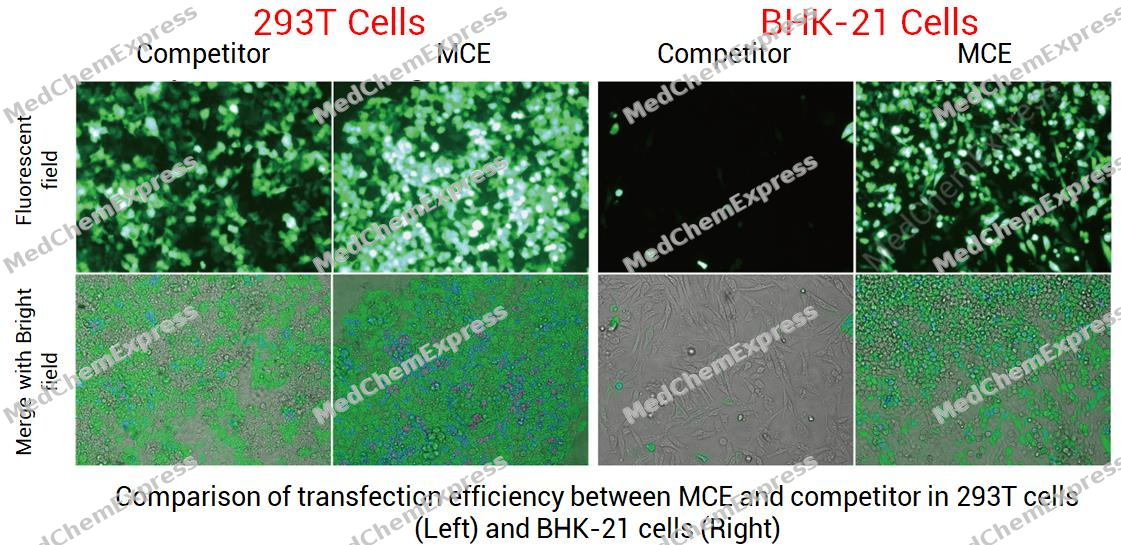
MCE PolyFast Transfection Reagent consists of cationic polymers and can introduce nucleic acids (DNA or RNA) into eukaryotic cells efficiently, including some hard-to-transfect cells.
-
Storage :
Store at -20°C for 2 years. Avoid repetitive freeze-thaw cycles.


To place orders, for customer services and technical support, please contact: MedChemExpress USA
Tel: 609-228-6898 E-mail: [email protected] [email protected]



-
HY-K2014
PEI Transfection Reagent -

HY-K2017
siRNA/miRNA Transfection Reagent -
HY-K0202
Protein A/G Magnetic Beads -
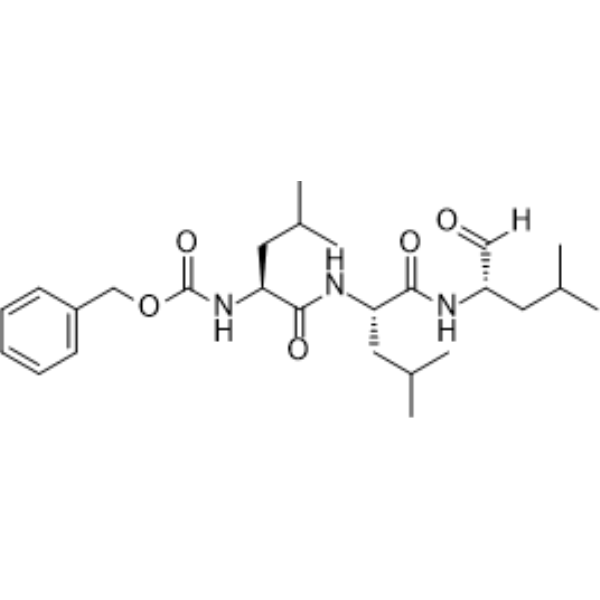
HY-13259
MG-132 -
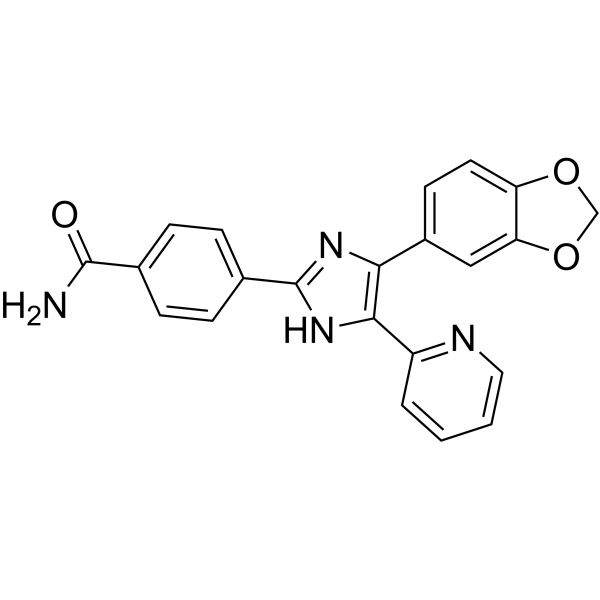
HY-10431
SB-431542 -
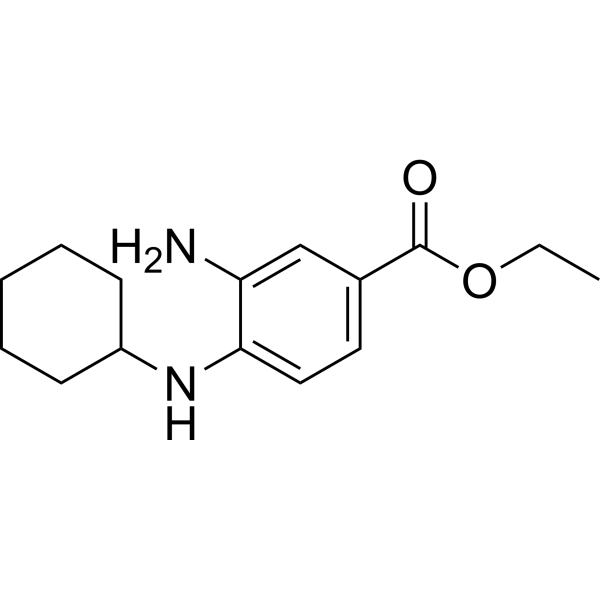
HY-100579
Ferrostatin-1 -

HY-K0301
Cell Counting Kit-8 -

HY-K2015
Lentivirus Transfection Reagent -
HY-K0010
Protease Inhibitor Cocktail (EDTA-Free, 100× in DMSO) -

HY-K1005
Ultra High Sensitivity ECL Kit -
HY-K0011
Protease Inhibitor Cocktail, mini-Tablet (EDTA-Free) -
HY-K0021
Phosphatase Inhibitor Cocktail I (100× in DMSO)


Description & Advantages
MCE PolyFast Transfection Reagent consists of cationic polymers and can introduce nucleic acids (DNA or RNA) into eukaryotic cells. In polymer-based transfection, exogenous DNA forms complexes with cationic polymers that enter host cells by endocytosis. PolyFast Transfection Reagent has high-efficiency, low-toxicity transfection of many cell types, including some hard-to-transfect cells.


Protocol
1. Prepare cells
1.1 Inoculate cells in advance until the desnity reaches 70-90% for cell transfection.
Note: The viability and general health of cells prior to transfection significantly affect transfection result. Cells should be at least 90% viable prior to transfection and have had sufficient time to recover from passaging.
1.2 Remove the medium. Wash twice with PBS, and then add 900 μL serum-free medium to each well of 6-well plate.
2. Prepare PolyFast Transfection Reagent/DNA complex
2.1 According to table 1, dilute 3 μL PolyFast Transfection Reagent with 50 μL serum-free medium for each well of 6-well plate and mix gently. Incubate at room temperature for 5 minutes.
2.2 According to table 1, dilute 1 μg DNA with 50 μL serum-free medium for each well of 6-well plate and mix gently. Incubate at room temperature for 5 minutes.
2.3 Mix the diluted PolyFast Transfection Reagent and DNA gently. Incubate at room temperature for 15 minutes.
3. Add PolyFast Transfection Reagent/DNA complex to cells
Add the PolyFast Transfection Reagent/DNA complex to cells in 6-well plate and mix well. Incubate at 37°C for 24-48 hours. The medium can be replaced with fresh serum-containing medium after 6 hours if necessary.
| Table 1. PolyFast Transfection Reagent: DNA Ratio. | |||||||
| Plate Size | 96-Well | 24-Well | 12-Well | 6-Well | 60 mm | 100 mm | |
|---|---|---|---|---|---|---|---|
| Growth Area (per well) | 0.3 cm2 | 2 cm2 | 4 cm2 | 9.5 cm2 | 20 cm2 | 60 cm2 | |
| Serum-free medium | 80 μL | 450 μL | 630 μL | 900 μL | 2.7 mL | 5.4 mL | |
| Dilution of Transfection Reagent | Transfection Reagent | 0.75 μL | 1.5 μL | 2.25 μL | 3 μL | 7.5 μL | 15 μL |
| Serum-free medium | 10 μL | 25 μL | 35 μL | 50 μL | 150 μL | 300 μL | |
| Dilution of DNA or RNA | RNA | 0.25 μg | 0.5 μg | 0.75 μg | 1 μg | 2.5 μg | 5 μg |
| Serum-free medium | 10 μL | 25 μL | 35 μL | 50 μL | 150 μL | 300 μL | |
| Total Volume (per well) | 100 μL | 500 μL | 700 μL | 1 mL | 3 mL | 6 mL | |
Note: 1) Generally, the ratio of DNA (μg) to PolyFast Transfection Reagent (μL) is 1:3, and the transfection effect can be optimized in the range of 1:1 to 1:5 if necessary.
2) RNA transfection just follows the protocol as described for DNA.
4. Detection
Measure transfection efficiency using an appropriate assay for the reporter gene. For transient transfection, cells are typically assayed 24-48 hours after transfection.


Publications
-
Journal Impact Factor
-
Most Recent
-
Cell Host MicrobeRothia mucilaginosa membrane vesicles stabilize labile iron to alleviate UVB-induced ferroptosis. [Abstract]2026 Jan 14;34(1):35-51.e9. PMID: 41500222
-
J Adv ResClostridium butyricum and its metabolites regulate macrophage polarization through miR-146a to antagonize gouty arthritis. [Abstract]2025 May 19:S2090-1232(25)00354-6. PMID: 40398744
-
J Invest Surg2025 Dec;38(1):2480799. PMID: 40114371
Storage
Store at -20°C for 2 years. Avoid repetitive freeze-thaw cycles.


Components
| Components | HY-K1014-750 μL | HY-K1014-1.5 mL | HY-K1014-7.5 mL |
|---|---|---|---|
| PolyFast Transfection Reagent | 750 μL | 1.5 mL | 5×1.5 mL |


 Please enter the correct Lot Number