



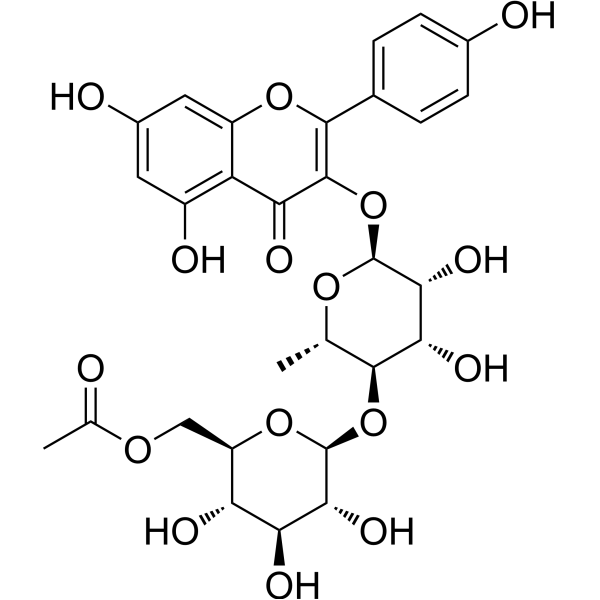
Multiflorin A
Multiflorin A is an orally active active ingredient of traditional herbal laxative, Pruni semen. Multiflorin A inhibits aromatase enzyme activity with an IC50 of 15.5 μM. Multiflorin A also inhibits quinone reductase 2 (QR2) and COX-2 enzyme. Multiflorin A has purgative activity and reduces postprandial blood glucose in mice. Multiflorin A modulates intestinal glucose transporters, tight junction proteins, and aquaporins, reshapes gut microbiota, and alters faecal metabolites. Multiflorin A can be used for the research of constipation and diabetes.
연구목적의 판매만을 진행합니다. 환자를 대상으로 한 판매는 하지 않습니다.
- CAS No.: 1350028-90-8
- 화학식: C29H32O16
- 분자량:636.55
-
보관:Powder -20°C, 3 years ; In solvent -80°C, 6 months , -20°C, 1 month

To place orders, for customer services and technical support, please contact: MedChemExpress USA
Tel: 609-228-6898 E-mail: [email protected] [email protected]


-
 Biological Activity
-
Chemical Information
- Protocol
- 순도&문서
- References
-
 Help & FAQs




Biological Activity
제품 설명
IC50 & Target
[1]|
Aromatase 15.5 μM (IC50) |
COX-2 |
In Vitro
Multiflorin A potently inhibits aromatase enzyme activity with an IC50 of 15.5 μM[2].
Multiflorin A (11.5 μg/mL) inhibits QR2 enzyme activity by 39%[2].
Multiflorin A (10 μg/mL) stimulates COX-1 enzyme activity by 29% and inhibits COX-2 enzyme activity by 16%[2].
Multiflorin A (20 μg/mL; 6 h) does not inhibit TNF-α-induced NF-κB activity in human embryonic kidney 293 cells at a concentration of 20 μg/mL[2].
Multiflorin A (20 μg/mL) exhibits no significant cytotoxicity toward Hepa1c1c7 or MCF-7 cells[2].
MedChemExpress (MCE) has not independently confirmed the accuracy of these methods. They are for reference only.
In Vivo
Multiflorin A (10-20 mg/kg; i.g.; single dose) effectively reverses Loperamide hydrochloride (HY-B0418A)-induced constipation in male ICR mice, significantly reducing first stool time and increasing faecal water content[1].
Multiflorin A (10 mg/kg; i.g.; single dose) inhibits postprandial blood glucose elevation in male ICR mice, with effects persisting for at least 6 h after administration[1].
Multiflorin A (10-20 mg/kg; i.g.; daily; 3 days) modulates intestinal glucose transporters, tight junction proteins, and aquaporins, reshapes gut microbiota, and alters faecal metabolites in male ICR mice[1].
MedChemExpress (MCE) has not independently confirmed the accuracy of these methods. They are for reference only.
-
Animal Model:ICR (male, 24-26 g)[1]
-
Dosage:20 mg/kg; 40 mg/kg
-
Administration:p.o.; single dose
-
Result:Induced watery diarrhoea in 62% of mice, significantly decreased the time to first red stool, and significantly increased faecal water content compared to controls at 20 mg/kg.
Induced watery diarrhoea in 100% of mice, significantly decreased the time to first red stool, and significantly increased faecal water content compared to controls at 40 mg/kg.
Caused noticeable watery diarrhoea and intestinal distension in fed mice, while fasted mice showed no watery diarrhoea.
-
Animal Model:ICR (male, 24-26 g, loperamide-induced constipation)[1]
-
Dosage:10 mg/kg; 20 mg/kg
-
Administration:p.o.; single dose
-
Result:Significantly decreased the time to first red stool and significantly increased faecal water content compared to the loperamide-induced constipation model group at 10 mg/kg.
Significantly decreased the time to first red stool and significantly increased faecal water content compared to the loperamide-induced constipation model group at 20 mg/kg.


Chemical Information
-
CAS No. 1350028-90-8
-
Appearance Solid
-
분자량 636.55
-
화학식 C29H32O16
-
Color Off-white to yellow
-
SMILES
O=C1C2=C(O)C=C(O)C=C2OC(C3=CC=C(C=C3)O)=C1O[C@H]4[C@@H]([C@@H]([C@H]([C@@H](O4)C)O[C@@H]5O[C@@H]([C@H]([C@@H]([C@H]5O)O)O)COC(C)=O)O)O
-
Structure Classification
-
Initial Source
-
선적
Room temperature in continental US; may vary elsewhere.
-
보관
Powder -20°C 3 years In solvent -80°C 6 months -20°C 1 month


순도&문서
-
Data Sheet (298 KB)
-
SDS (252 KB)
- Français - FR (252 KB)
- Deutsch - DE (252 KB)
- Norwegian - NO (252 KB)
- Español - ES (252 KB)
- Swedish - SV (252 KB)
- Italian - IT (252 KB)
- Korean - KR (252 KB)
- Portuguese - PT (252 KB)
-
Handling Instructions (2659 KB)
References

Calculators
Concentration (start) × Volume (start) = Concentration (final) × Volume (final)


Multiflorin A Related Classifications
HY-N12326 Related Classifications
 Powered by Bioz