



Gemtuzumab ozogamicin
Based on 2 publication(s) in Google Scholar
Gemtuzumab ozogamicin is an antibody-drug conjugate (ADC) consisting of a humanized immunoglobulin (IgG4) antibody directed against CD33 that is conjugated to the cytotoxic agent Calicheamicin (HY-19609). The antibody portion is Gemtuzumab (HY-P99971), and the drug-linker conjugate for ADC is N-Ac-γ-Calicheamicin-AcBut-NHS ester (HY-103688). Gemtuzumab ozogamicin can be used for the research of acute myeloid leukemia (AML).
For research use only. We do not sell to patients.
- Purity : 95.00%
- CAS No.: 220578-59-6
- Molecular Weight:151000 (average)
-
Storage:
Please store the product under the recommended conditions in the Certificate of Analysis.


To place orders, for customer services and technical support, please contact: MedChemExpress USA
Tel: 609-228-6898 E-mail: [email protected] [email protected]


-
 Biological Activity
-
Chemical Information
- Protocols
- Purity & Documentation
- References
-
 Help & FAQs


-

HY-P3239
Belantamab mafodotinAnti-BCMA ADC -

HY-P99107A
Brentuximab vedotin (solution)ADC -

HY-P99971
GemtuzumabCD33 ADC Antibody -

HY-P99349
Loncastuximab tesirineAntibody-Drug Conjugate -

HY-132253A
Polatuzumab vedotin (solution)Microtubule Inhibitor -
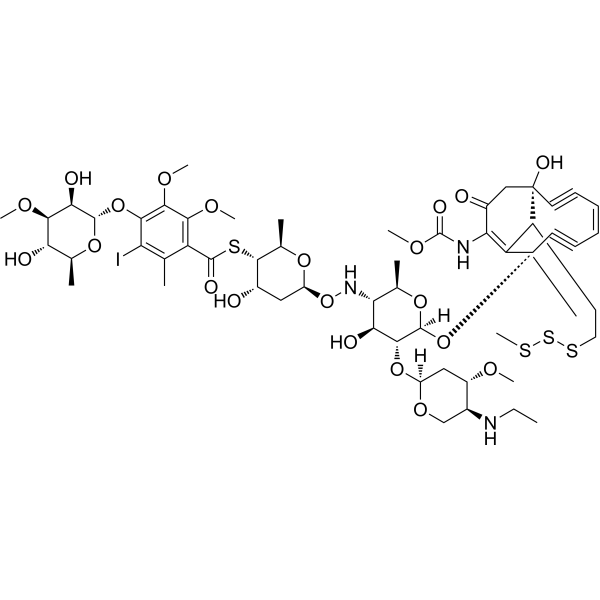
HY-19609
CalicheamicinDNA-binding ADC Cytotoxin -

HY-141601
Telisotuzumab vedotinAnti-c-MET ADC -
HY-P99001
Human IgG1 kappa, Isotype ControlIgG1κ Isotype Control -

HY-152963
Tisotumab vedotinAntibody-Drug Conjugate -

HY-138298A
Trastuzumab deruxtecanHER2 ADC -

HY-P9921
Trastuzumab emtansineAntibody-drug Conjugate -

HY-141598
Datopotamab deruxtecan (solution)TROP2-Targeted ADC
Publications Citing Use of MedChemExpress (MCE) Gemtuzumab ozogamicin
More

Biological Activity
Description
In Vitro
Gemtuzumab ozogamicin (1-250 ng/mL ; 72 hours) has cell cytotoxicity in CD33-positive cells[1].
Gemtuzumab ozogamicin is an ADC. After binding of the antibody to CD33 and subsequent internalization, Calicheamicin mediates cytotoxicity to CD33-positive myeloid cells primarily through induction of DNA damage and subsequent apoptosis[1].
Gemtuzumab ozogamicin iproduces significant inhibition of colony formation in cultures of adult leukemic bone marrow cells[3].
Gemtuzumab ozogamicin (5-100 μg/L) suppressed the cell growth of HL-60, NOMO-1, NB-3 and NKM-1 cell lines in a dose-dependent manner[3].
Gemtuzumab ozogamicin (Compound GO) (1-100 nM, 24 h) induces dose-dependent capase activation at 10 and 100 nM in HL-60 cells[4].
Gemtuzumab ozogamicin (1 nM-1 μM, 72 h) kills 95.05% of HL-60 and 42.61% of K-562 cells[4].
MedChemExpress (MCE) has not independently confirmed the accuracy of these methods. They are for reference only. Further protocols information, click here.
-
Cell Line:CD33-positive and CD33-deficient cells (HL60, HL60R, Kasumi-1, MV4-11, MV4-11R, primary CD34-positive HSPCs and primary AML blasts)
-
Concentration:0, 1, 5, 10, 25, 50, 100, 250 ng/mL
-
Incubation Time:72 hours
-
Result:Wildtype HL60 exhibited the highest sensitivity to GO (IC50=1.37 ng/mL), and almost all HL60 cells died at 5 ng/mL concentration.
HL60R, Kasumi-1, MV4-11 and MV4-11R showed similar sensitivity, with IC50s of 2.28, 3.19, 3.63 and 5.36 ng/mL, respectively.
IC50 in CD33-negative HL60R, Kasumi-1, MV4-11 and MV4-11R cells also increased significantly to 95.53, 50.78, 72.74 and 66.8 ng/mL, respectively.
Clinical Trial
| NCT Number | Sponsor | Condition | Start Date |
Phase

|
|---|---|---|---|---|
| NCT01329991 | Plexxikon| | 2011-05 | PHASE1 |


Chemical Information
-
CAS No. 220578-59-6
-
Appearance Solid
-
Molecular Weight 151000 (average)
-
Color White to off-white
-
SMILES
[Gemtuzumab ozogamicin]
-
Preparation Instructions
The product can be reconstituted/diluted with sterile PBS or saline.
-
Shipping
Shipping with dry ice.
-
Storage
Please store the product under the recommended conditions in the Certificate of Analysis.


Publications (2)
-
Journal Impact Factor
-
Most Recent
-
-
bioRxiv
2025 Aug 21:2025.08.17.670714. PMID: 40894621

Protocols
-
Cell Viability Determination by MTT Colorimetric Assay
The following protocol uses the MTT colorimetric assay as a classic literature-established method for assessing cell viability/metabolic activity in cultured mammalian cells. MTT[3-(4,5-dimethylthiazol-2-yl)-2,5-diphenyltetrazolium bromide] is reduced by metabolically active cells to a colored formazan product; the amount of formazan is quantified spectrophotometrically and provides an indirect measure of metabolically active viable cells. Importantly, MTT reduction reflects cellular oxidoreductase/metabolic activity rather than an absolute direct count of living cells, so changes in cellular metabolism can alter the signal independently of cell number.


Purity & Documentation
-
Data Sheet (270 KB)
-
SDS (251 KB)
- English - EN (251 KB)
- Français - FR (251 KB)
- Deutsch - DE (251 KB)
- Norwegian - NO (251 KB)
- Español - ES (251 KB)
- Swedish - SV (251 KB)
- Italian - IT (251 KB)
- Korean - KR (251 KB)
- Portuguese - PT (251 KB)
-
Handling Instructions (2659 KB)
References
[1]. Yi Liu, et al. CD33-directed immunotherapy with third-generation chimeric antigen receptor T cells and gemtuzumab ozogamicin in intact and CD33-edited acute myeloid leukemia and hematopoietic stem and progenitor cells. Int J Cancer. 2022 Apr 1;150(7):1141-1155. [Content Brief]
[2]. Baron J, et al. Gemtuzumab ozogamicin for the treatment of acute myeloid leukemia. Expert Rev Clin Pharmacol. 2018;11(6):549-559. [Content Brief]
[3]. McGavin, J. K., & Spencer, C. M. (2001). Gemtuzumab ozogamicin. Drugs, 61(9), 1317–1324. [Content Brief]
[4]. Petrich, T., et al., (2010). In vitro experimental (211)At-anti-CD33 antibody therapy of leukaemia cells overcomes cellular resistance seen in vivo against gemtuzumab ozogamicin. European journal of nuclear medicine and molecular imaging, 37(5), 851–861. [Content Brief]

Calculators
Concentration (start) × Volume (start) = Concentration (final) × Volume (final)


Gemtuzumab ozogamicin Related Classifications
HY-109539 Related Classifications
 Powered by Bioz