



ACVR2A/Activin RIIA Protein, Human/Cynomolgus (HEK293, His, solution)

Based on 1 Customer Validation
ACVR2A, also known as Activin RIIA, is an activin type II receptor. On ligand binding, ACVR2A can forms a receptor complex consisting of two type II and two type I transmembrane serine/threonine kinases. ACVR2A is a receptor for Activin A, Activin B and Inhibin A. ACVR2A/Activin RIIA Protein, Human/Cynomolgus (HEK293, His, solution) is produced in HEK293 cells with six C-Terminal His-tags. It consists of 115 amino acids (A20-P134).
- Species: Human; Cynomolgus
- Source: HEK293
-
Storage:Stored at -80°C for 1 year from date of receipt. It is stable at -20°C for 3 months after opening. It is recommended to freeze aliquots at -80°C for extended storage. Avoid repeated freeze-thaw cycles.


To place orders, for customer services and technical support, please contact: MedChemExpress USA
Tel: 609-228-6898 E-mail: [email protected] [email protected]


-
 Biological Activity
-
Technical Parameters
-
Product Properties
- Documentation
- References
- Help & FAQs




Biological Activity
Description
ACVR2A, also known as Activin RIIA, is an activin type II receptor. On ligand binding, ACVR2A can forms a receptor complex consisting of two type II and two type I transmembrane serine/threonine kinases. ACVR2A is a receptor for Activin A, Activin B and Inhibin A[1][2]. ACVR2A/Activin RIIA Protein, Human/Cynomolgus (HEK293, His, solution) is produced in HEK293 cells with six C-Terminal His-tags. It consists of 115 amino acids (A20-P134).
Background
ACVR2A is a type II member of the TGF-β family of receptor Serine/Threonine kinases. ACVR2A is a receptor for Activin A, Activin B and Inhibin A[1][2].
The sequence of amino acids in ACVR2A proteins from different species is very stable, which leads to the conclusion that in the process of evolution, ACVR2A has been only slightly altered, and that both in humans and in animals, its function is similar.
Signaling by activins and BMPs is highly promiscuous, since apart from signaling through ALK4/7, the activin type II receptors (ACVR2A and 2B) can interact also with several type I BMP receptors (ALK1/2/3/6), which can also form complexes with the type II BMP receptor, BMPRII. Type II receptors phosphorylate and activate type I receptors which autophosphorylate, then bind and activate SMAD transcriptional regulators. ACVR2A can form complexes with different type I receptors that signal either to Smad2/3 (ALK4) or to Smad1/5/8 (ALK2, ALK3, ALK6). The different type I receptors compete for binding to ACVR2A and that this competition provides a mechanism that balances signaling between Activin A-mediated, ALK4-dependent Smad2/3 signaling, and BMP-mediated ALK2 or ALK3-dependent signaling to Smad1/5/8. In myeloma cells, BMP-6- and BMP-9-induced activation of SMAD1/5/8 through ACVR2A/ACVR2B/ALK2 is inhibited by activin A treatment[1][3].
In Vitro
Recombinant human ACVR2A (5 μg/mL) inhibits the effects of BMP-9 on INA-6 and IH-1 cells[1].
Recombinant human ACVR2A (100 μg/mL; 96 hours) blocks the β-cell-proliferative effect of adenoviruses containing mouse Pdx-1 (AdCMV-mPdx-1) treatment[4].
Verified Bioactivity
This product does not contain protein kinase domain.
MCE Validation Data
-
Purity - SDS-PAGE
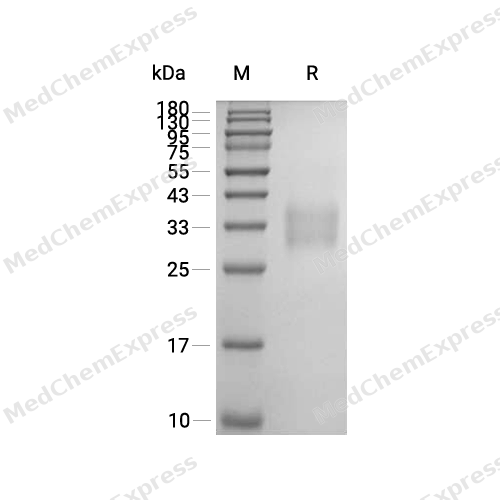
Purity - SDS-PAGE


Technical Parameters
-
Species Human; Cynomolgus
-
Source HEK293
-
Tag C-6*His
-
Accession
P27037-1/G7PKJ4 (A20-P134)
-
Molecular Construction
-
N-term
-
ACVR2A (A20-P134)
Accession # P27037-1 -
6*His
-
C-term
-
-
Protein Length
Extracellular Domain
-
Synonyms
ACVR2A; Activin Receptor Type-2A; Prev. ACVR2; Activin Receptor Type IIA; ACTRII; ACTR-IIA; Activin A Receptor, Type IIA; ACTRIIA; Activin A Receptor Type 2A; Activin A Receptor, Type II
-
AA Sequence
AILGRSETQECLFFNANWEKDRTNQTGVEPCYGDKDKRRHCFATWKNISGSIEIVKQGCWLDDINCYDRTDCVEKKDSPEVYFCCCEGNMCNEKFSYFPEMEVTQPTSNPVTPKP
-
Predicted Molecular Mass
14.4 kDa
-
Molecular Weight
Approximately 28-38 kDa, based on SDS-PAGE under reducing conditions.
-
Glycosylation
Yes
-
Purity
≥ 95%, as determined by reducing SDS-PAGE.


Product Properties
Solution.
Supplied as a 0.22 μm filtered solution of 20 mM PB, 300 mM NaCl, 10% Glycerol, 5% Trealose, pH 7.4.
<1 EU/μg, determined by LAL method.
Please use rapid thawing with running water to thaw the protein.
Stored at -80°C for 1 year from date of receipt. It is stable at -20°C for 3 months after opening. It is recommended to freeze aliquots at -80°C for extended storage. Avoid repeated freeze-thaw cycles.
Shipping with dry ice.


Documentation
-
Data Sheet (263 KB)
-
SDS (252 KB)
- English - EN (252 KB)
- Français - FR (252 KB)
- Deutsch - DE (252 KB)
- Norwegian - NO (252 KB)
- Español - ES (252 KB)
- Swedish - SV (252 KB)
- Italian - IT (252 KB)
- Korean - KR (252 KB)
- Portuguese - PT (252 KB)
-
Handling Instructions (2659 KB)


References
[1]. Oddrun Elise Olsen, et al. Activin A inhibits BMP-signaling by binding ACVR2A and ACVR2B. Cell Commun Signal. 2015 Jun 6;13:27. [Content Brief]
[2]. V K Chin, et al. Inhibition of Activin A suppressed tumor necrosis factor-α secretion and improved histopathological conditions in malarial mice. Trop Biomed. 2021 Mar 1;38(1):187-204. [Content Brief]
[3]. Szabina Szófia Szilágyi, et al. Competition between type I activin and BMP receptors for binding to ACVR2A regulates signaling to distinct Smad pathways. BMC Biol. 2022 Feb 18;20(1):50. [Content Brief]
[4]. Heather L Hayes, et al. A Pdx-1-Regulated Soluble Factor Activates Rat and Human Islet Cell Proliferation. Mol Cell Biol. 2016 Nov 14;36(23):2918-2930. [Content Brief]

Calculators
Concentration (start) × Volume (start) = Concentration (final) × Volume (final)


 Powered by Bioz

