



Amphiregulin Protein, Human (HEK293)
Based on 3 publication(s) in Google Scholar
Amphiregulin Protein, an EGFR ligand, serves as an autocrine growth factor and mitogen for various cells, including astrocytes, Schwann cells, and fibroblasts. It promotes cellular proliferation and interacts with CNIH in its immature precursor stage. Amphiregulin's EGFR activation underscores its role in essential cellular processes, emphasizing its significance as a regulator of cell growth and function in diverse cell types. Amphiregulin Protein, Human (HEK293) is an EGF receptor (EGFR) ligand, and essential for epithelial development in various organs.
- Species: Human
- Source: HEK293
-
Storage:Stored at -20°C for 2 years from date of receipt. After reconstitution, it is stable at 4°C for 1 week or -20°C for longer (with carrier protein). It is recommended to freeze aliquots at -20°C or -80°C for extended storage.


To place orders, for customer services and technical support, please contact: MedChemExpress USA
Tel: 609-228-6898 E-mail: [email protected] [email protected]


-
 Biological Activity
-
Technical Parameters
-
Product Properties
- Documentation
- References
- Help & FAQs


-

HY-P73031
Epiregulin Protein, Human (HEK293, Fc) -
HY-P702502
Amphiregulin Protein, Mouse -
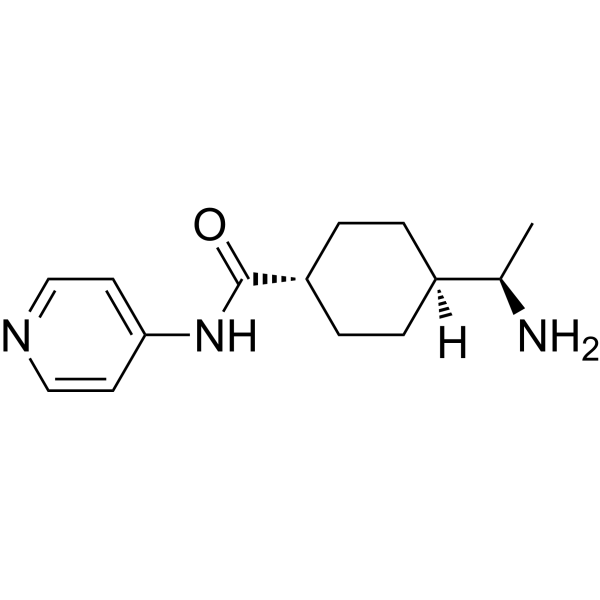
HY-10071
Y-27632ROCK Inhibitor -
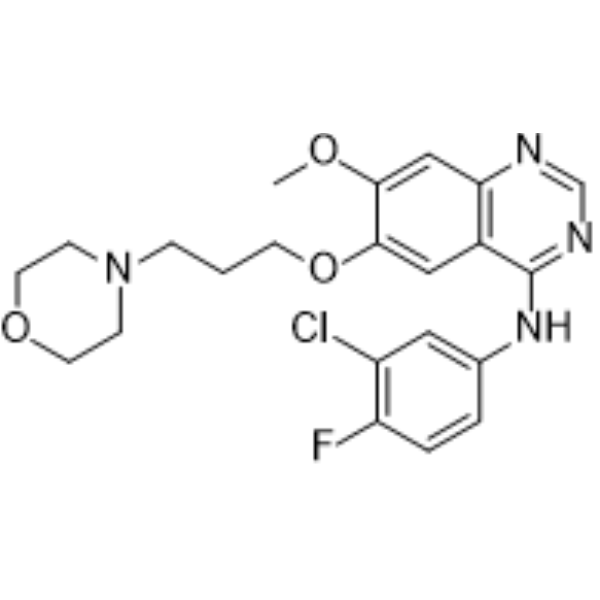
HY-50895
GefitinibEGFR Inhibitor -
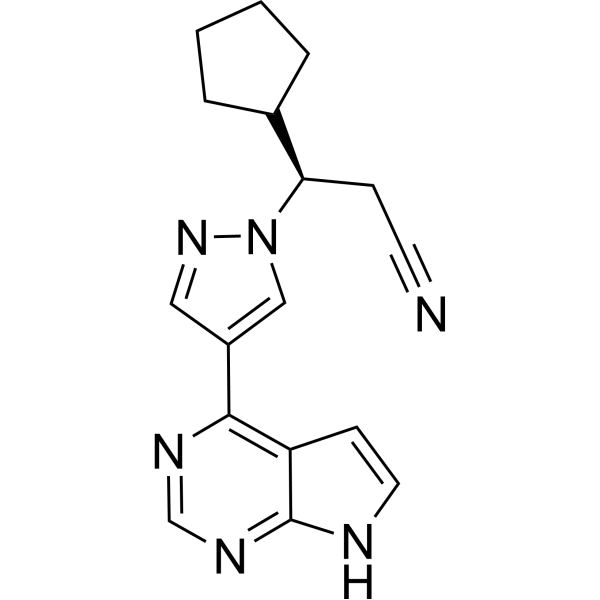
HY-50856
RuxolitinibJAK1/2 Inhibitor -
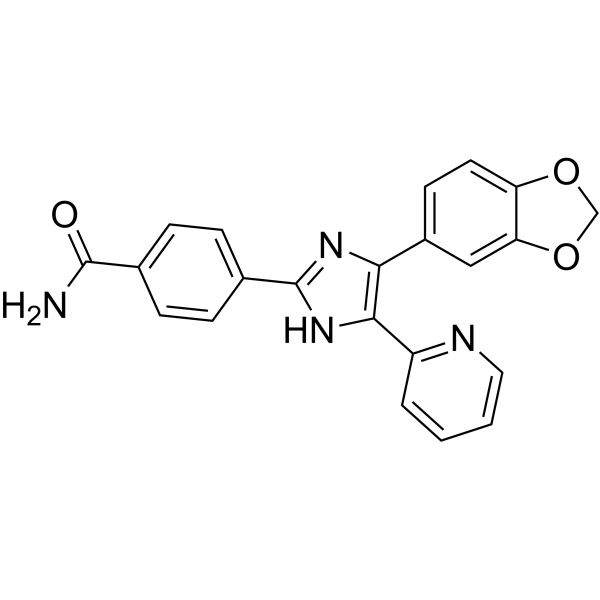
HY-10431
SB-431542TGF-β Receptor Kinase Inhibitor -
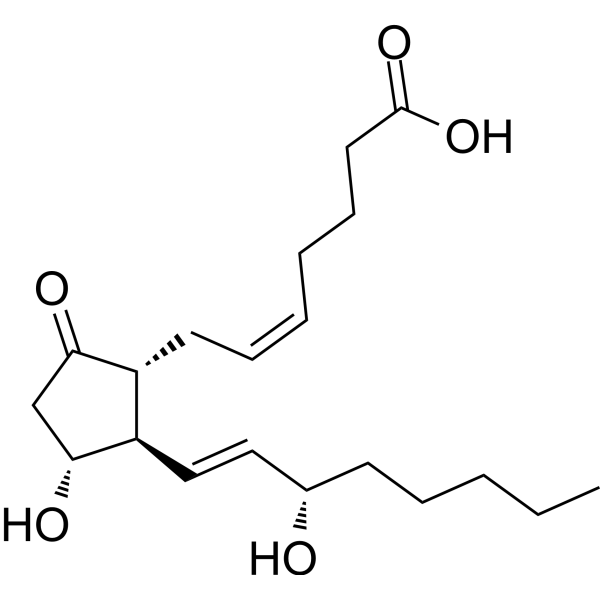
HY-101952
Prostaglandin E2Prostaglandin Receptor Agonist -
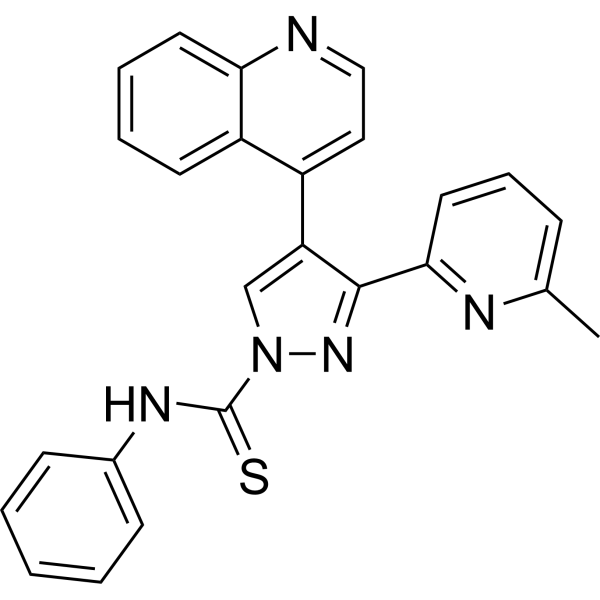
HY-10432
A 83-01ALK4/5/7 Inhibitor -
HY-P77868
Amphiregulin Protein, Mouse (HEK293, Fc) -
HY-P70543
TGF beta 1/TGFB1 Protein, Human (HEK293) -
HY-P70445
IL-4 Protein, Human -
HY-P7011
Epiregulin Protein, Human


Biological Activity
Description
Amphiregulin Protein, an EGFR ligand, serves as an autocrine growth factor and mitogen for various cells, including astrocytes, Schwann cells, and fibroblasts. It promotes cellular proliferation and interacts with CNIH in its immature precursor stage. Amphiregulin's EGFR activation underscores its role in essential cellular processes, emphasizing its significance as a regulator of cell growth and function in diverse cell types. Amphiregulin Protein, Human (HEK293) is an EGF receptor (EGFR) ligand, and essential for epithelial development in various organs.
Background
Amphiregulin, an EGF receptor (EGFR) ligand, and essential for epithelial development in various organs. Amphiregulin is suggested to act as a protective factor in a liver injury model. In mice model with bleomycin-induced pneumopathy, Recombinant Human Amphiregulin improves the survival rate and suppresses the degrees of inflammation and fibrosis and the number of TUNEL-positive cells in lung tissues. Recombinant Human Amphiregulin treatment enhances the activation of Akt and Erk in lung epithelial cells[1].
Verified Bioactivity
Measured in a cell proliferation assay using Balb/3T3 mouse embryonic fibroblast cells. The ED50 for this effect < 15 ng/mL.
MCE Validation Data
-
Purity - SDS-PAGE
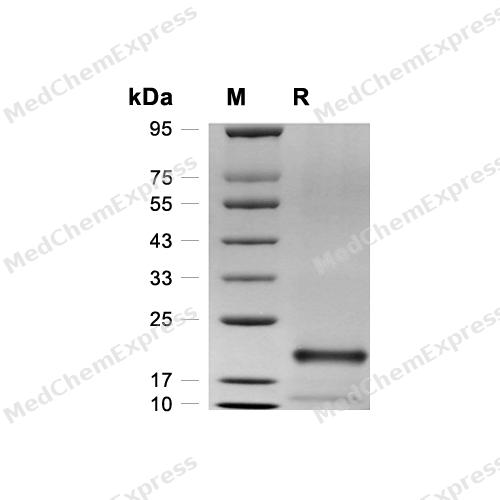
Purity - SDS-PAGE
-
Bioactivity - Cell-Based Assay
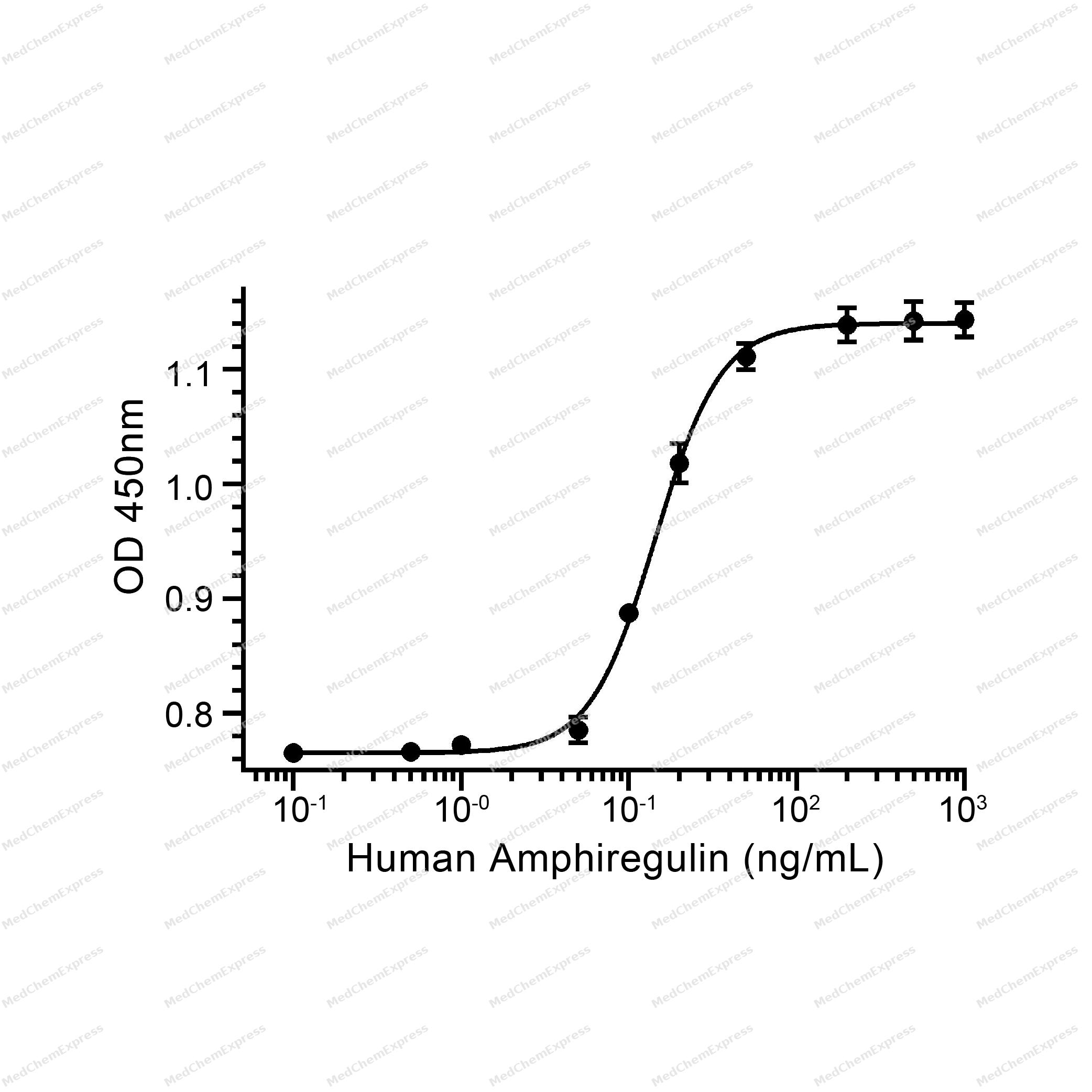
Bioactivity - Cell-Based Assay


Publications (3)
-
Journal Impact Factor
-
Most Recent
-
Adv Sci (Weinh)
Amphiregulin and Epiregulin Confer Radioresistance in Esophageal Squamous Cell Carcinoma Through Oxidative Phosphorylation. [Abstract]2025 Nov 9:e07524. PMID: 41208199 -
Cell Rep Med
Tumor-associated monocytes promote mesenchymal transformation through EGFR signaling in glioma. [Abstract]2023 Sep 19;4(9):101177. PMID: 37652019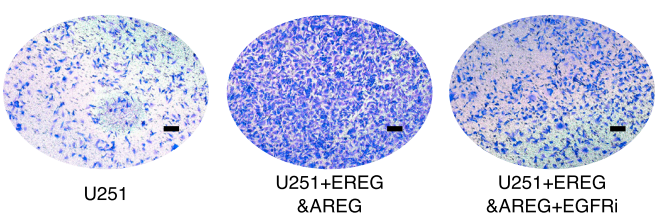
Amphiregulin Protein, Human (HEK293) purchased from MedChemExpress. Usage Cited in: Cell Rep Med. 2023 Sep 19;4(9):101177. [Abstract]
Representative images of GB U251 cells in a trans-well invasion assay under different treatment conditions were shown. The results showed that the invasion of U251 cells increased more than 2-fold with the addition of Amphiregulin Protein, Human (HEK293) (AREG, 200 ng/mL) and EREG (200 ng/mL) in the medium. Moreover, adding the EGFR inhibitor gefitinib in the medium notably decreased the invasion, demonstrating the role of EGFR signaling in regulating U251 cell invasion. Scale bar, 100 μm. Abbreviations: EGFRi, EGFR inhibitor gefitinib.
-


Technical Parameters
-
Species Human
-
Source HEK293
-
Tag Tag Free
-
Accession
P15514 (S101-K198)
-
Molecular Construction
-
N-term
-
Amphiregulin (S101-K198)
Accession # P15514 -
C-term
-
-
Protein Length
Partial
-
Synonyms
AREG; AR; Prev. AREGB; Schwannoma-Derived Growth Factor; Prev. SDGF; Amphiregulin B; CRDGF; Amphiregulin; Colorectum Cell-Derived Growth Factor
-
AA Sequence
SVRVEQVVKPPQNKTESENTSDKPKRKKKGGKNGKNRRNRKKKNPCNAEFQNFCIHGECKYIEHLEAVTCKCQQEYFGERCGEKSMKTHSMIDSSLSK
-
Predicted Molecular Mass
11.3 kDa
-
Molecular Weight
Approximately 15-23 kDa, based on SDS-PAGE under reducing conditions.
-
Glycosylation
Yes
-
Purity
≥ 95%, as determined by reducing SDS-PAGE.


Product Properties
Lyophilized powder
1.Lyophilized from a 0.22 μm filtered solution of PBS.
2.Lyophilized from a 0.22 μm filtered solution of PBS, pH 7.4.
3.Lyophilized from a 0.22 μm filtered solution of PBS, pH 7.4, 8% trehalose.
Please refer to the lot-specific COA for specific buffer information.
<0.2 EU/μg, determined by LAL method.
It is not recommended to reconstitute to a concentration less than 100 μg/mL in ddH2O. For long term storage it is recommended to add a carrier protein (0.1% BSA, 5% HSA, 10% FBS or 5% Trehalose).
Stored at -20°C for 2 years from date of receipt. After reconstitution, it is stable at 4°C for 1 week or -20°C for longer (with carrier protein). It is recommended to freeze aliquots at -20°C or -80°C for extended storage.
Room temperature in continental US; may vary elsewhere.


Documentation
-
Data Sheet (261 KB)
-
SDS (252 KB)
- English - EN (252 KB)
- Français - FR (252 KB)
- Deutsch - DE (252 KB)
- Norwegian - NO (252 KB)
- Español - ES (252 KB)
- Swedish - SV (252 KB)
- Italian - IT (252 KB)
- Korean - KR (252 KB)
- Portuguese - PT (252 KB)
-
Handling Instructions (2659 KB)


References

Calculators
Concentration (start) × Volume (start) = Concentration (final) × Volume (final)


 Powered by Bioz

