



CD164 Protein, Rat (HEK293, Fc)

Based on 1 Customer Validation
CD164 Protein, a sialomucin, crucially influences hematopoiesis and cell adhesion. It enhances myogenesis by positively regulating myoblast migration and promoting the fusion of myoblasts into myotubes through interactions with CXCR4. This highlights CD164's significant role in various cellular activities related to muscle development and function. CD164 Protein, Rat (HEK293, Fc) is the recombinant rat-derived CD164 protein, expressed by HEK293 , with C-hFc labeled tag.
- Species: Rat
- Source: HEK293
-
Storage:Stored at -20°C for 2 years from date of receipt. After reconstitution, it is stable at 4°C for 1 week or -20°C for longer (with carrier protein). It is recommended to freeze aliquots at -20°C or -80°C for extended storage.


To place orders, for customer services and technical support, please contact: MedChemExpress USA
Tel: 609-228-6898 E-mail: [email protected] [email protected]


-
 Biological Activity
-
Technical Parameters
-
Product Properties
- Documentation
- Help & FAQs




Biological Activity
Description
CD164 Protein, a sialomucin, crucially influences hematopoiesis and cell adhesion. It enhances myogenesis by positively regulating myoblast migration and promoting the fusion of myoblasts into myotubes through interactions with CXCR4. This highlights CD164's significant role in various cellular activities related to muscle development and function. CD164 Protein, Rat (HEK293, Fc) is the recombinant rat-derived CD164 protein, expressed by HEK293 , with C-hFc labeled tag.
Background
CD164 protein is a sialomucin that potentially plays a crucial role in hematopoiesis and may also be involved in cell adhesion. It exerts its influence on myogenesis by enhancing CXCR4-dependent cell motility and positively regulates the migration of myoblasts. Additionally, CD164 protein promotes the fusion of myoblasts into myotubes, a process that is analogous to other similar proteins. Notably, it interacts with CXCR4, further emphasizing its significance in various cellular activities related to muscle development and function.
Verified Bioactivity
When Recombinant Rat CD164 Protein is immobilized at 2 µg/mL (100 µL/well) can bind Anti-CD164 antibody. The ED50 for this effect is 15.05 ng/mL.
MCE Validation Data
-
Purity - SDS-PAGE
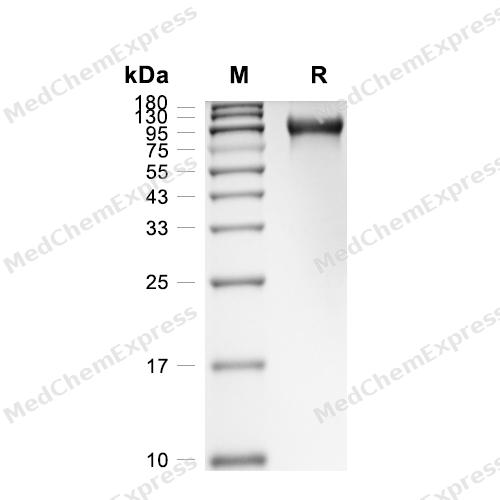
Purity - SDS-PAGE
-
Bioactivity - ELISA
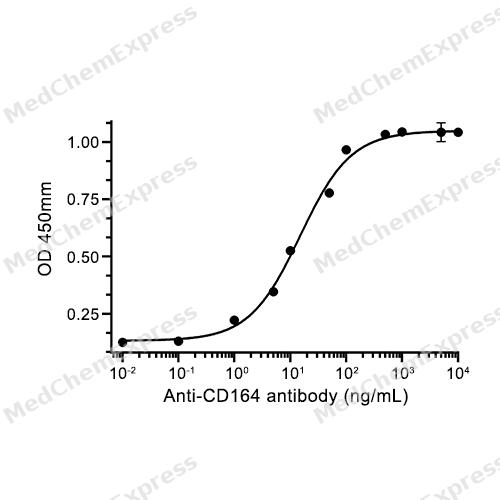
Bioactivity - ELISA


Technical Parameters
-
Species Rat
-
Source HEK293
-
Tag C-hFc
-
Accession
Q9QX82 (Q24-D160)
-
Molecular Construction
-
N-term
-
CD164 (Q24-D160)
Accession # Q9QX82 -
hFc
-
C-term
-
-
Protein Length
Extracellular Domain
-
Synonyms
CD164; Endolyn; CD164 Molecule; DFNA66; MGC-24v; CD164 Antigen, Sialomucin; MUC-24; Deafness, Autosomal Dominant 66; MGC-24; CD164 Molecule, Sialomucin; Multi-Glycosylated Core Protein 24; CD164 Variant C; Sialomucin Core Protein 24; CD164 Antigen
-
AA Sequence
QSNSSASPNVTDPPTTTSKVVPTTLTTTKPPETCESFNSCVSCVNATLTNNITCVWLDCHEANKTYCSSELVSNCTQKTSTDSCSVIPTTPVPTNSTAKPTTRPSSPTPTPSVVTSAGATNTTVTPTSQPERKSTFD
-
Molecular Weight
Approximately 90 kDa & 35 kDa, based on SDS-PAGE under reducing conditions.
-
Glycosylation
Yes
-
Purity
≥ 95%, as determined by reducing SDS-PAGE.


Product Properties
Lyophilized powder.
Lyophilized from a 0.22 μm filtered solution of PBS, pH 7.4.
<1 EU/μg, determined by LAL method.
It is not recommended to reconstitute to a concentration less than 100 μg/mL in ddH2O. For long term storage it is recommended to add a carrier protein (0.1% BSA, 5% HSA, 10% FBS or 5% Trehalose).
Stored at -20°C for 2 years from date of receipt. After reconstitution, it is stable at 4°C for 1 week or -20°C for longer (with carrier protein). It is recommended to freeze aliquots at -20°C or -80°C for extended storage.
Room temperature in continental US; may vary elsewhere.


Documentation
-
Data Sheet (236 KB)
-
SDS (251 KB)
- English - EN (251 KB)
- Français - FR (251 KB)
- Deutsch - DE (251 KB)
- Norwegian - NO (251 KB)
- Español - ES (251 KB)
- Swedish - SV (251 KB)
- Italian - IT (251 KB)
- Korean - KR (251 KB)
- Portuguese - PT (251 KB)
-
Handling Instructions (2659 KB)

Calculators
Concentration (start) × Volume (start) = Concentration (final) × Volume (final)


 Powered by Bioz

