



HSF1 Protein, Human (His)

Based on 1 Customer Validation
HSF1 is a stress-inducible transcription factor that coordinates the heat shock response by binding to the heat shock element (HSE) and activating heat shock genes. In unstressed cells, it remains inactive in multichaperone complexes. HSF1 Protein, Human (His) is the recombinant human-derived HSF1 protein, expressed by E. coli , with N-6*His labeled tag.
- Species: Human
- Source: E. coli
-
Storage:Stored at -20°C for 2 years from date of receipt. After reconstitution, it is stable at 4°C for 1 week or -20°C for longer (with carrier protein). It is recommended to freeze aliquots at -20°C or -80°C for extended storage.


To place orders, for customer services and technical support, please contact: MedChemExpress USA
Tel: 609-228-6898 E-mail: [email protected] [email protected]


-
 Biological Activity
-
Technical Parameters
-
Product Properties
- Documentation
- Help & FAQs




Biological Activity
Description
HSF1 is a stress-inducible transcription factor that coordinates the heat shock response by binding to the heat shock element (HSE) and activating heat shock genes. In unstressed cells, it remains inactive in multichaperone complexes. HSF1 Protein, Human (His) is the recombinant human-derived HSF1 protein, expressed by E. coli , with N-6*His labeled tag.
Background
HSF1, a stress-responsive and DNA-binding transcription factor, is a central orchestrator of the heat shock response (HSR), leading to the transcriptional activation of a multitude of heat shock proteins (HSPs) crucial for cellular protection against damage. In unstressed conditions, HSF1 resides in a HSP90-containing multichaperone complex, maintaining an inactivated monomeric state. Upon exposure to stress, particularly heat, HSF1 undergoes homotrimerization and activates the transcription of HSP genes by binding to heat shock elements (HSEs) in their promoters. This transition is reversible, and during the recovery phase of the HSR, HSF1 returns to its unactivated form. Beyond transcriptional activation, HSF1 participates in various cellular processes, including chromatin-associated complex formation with TTC5/STRAP and p300/EP300, repression of Ras-induced c-fos gene transcription, regulation of pre-mRNA processing, nuclear export of stress-induced mRNA, and modulation of mitotic progression. Additionally, in the context of microbial infection, HSF1 plays a role in the reactivation of latent human immunodeficiency virus (HIV-1) transcription by binding to the HIV-1 long terminal repeat promoter.
MCE Validation Data
-
Purity - SDS-PAGE
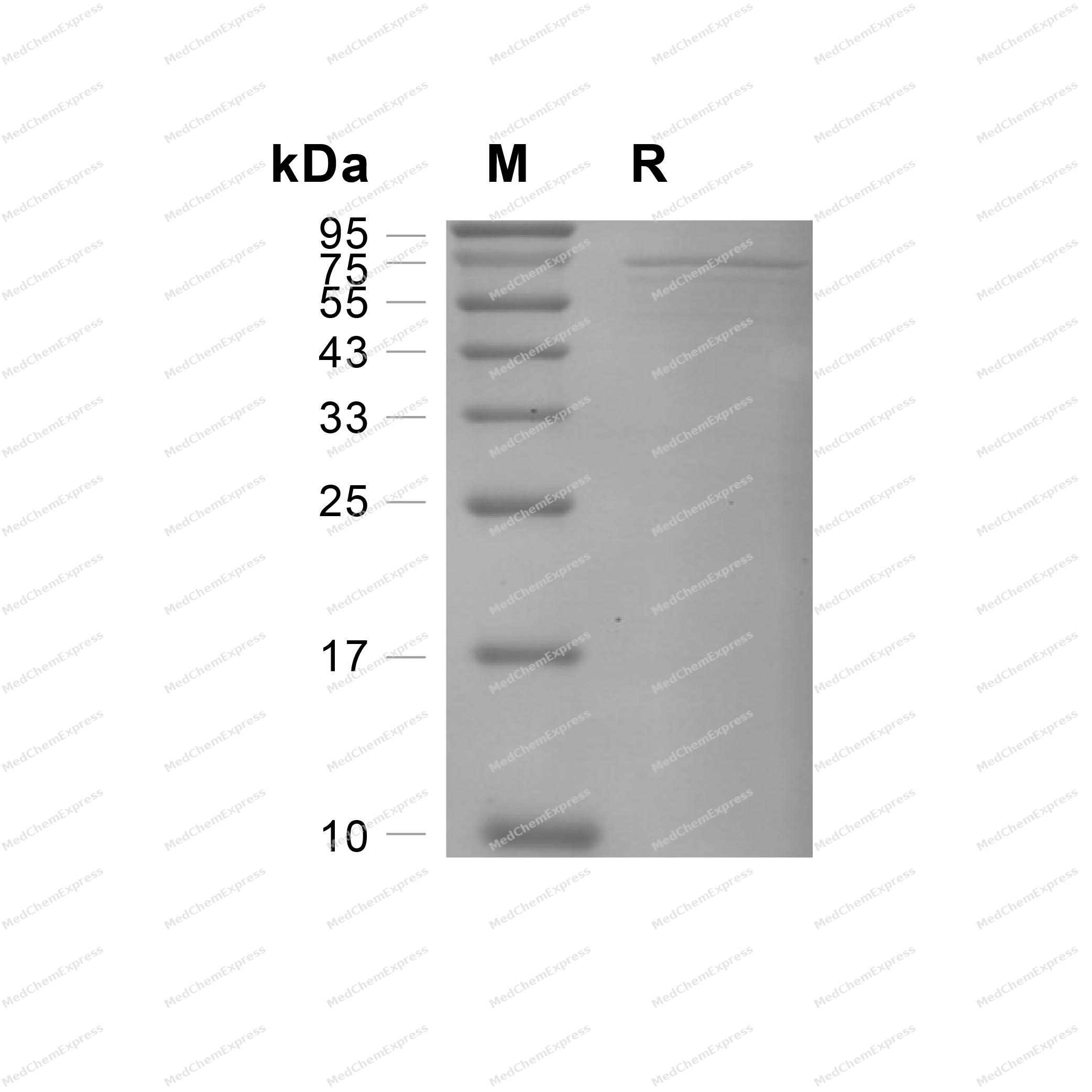
Purity - SDS-PAGE


Technical Parameters
-
Species Human
-
Source E. coli
-
Tag N-6*His
-
Accession
Q00613-1 (D2-S529)
-
Molecular Construction
-
N-term
-
His
-
HSF1 (D2-S529)
Accession # Q00613-1 -
C-term
-
-
Protein Length
Full Length of Isoform-1
-
Synonyms
HSF1; Heat Shock Factor Protein 1; Heat Shock Transcription Factor 1; HSTF 1; HSTF1; HSF 1
-
AA Sequence
DLPVGPGAAGPSNVPAFLTKLWTLVSDPDTDALICWSPSGNSFHVFDQGQFAKEVLPKYFKHNNMASFVRQLNMYGFRKVVHIEQGGLVKPERDDTEFQHPCFLRGQEQLLENIKRKVTSVSTLKSEDIKIRQDSVTKLLTDVQLMKGKQECMDSKLLAMKHENEALWREVASLRQKHAQQQKVVNKLIQFLISLVQSNRILGVKRKIPLMLNDSGSAHSMPKYSRQFSLEHVHGSGPYSAPSPAYSSSSLYAPDAVASSGPIISDITELAPASPMASPGGSIDERPLSSSPLVRVKEEPPSPPQSPRVEEASPGRPSSVDTLLSPTALIDSILRESEPAPASVTALTDARGHTDTEGRPPSPPPTSTPEKCLSVACLDKNELSDHLDAMDSNLDNLQTMLSSHGFSVDTSALLDLFSPSVTVPDMSLPDLDSSLASIQELLSPQEPPRPPEAENSSPDSGKQLVHYTAQPLFLLDPGSVDTGSNDLPVLFELGEGSYFSEGDGFAEDPTISLLTGSEPPKAKDPTVS
-
Molecular Weight
Approximately 67 kDa, based on SDS-PAGE under reducing conditions.
-
Purity
≥ 90%, as determined by reducing SDS-PAGE.


Product Properties
Lyophilized powder
Lyophilized a 0.22 μm filtered solution of PBS, pH 7.4 or PBS, pH 7.4, 8% trehalose.
<1 EU/μg, determined by LAL method.
It is not recommended to reconstitute to a concentration less than 100 μg/mL in ddH2O. For long term storage it is recommended to add a carrier protein (0.1% BSA, 5% HSA, 10% FBS or 5% Trehalose).
Stored at -20°C for 2 years from date of receipt. After reconstitution, it is stable at 4°C for 1 week or -20°C for longer (with carrier protein). It is recommended to freeze aliquots at -20°C or -80°C for extended storage.
Room temperature in continental US; may vary elsewhere.


Documentation
-
Data Sheet (238 KB)
-
SDS (251 KB)
- English - EN (251 KB)
- Français - FR (251 KB)
- Deutsch - DE (251 KB)
- Norwegian - NO (251 KB)
- Español - ES (251 KB)
- Swedish - SV (251 KB)
- Italian - IT (251 KB)
- Korean - KR (251 KB)
- Portuguese - PT (251 KB)
-
Handling Instructions (2659 KB)

Calculators
Concentration (start) × Volume (start) = Concentration (final) × Volume (final)


 Powered by Bioz

