



IL-17F Protein, Mouse (HEK293, His)

Based on 1 Customer Validation
IL-17F is an inflammatory homodimeric cytokine that induces many proinflammatory cytokines and chemokines. IL-17F also induces antimicrobial peptides. IL-17F plays a protective role in colon cancer development and can be used for the research of autoimmune diseases, infection and cancer. IL-17F Protein, Mouse (HEK293, His) is a recombinant mouse IL-17F protein with His tag at the C-terminus and is expressed in HEK293 cells.
- Species: Mouse
- Source: HEK293
-
Storage:Stored at -20°C for 2 years from date of receipt. After reconstitution, it is stable at 4°C for 1 week or -20°C for longer (with carrier protein). It is recommended to freeze aliquots at -20°C or -80°C for extended storage.


To place orders, for customer services and technical support, please contact: MedChemExpress USA
Tel: 609-228-6898 E-mail: [email protected] [email protected]


-
 Biological Activity
-
Technical Parameters
-
Product Properties
- Documentation
- References
- Help & FAQs




Biological Activity
Description
IL-17F is an inflammatory homodimeric cytokine that induces many proinflammatory cytokines and chemokines. IL-17F also induces antimicrobial peptides. IL-17F plays a protective role in colon cancer development and can be used for the research of autoimmune diseases, infection and cancer[1][2]. IL-17F Protein, Mouse (HEK293, His) is a recombinant mouse IL-17F protein with His tag at the C-terminus and is expressed in HEK293 cells.
Background
Interleukin-17F (IL-17F) belongs to the IL-17 cytokine family. IL-17F is expressed in activated CD4 T cells, activated monocytes, basophils and mast cells. IL-17F can be produced by differentiated TH17 cells, lamina propria T cells, memory CD4+ T cells, γδ T cells and NKT cells[1].
The mouse IL-17F shares 55.90% amino acid sequence identity with human and 86.34% identity with rat.
IL-17F is an inflammatory cytokine that induces many proinflammatory cytokines and chemokines, including TGF-β, IL-2, ICAM1, GM-CSF, CCL2, CCL7, TSLP, MMP13, IL-6 and CXCL1. IL-17F also induces antimicrobial peptides including hBD-2, S100A7, S100A8 and S100A9 with IL-22 and can synergize with IL-23 in human eosinophils to promote the production of IL-1β and IL-6. IL-17F is a homodimeric cytokine. IL-17F shares the most similarities with IL-17A (50% homology) and can be produced as an IL-17AF heterodimer. IL-17A, IL-17F and IL-17A/F use the same receptor complex: IL-17RA and IL-17RC heterodimer. They trigger qualitatively similar signaling pathways, and IL-17F exhibits the lowest biological activity. IL-17F shows about 100–1000 times lower affinity to the IL-17RA subunit than IL-17A, and does not compete with IL-17A binding to IL-17RA[1][2].
IL-17F plays a protective role in colon cancer development and can be used for the research of autoimmune diseases, infection and cancer[1][3][4].
In Vitro
IL-17F (100 ng/mL; overnight) induces proinflammatory cytokines and chemokines in vitro via IL-17RA, TRAF6, and Act1 in mouse embryonic fibroblasts (MEFs)[5].
In Vivo
IL-17F (0.5 μg/mouse; i.p.; once) results in the recruitment of neutrophils within 4 h in mice[5].
MCE Validation Data
-
Purity - SDS-PAGE
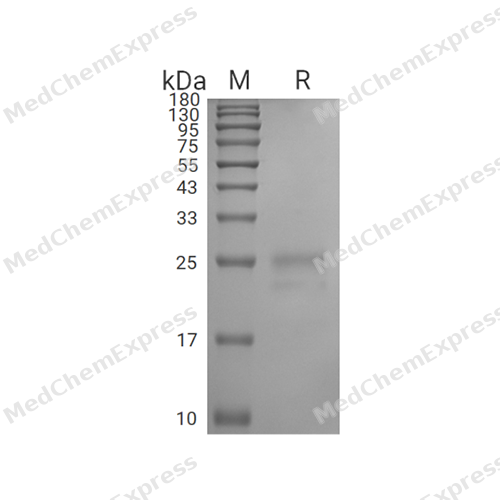
Purity - SDS-PAGE


Technical Parameters
-
Species Mouse
-
Source HEK293
-
Tag C-6*His
-
Accession
Q7TNI7-1 (R29-A161)
-
Protein Length
Full Length of Isoform-1
-
Synonyms
IL17F; ML1; Interleukin 17F; Interleukin-17F; IL-17F; Cytokine ML-1; ML-1; CANDF6
-
AA Sequence
RKNPKAGVPALQKAGNCPPLEDNTVRVDIRIFNQNQGISVPREFQNRSSSPWDYNITRDPHRFPSEIAEAQCRHSGCINAQGQEDSTMNSVAIQQEILVLRREPQGCSNSFRLEKMLLKVGCTCVKPIVHQAA
-
Predicted Molecular Mass
15.9 kDa
-
Molecular Weight
Approximately 17-23 kDa, based on SDS-PAGE under reducing conditions.
-
Glycosylation
Yes
-
Purity
≥ 95%, as determined by reducing SDS-PAGE.


Product Properties
Lyophilized powder.
Lyophilized from a 0.22 μm filtered solution of PBS, pH 7.4.
<1 EU/μg, determined by LAL method.
It is not recommended to reconstitute to a concentration less than 100 μg/mL in ddH2O. For long term storage it is recommended to add a carrier protein (0.1% BSA, 5% HSA, 10% FBS or 5% Trehalose).
Stored at -20°C for 2 years from date of receipt. After reconstitution, it is stable at 4°C for 1 week or -20°C for longer (with carrier protein). It is recommended to freeze aliquots at -20°C or -80°C for extended storage.
Room temperature in continental US; may vary elsewhere.


Documentation
-
Data Sheet (264 KB)
-
SDS (251 KB)
- English - EN (251 KB)
- Français - FR (251 KB)
- Deutsch - DE (251 KB)
- Norwegian - NO (251 KB)
- Español - ES (251 KB)
- Swedish - SV (251 KB)
- Italian - IT (251 KB)
- Korean - KR (251 KB)
- Portuguese - PT (251 KB)
-
Handling Instructions (2659 KB)


References
[1]. Chang SH, et al. IL-17F: regulation, signaling and function in inflammation. Cytokine. 2009 Apr;46(1):7-11. [Content Brief]
[2]. McGeachy MJ, et al. The IL-17 Family of Cytokines in Health and Disease. Immunity. 2019 Apr 16;50(4):892-906. [Content Brief]
[3]. Ferreira N, et al. IL-17A and IL-17F orchestrate macrophages to promote lung cancer. Cell Oncol (Dordr). 2020 Aug;43(4):643-654. [Content Brief]
[4]. Tong Z, et al. A protective role by interleukin-17F in colon tumorigenesis. PLoS One. 2012;7(4):e34959. [Content Brief]
[5]. Yang XO, et al. Regulation of inflammatory responses by IL-17F. J Exp Med. 2008 May 12;205(5):1063-75. [Content Brief]

Calculators
Concentration (start) × Volume (start) = Concentration (final) × Volume (final)


 Powered by Bioz

