



PDGF-BB Protein, Human (His)
Based on 2 publication(s) in Google Scholar
The PDGF-BB protein is a key growth factor that centrally regulates embryonic development, cell proliferation, migration, survival, and chemotaxis. It is known for its potent mitogenic effects on mesenchymal cells and is essential for the normal proliferation and recruitment of pericytes and vascular smooth muscle cells in tissues such as the central nervous system, skin, lungs, heart, and placenta. PDGF-BB Protein, Human (His) is the recombinant human-derived PDGF-BB protein, expressed by E. coli , with N-6*His labeled tag.
- Species: Human
- Source: E. coli
-
Storage:Stored at -20°C for 2 years from date of receipt. After reconstitution, it is stable at 4°C for 1 week or -20°C for longer (with carrier protein). It is recommended to freeze aliquots at -20°C or -80°C for extended storage.


To place orders, for customer services and technical support, please contact: MedChemExpress USA
Tel: 609-228-6898 E-mail: [email protected] [email protected]


-
 Biological Activity
-
Technical Parameters
-
Product Properties
- Documentation
- Help & FAQs


-

HY-P7110A
VEGF165 Protein, Human (HEK293) -
HY-P70598
PDGF-AA Protein, Human -
HY-P7109
EGF Protein, Human -
HY-P70499
Osteopontin/OPN Protein, Human (HEK293, His) -
HY-P70543
TGF beta 1/TGFB1 Protein, Human (HEK293) -
HY-P7025
IFN-gamma Protein, Human -
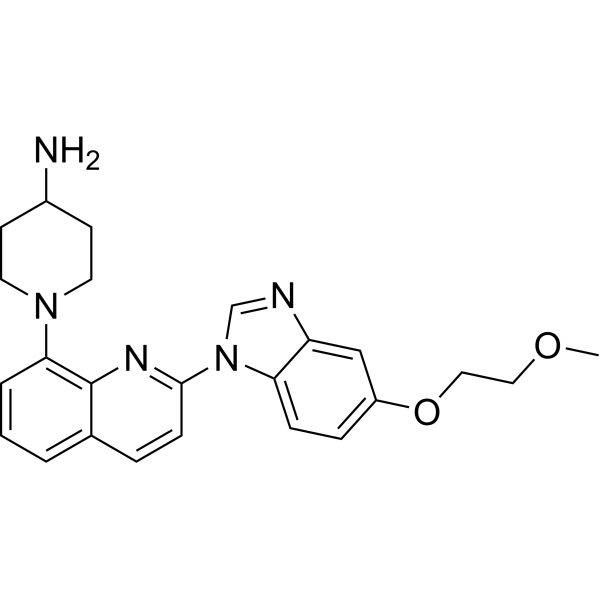
HY-12050
CP-673451 -
HY-P7018
IGF-I/IGF-1 Protein, Human (70a.a) -
HY-P7028
IL-1 beta Protein, Human -
HY-P70558
Noggin Protein, Human (HEK293) -
HY-P70426A
TNF-alpha/TNFSF2 protein, Human (His) -
HY-P70061
Angiopoietin-1 Protein, Human (HEK293, Fc)


Biological Activity
Description
The PDGF-BB protein is a key growth factor that centrally regulates embryonic development, cell proliferation, migration, survival, and chemotaxis. It is known for its potent mitogenic effects on mesenchymal cells and is essential for the normal proliferation and recruitment of pericytes and vascular smooth muscle cells in tissues such as the central nervous system, skin, lungs, heart, and placenta. PDGF-BB Protein, Human (His) is the recombinant human-derived PDGF-BB protein, expressed by E. coli , with N-6*His labeled tag.
Background
GMP PDGF-BB Protein, a pivotal growth factor, assumes a central role in regulating embryonic development, cell proliferation, migration, survival, and chemotaxis. Renowned for its potent mitogenic effects on mesenchymal cells, GMP PDGF-BB is indispensable for the normal proliferation and recruitment of pericytes and vascular smooth muscle cells in various tissues, including the central nervous system, skin, lung, heart, and placenta. Its vital contributions extend to the development of blood vessels and kidney glomeruli, highlighting its significance in vascular and renal physiology. A key participant in wound healing, GMP PDGF-BB's signaling dynamics are finely tuned through heterodimer formation with PDGFA. Present as an antiparallel homodimer, GMP PDGF-BB engages in disulfide-linked interactions with PDGFRA and PDGFRB homodimers, as well as with heterodimers formed by PDGFRA and PDGFRB. Additionally, it forms antiparallel heterodimers with PDGFA, further diversifying its regulatory repertoire. Notably, GMP PDGF-BB establishes connections with XLKD1, LRP1, and SORL1, contributing to a network of interactions that modulate its multifaceted functions.
Verified Bioactivity
Measured in a cell proliferation assay using NIH 3T3 mouse fibroblast cells. The ED50 for this effect is ≤5.712 ng/mL, corresponding to a specific activity is ≥1.751×10⁵ units/mg.
MCE Validation Data
-
Purity - SDS-PAGE
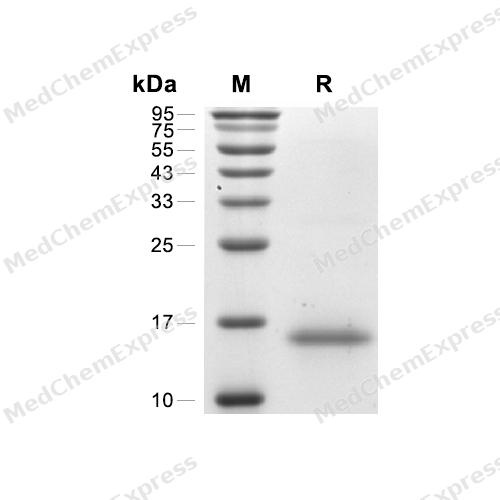
Purity - SDS-PAGE
-
Bioactivity - Cell-Based Assay
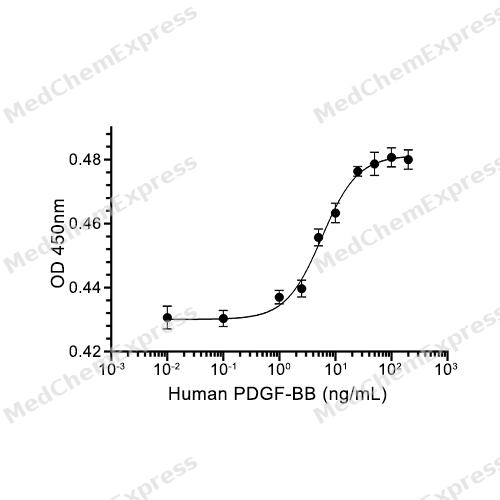
Bioactivity - Cell-Based Assay


Publications (2)
-
Journal Impact Factor
-
Most Recent
-
Cell Signal
VMP1 enhances autophagy to mitigate cardiac fibroblast activation and reduce post-ischemia-reperfusion fibrosis. [Abstract]2025 Dec:136:112105. PMID: 40886926
PDGF-BB Protein, Human (His) purchased from MedChemExpress. Usage Cited in: Cell Signal. 2025 Dec:136:112105. [Abstract]
In NRCFs, VMP1 mRNA levels were downregulated following stimulation with PDGF-BB (10 ng/mL).
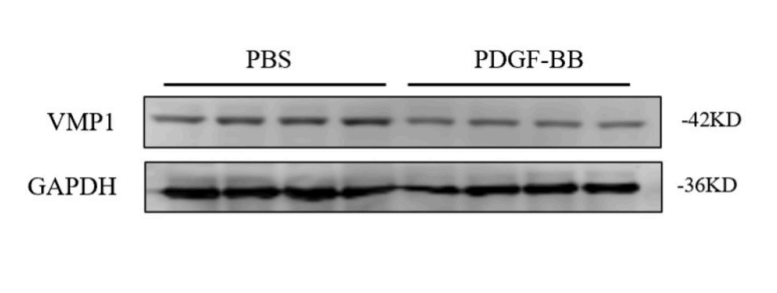
PDGF-BB Protein, Human (His) purchased from MedChemExpress. Usage Cited in: Cell Signal. 2025 Dec:136:112105. [Abstract]
In NRCFs, VMP1 protein levels were downregulated following treatment with PDGF-BB (10 ng/mL).
-


Technical Parameters
-
Species Human
-
Source E. coli
-
Tag N-6*His
-
Accession
P01127-1 (S82-T190)
-
Molecular Construction
-
N-term
-
6*His
-
PDGF-BB (S82-T190)
Accession # P01127 -
C-term
-
-
Protein Length
Full Length of PDGFB
-
Synonyms
PDGFB; Platelet-Derived Growth Factor 2; Prev. SIS; PDGF Subunit B; Platelet-Derived Growth Factor Beta Polypeptide; PDGF2; Platelet-Derived Growth Factor Subunit B; Platelet-Derived Growth Factor, Beta Polypeptide (Oncogene SIS); Platelet-Derived Growth
-
AA Sequence
SLGSLTIAEPAMIAECKTRTEVFEISRRLIDRTNANFLVWPPCVEVQRCSGCCNNRNVQCRPTQVQLRPVQVRKIEIVRKKPIFKKATVTLEDHLACKCETVAAARPVT
-
Predicted Molecular Mass
12.3 kDa
-
Molecular Weight
Approximately 15 kDa, based on SDS-PAGE under reducing conditions.
-
Structure/Form
Monomer
-
Purity
≥ 95%, as determined by reducing SDS-PAGE.


Product Properties
Lyophilized powder
1.Lyophilized from a 0.22 μm filtered solution of 50 mM Tris-HCl, 300 mM NaCl, 200 mM arginine, pH 8.0.
2.Lyophilized from a 0.22 μm filtered solution of 50 mM Tris-HCl, 300 mM NaCl, 200 mM arginine, pH 8.0, 5% trehalose.
Note: For SPR assay, please replace the buffer. Primary amine components (e.g., Tris, imidazole) can affect protein-coupled chips.
Please refer to the lot-specific COA for specific buffer information.
<1 EU/μg, determined by LAL method.
It is not recommended to reconstitute to a concentration less than 100 μg/mL in ddH2O. For long term storage it is recommended to add a carrier protein (0.1% BSA, 5% HSA, 10% FBS or 5% Trehalose).
Stored at -20°C for 2 years from date of receipt. After reconstitution, it is stable at 4°C for 1 week or -20°C for longer (with carrier protein). It is recommended to freeze aliquots at -20°C or -80°C for extended storage.
Room temperature in continental US; may vary elsewhere.


Documentation
-
Data Sheet (236 KB)
-
SDS (251 KB)
- English - EN (251 KB)
- Français - FR (251 KB)
- Deutsch - DE (251 KB)
- Norwegian - NO (251 KB)
- Español - ES (251 KB)
- Swedish - SV (251 KB)
- Italian - IT (251 KB)
- Korean - KR (251 KB)
- Portuguese - PT (251 KB)
-
Handling Instructions (2659 KB)

Calculators
Concentration (start) × Volume (start) = Concentration (final) × Volume (final)


 Powered by Bioz

