



Serpin A4 Protein, Human (HEK293, His)
Based on 1 publication(s) in Google Scholar
Serpin A4 Protein inhibits tissue kallikrein's amidolytic and kininogenase activities by forming a heat- and SDS-stable equimolar complex with the enzyme. Tissue kallikrein concurrently cleaves the reactive site of Serpin A4, producing a small C-terminal fragment. The protein, existing as a monomer and occasionally forming homodimers, demonstrates its regulatory role in modulating tissue kallikrein-mediated enzymatic activities. Serpin A4 Protein, Human (HEK293, His) is the recombinant human-derived Serpin A4 protein, expressed by HEK293 , with C-6*His labeled tag.
- Species: Human
- Source: HEK293
-
Storage:Stored at -20°C for 2 years from date of receipt. After reconstitution, it is stable at 4°C for 1 week or -20°C for longer (with carrier protein). It is recommended to freeze aliquots at -20°C or -80°C for extended storage.


To place orders, for customer services and technical support, please contact: MedChemExpress USA
Tel: 609-228-6898 E-mail: [email protected] [email protected]


-
 Biological Activity
-
Technical Parameters
-
Product Properties
- Documentation
- Help & FAQs




Biological Activity
Description
Serpin A4 Protein inhibits tissue kallikrein's amidolytic and kininogenase activities by forming a heat- and SDS-stable equimolar complex with the enzyme. Tissue kallikrein concurrently cleaves the reactive site of Serpin A4, producing a small C-terminal fragment. The protein, existing as a monomer and occasionally forming homodimers, demonstrates its regulatory role in modulating tissue kallikrein-mediated enzymatic activities. Serpin A4 Protein, Human (HEK293, His) is the recombinant human-derived Serpin A4 protein, expressed by HEK293 , with C-6*His labeled tag.
Background
Serpin A4 Protein functions as an inhibitor, specifically targeting the amidolytic and kininogenase activities of tissue kallikrein. This inhibitory mechanism involves the formation of an equimolar complex between the inhibitor and the enzyme, which is heat- and SDS-stable. Concurrently, tissue kallikrein cleaves the reactive site of Serpin A4, generating a small C-terminal fragment. The protein exists as a monomer and, in some instances, forms homodimers, showcasing its regulatory role in modulating tissue kallikrein-mediated enzymatic activities.
Verified Bioactivity
Measured by its ability to inhibit KLK1 (HY-P73262) cleavage of a colorimetric peptide substrate, Pro-Phe-Arg-7-amido-4-methylcoumarin(HY-P2618) that incubate at 37°C for 60 minutes. The IC50 value is <10 nM.
MCE Validation Data
-
Purity - SDS-PAGE
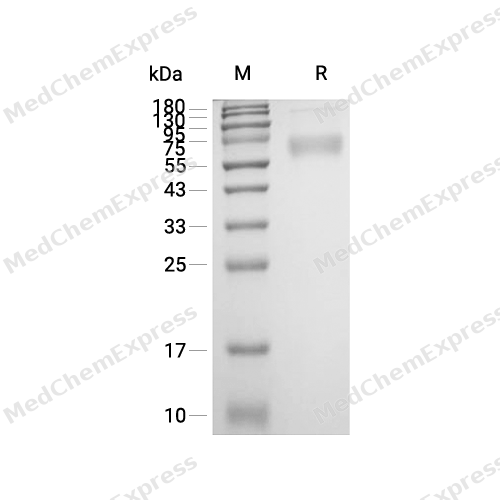
Purity - SDS-PAGE

Assay Procedure
Materials
Activation buffer: 50 mM Tris, 10 mM CaCl2, 150 mM NaCl, pH 7.5 (TCN)
Inhibition buffer: 25 mM Tris, 150 mM NaCl, pH 7.5
Assay buffer: 50 mM CHES, 250 mM NaCl, pH 10.0
Kallikrein-1 Protein, Human (240a.a, HEK293, His) (HY-P73262)
Bacterial Thermolysin
1,10-Phenanthroline
Serpin A4 Protein, Human (HEK293, His) (HY-P71143)
Substrate: Pro-Phe-Arg-7-amido-4-methylcoumarin (PFR-AMC, HY-137784)
Procedure
1. Dilute Human KLK1 to 100 μg/mL in activation buffer (containing 1 μg/mL Bacterial Thermolysin) .
2. Incubate at 37°C for 1 hour.
3. Add 1,10-Phenanthroline to a final concentration of 10 mM to stop the activation reaction.
4. Prepare different concentrations of Human Serpin A4 in assay buffer with the following serial dilutions: 8000, 4000, 2000, 1000, 625, 415, 200, 75 nM.
5. Dilute active Human KLK1 to 5 μg/mL in inhibition buffer.
6. Mix 20 μL of 5 μg/mL Human KLK1 with 20 μL of the Human Serpin A4 dilution series. Include two controls: 20 μL of inhibitor buffer and 20 μL of 5 μg/mL Human KLK1.
7. Incubate at 37°C for 1 hour.
8. Dilute the curve 62.5 times by adding assay buffer to each dilution.
9. Dilute the substrate to 200 μM in assay buffer.
10. Add 50 μL of the diluted mixture to the plate and initiate the reaction by adding 50 μL of 200 μM substrate to the wells. For the blank control group, add 50 μL of assay buffer and 50 μL of substrate.
11. Read in kinetic mode for 5 minutes at excitation wavelength 380 nm and emission wavelength 460 nm.
12. Determine the 50% inhibitory concentration (IC50) of Human Serpin A4 by plotting RFU/min versus concentration and fitting the data with a 4-parameter logistic (4-PL) curve.


Publications (1)
-
Journal Impact Factor
-
Most Recent
-
Adv Sci (Weinh)
A Novel tRF, HCETSR, Derived From tRNA-Glu/TTC, Inhibits HCC Malignancy by Regulating the SPBTN1-catenin Complex Axis. [Abstract]2025 Apr;12(13):e2415229. PMID: 39921434


Technical Parameters
-
Species Human
-
Source HEK293
-
Tag C-6*His
-
Accession
P29622 (Q21-P427)
-
Molecular Construction
-
N-term
-
Serpin A4 (Q21-P427)
Accession # P29622 -
6*His
-
C-term
-
-
Protein Length
Full Length of Mature Protein
-
Synonyms
SERPINA4; Testicular Secretory Protein Li 22; Prev. PI4; Peptidase Inhibitor 4; KST; Kallikrein Inhibitor; Kallistatin; Serpin A4; KLST; PI-4; KAL; Serpin Peptidase Inhibitor, Clade A (Alpha-1 Antiproteinase, Antitrypsin), Member 4, Isoform CRA_a; Serine (Or Cysteine) Proteinase Inhibitor, Clade A (Alpha-1 Antiproteinase, Antitrypsin), Member 4; Protease Inhibitor 4 (Kallistatin); Serpin Peptidase Inhibitor, Clade A (Alpha-1 Antiproteinase, Antitrypsin), Member 4; Serpin Family A Member 4; Sserpin Family A Member 4
-
AA Sequence
QLHVEHDGESCSNSSHQQILETGEGSPSLKIAPANADFAFRFYYLIASETPGKNIFFSPLSISAAYAMLSLGACSHSRSQILEGLGFNLTELSESDVHRGFQHLLHTLNLPGHGLETRVGSALFLSHNLKFLAKFLNDTMAVYEAKLFHTNFYDTVGTIQLINDHVKKETRGKIVDLVSELKKDVLMVLVNYIYFKALWEKPFISSRTTPKDFYVDENTTVRVPMMLQDQEHHWYLHDRYLPCSVLRMDYKGDATVFFILPNQGKMREIEEVLTPEMLMRWNNLLRKRNFYKKLELHLPKFSISGSYVLDQILPRLGFTDLFSKWADLSGITKQQKLEASKSFHKATLDVDEAGTEAAAATSFAIKFFSAQTNRHILRFNRPFLVVIFSTSTQSVLFLGKVVDPTKP
-
Predicted Molecular Mass
47.2 kDa
-
Molecular Weight
Approximately 50-80 kDa & 110-130 kDa, based on SDS-PAGE under reducing conditions.
-
Glycosylation
Yes
-
Structure/Form
Monomer and some Non-covalent homodimers.
-
Purity
≥ 95%, as determined by reducing SDS-PAGE.


Product Properties
Lyophilized powder
1.Lyophilized from a 0.22 μm filtered solution of 50 mM Tris-HCl, 150 mM NaCl, 10 mM NaCl, pH 8.0.
2.Lyophilized from a 0.22 μm filtered solution of 20 mM PB, 6% Trehalose, 4% Mannitol, 50 mM NaCl, 0.05% Tween 80, pH 6.0.
3.Lyophilized from a 0.22 μm filtered solution of 20 mM PB, 50 mM NaCl, pH 6.0, 8% trehalose.
Note: For SPR assay, please replace the buffer. Primary amine components (e.g., Tris, imidazole) can affect protein-coupled chips.
<1 EU/μg, determined by LAL method.
It is not recommended to reconstitute to a concentration less than 100 μg/mL in ddH2O. For long term storage it is recommended to add a carrier protein (0.1% BSA, 5% HSA, 10% FBS or 5% Trehalose).
Stored at -20°C for 2 years from date of receipt. After reconstitution, it is stable at 4°C for 1 week or -20°C for longer (with carrier protein). It is recommended to freeze aliquots at -20°C or -80°C for extended storage.
Room temperature in continental US; may vary elsewhere.


Documentation
-
Data Sheet (238 KB)
-
SDS (252 KB)
- English - EN (252 KB)
- Français - FR (252 KB)
- Deutsch - DE (252 KB)
- Norwegian - NO (252 KB)
- Español - ES (252 KB)
- Swedish - SV (252 KB)
- Italian - IT (252 KB)
- Korean - KR (252 KB)
- Portuguese - PT (252 KB)
-
Handling Instructions (2659 KB)

Calculators
Concentration (start) × Volume (start) = Concentration (final) × Volume (final)


 Powered by Bioz

