



SR9011 hydrochloride
Based on 8 publication(s) in Google Scholar
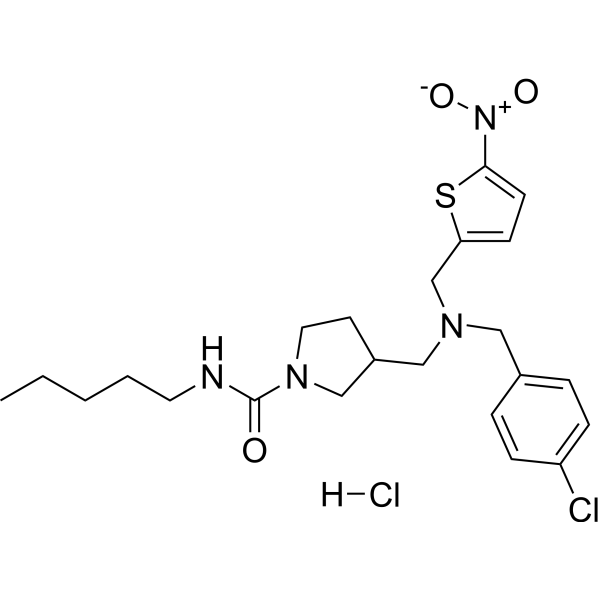
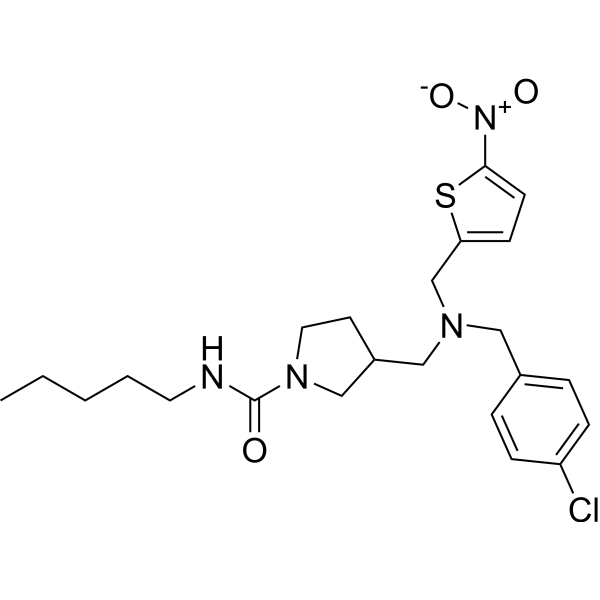
SR9011 hydrochloride is a REV-ERBα/β agonist with IC50s of 790 nM and 560 nM for REV-ERBα and REV-ERBβ, respectively.
For research use only. We do not sell to patients.
- Purity : 98.97%
- CAS No.: 2070014-94-5
- Formula: C23H32Cl2N4O3S
- Molecular Weight:515.50
-
Storage:
4°C, sealed storage, away from moisture
* In solvent : -80°C, 6 months; -20°C, 1 month (sealed storage, away from moisture)

To place orders, for customer services and technical support, please contact: MedChemExpress USA
Tel: 609-228-6898 E-mail: [email protected] [email protected]


-
 Biological Activity
-
Chemical Information
-
Solvent & Solubility
- Purity & Documentation
- References
-
 Help & FAQs



Publications Citing Use of MedChemExpress (MCE) SR9011 hydrochloride
More- Cancer Res. 2022 Apr 15;82(8):1503-1517. [Abstract]
- Acta Pharmacol Sin. 2019 Jan;40(1):26-34. [Abstract]
- Free Radic Biol Med. 2019 Dec:145:312-320. [Abstract]
- Cell Prolif. 2021 Mar;54(3):e12988. [Abstract]
- Br J Pharmacol. 2021 Jan;178(2):328-345. [Abstract]
- J Clin Endocrinol Metab. 2025 Mar 17;110(4):991-1002. [Abstract]
- J Pharm Biomed Anal. 2021 Feb 20:195:113870. [Abstract]
- Drug Test Anal. 2021 Feb;13(2):283-298. [Abstract]
 Customer Validation & Images

-
WB


Biological Activity
Description
IC50 & Target
IC50: 790 nM (Rev-ErbBα), 560 nM (Rev-ErbBβ)[1]
In Vitro
SR9011 dose-dependently increases the REV-ERB-dependent repressor activity assessed in HEK293 cells expressing a chimeric Gal4 DNA Binding Domain (DBD) - REV-ERB ligand binding domain (LBD) α or β and a Gal4-responsive luciferase reporter (REV-ERBα IC50=790 nM, REV-ERBβ IC50=560 nM). SR9011 potently and efficaciously suppresses transcription in a cotransfection assay using full-length REV-ERBα along with a luciferase reporter driven by the Bmal1 promoter (SR9011 IC50=620 nM). SR9011 suppresses the expression ofBMAL1 mRNA in HepG2 cells in a REV-ERBα/β-dependent manner[1] SR9011 suppresses proliferation of the breast cancer cell lines regardless of their ER or HER2 status. SR9011 appears to pause the cell cycle of the breast cancer cells prior to M phase. Cyclin A (CCNA2) is identified as a direct target gene of REV-ERB suggesting that suppression of expression of this cyclin by SR9011 may mediate the cell cycle arrest. Treatment with SR9011 results in an increase in cells in the G0/G1 phase and a decrease of cells in S and G2/M phase suggesting that activation of REV-ERB may be resulting in decreased transition from G1 to S phase and/or from S to G2/M phase[2].
MedChemExpress (MCE) has not independently confirmed the accuracy of these methods. They are for reference only. .
In Vivo
MedChemExpress (MCE) has not independently confirmed the accuracy of these methods. They are for reference only.


Chemical Information
-
CAS No. 2070014-94-5
-
Appearance Solid
-
Molecular Weight 515.50
-
Formula C23H32Cl2N4O3S
-
Color Light yellow to brown
-
SMILES
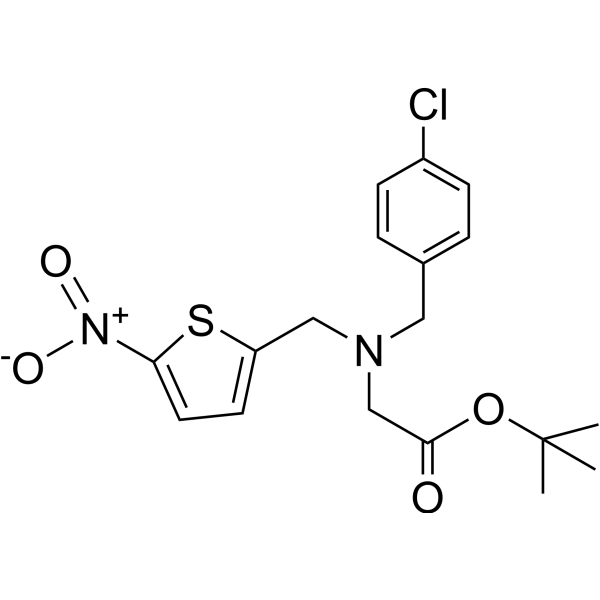
O=C(N1CC(CN(CC2=CC=C(Cl)C=C2)CC3=CC=C([N+]([O-])=O)S3)CC1)NCCCCC.[H]Cl
-
Shipping
Room temperature in continental US; may vary elsewhere.
-
Storage
4°C, sealed storage, away from moisture
* In solvent : -80°C, 6 months; -20°C, 1 month (sealed storage, away from moisture)


Publications (8)
-
Journal Impact Factor
-
Most Recent
-
Cancer Res
Disrupting Circadian Rhythm via the PER1-HK2 Axis Reverses Trastuzumab Resistance in Gastric Cancer. [Abstract]2022 Apr 15;82(8):1503-1517. PMID: 35255118 -
Acta Pharmacol Sin
Pharmacological activation of REV-ERBα represses LPS-induced microglial activation through the NF-κB pathway. [Abstract]2019 Jan;40(1):26-34. PMID: 29950615
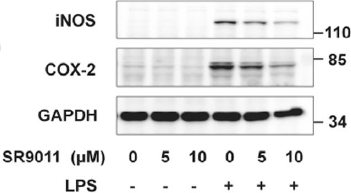
SR9011 hydrochloride purchased from MedChemExpress. Usage Cited in: Acta Pharmacol Sin. 2019 Jan;40(1):26-34. [Abstract]
BV2 cells are pretreated with different doses of SR9011 (0-10 μM) for 4 h and then exposed to LPS (100 ng/mL) for 12 h. Cell lysates are analyzed by Western blot for iNOS, COX-2, and GAPDH. The relative band intensities of iNOS and COX-2 to GAPDH are analyzed
-
Free Radic Biol Med
2019 Dec:145:312-320. PMID: 31585206 -
Cell Prolif
Circadian clock genes promote glioma progression by affecting tumour immune infiltration and tumour cell proliferation. [Abstract]2021 Mar;54(3):e12988. PMID: 33442944 -
Br J Pharmacol
Targeted inhibition of Rev-erb-α/β limits ferroptosis to ameliorate folic acid-induced acute kidney injury. [Abstract]2021 Jan;178(2):328-345. PMID: 33068011 -
J Clin Endocrinol Metab
2025 Mar 17;110(4):991-1002. PMID: 39359072 -
J Pharm Biomed Anal
Screening method of mildronate and over 300 doping agents by reversed-phase liquid chromatography-high resolution mass spectrometry. [Abstract]2021 Feb 20:195:113870. PMID: 33453569 -
Drug Test Anal
High-throughput liquid chromatography tandem mass spectrometry assay as initial testing procedure for analysis of total urinary fraction. [Abstract]2021 Feb;13(2):283-298. PMID: 32852861


Solvent & Solubility
In Vitro:
DMSO : ≥ 32 mg/mL (62.08 mM; Hygroscopic DMSO has a significant impact on the solubility of product, please use newly opened DMSO)
H2O : < 0.1 mg/mL (insoluble)
* "≥" means soluble, but saturation unknown.
Please refer to the solubility information to select the appropriate solvent. Once prepared, please aliquot and store the solution to prevent product inactivation from repeated freeze-thaw cycles.
Storage method and period of stock solution: -80°C, 6 months; -20°C, 1 month (sealed storage, away from moisture). When stored at -80°C, please use it within 6 months. When stored at -20°C, please use it within 1 month.
Please refer to the solubility information to select the appropriate solvent. Once prepared, please aliquot and store the solution to prevent product inactivation from repeated freeze-thaw cycles.
Storage method and period of stock solution: -80°C, 6 months; -20°C, 1 month (sealed storage, away from moisture). When stored at -80°C, please use it within 6 months. When stored at -20°C, please use it within 1 month.
Concentration (start) × Volume (start) = Concentration (final) × Volume (final)


Purity & Documentation
-
Data Sheet (281 KB)
-
SDS (393 KB)
- English - EN (393 KB)
- Français - FR (393 KB)
- Deutsch - DE (393 KB)
- Norwegian - NO (393 KB)
- Español - ES (393 KB)
- Swedish - SV (393 KB)
- Italian - IT (393 KB)
- Korean - KR (393 KB)
- Portuguese - PT (393 KB)
-
Handling Instructions (2659 KB)
References
[1]. Solt LA, et al. Regulation of circadian behaviour and metabolism by synthetic REV-ERB agonists. Nature. 2012 Mar 29;485(7396):62-8. [Content Brief]
[2]. Wang Y, et al. Anti-proliferative actions of a synthetic REV-ERBα/β agonist in breast cancer cells. Biochem Pharmacol. 2015 Aug 15;96(4):315-22. [Content Brief]


Complete Stock Solution Preparation Table
Please refer to the solubility information to select the appropriate solvent. Once prepared, please aliquot and store the solution to prevent product inactivation from repeated freeze-thaw cycles.
Storage method and period of stock solution: -80°C, 6 months; -20°C, 1 month (sealed storage, away from moisture). When stored at -80°C, please use it within 6 months. When stored at -20°C, please use it within 1 month.
| Optional Solvent | Concentration Solvent Mass | 1 mg | 5 mg | 10 mg | 25 mg |
|---|---|---|---|---|---|
| DMSO | 1 mM | 1.9399 mL | 9.6993 mL | 19.3986 mL | 48.4966 mL |
| 5 mM | 0.3880 mL | 1.9399 mL | 3.8797 mL | 9.6993 mL | |
| 10 mM | 0.1940 mL | 0.9699 mL | 1.9399 mL | 4.8497 mL | |
| 15 mM | 0.1293 mL | 0.6466 mL | 1.2932 mL | 3.2331 mL | |
| 20 mM | 0.0970 mL | 0.4850 mL | 0.9699 mL | 2.4248 mL | |
| 25 mM | 0.0776 mL | 0.3880 mL | 0.7759 mL | 1.9399 mL | |
| 30 mM | 0.0647 mL | 0.3233 mL | 0.6466 mL | 1.6166 mL | |
| 40 mM | 0.0485 mL | 0.2425 mL | 0.4850 mL | 1.2124 mL | |
| 50 mM | 0.0388 mL | 0.1940 mL | 0.3880 mL | 0.9699 mL | |
| 60 mM | 0.0323 mL | 0.1617 mL | 0.3233 mL | 0.8083 mL |


SR9011 hydrochloride Related Classifications
HY-16988A Related Classifications
 Powered by Bioz