



DAPK
Death associated protein kinase
DAPK (Death-associated protein kinase) is the founding member of a newly classified family of Ser/Thr kinases, whose members not only possess significant homology in their catalytic domains, but also share cell death-associated functions. The realization that DAPk is a tumor suppressor gene, whose expression is lost in multiple tumor types, has spurred a flurry of interest in the kinase family and produced an impressive body of literature concerning its function, regulation, and connection to disease. The DAPk family has been linked to several cell death-related signaling pathways, and functions other than cell death have also been proposed.
All Product Categories
-
DAPK Related Products (29)
Related Products (29)

-
Recombinant Proteins (1)
-
Antibodies (5)
- 1
- 2
-
TAT-GluN2BCTM
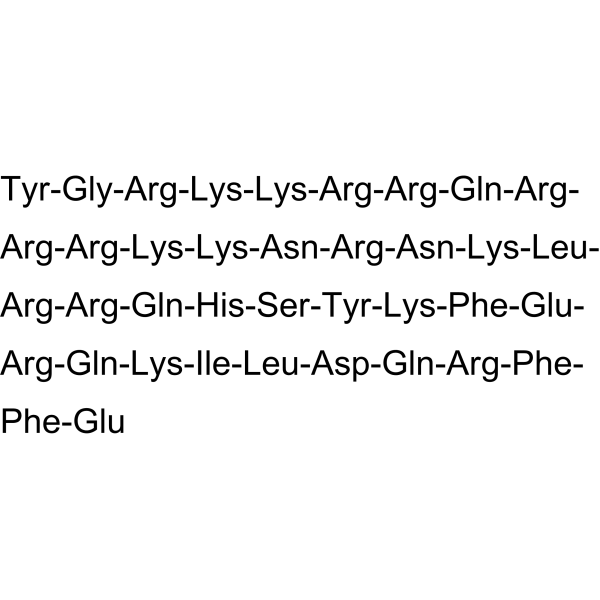 0 ImagesCat. No.: HY-P5277CAS No.: 1587742-50-4TAT-GluN2BCTM is a membrane-permeable DAPK1-targeting peptide. TAT-GluN2BCTM targets active DAPK1 to lysosomes for degradation. TAT-GluN2BCTM protects neurons from oxidative stress and NMDAR-mediated excitotoxicity by knocking down DAPK1. TAT-GluN2BCTM can be used in the study of neuroprotection.
-
DRAK2-IN-2
 0 ImagesCat. No.: HY-184326CAS No.: 3080324-43-9DRAK2-IN-2 is a selective DRAK2 inhibitor with an IC50 value of 198.5 nM. DRAK2-IN-2 inhibits DRAK2-mediated phosphorylation of ULK1 at the Ser56 site. DRAK2-IN-2 enhances insulin secretion, increases mitochondrial membrane potential, alleviates Palmitic acid (HY-N0830)-induced mitochondrial membrane potential damage and Apoptosis, and improves glucose tolerance in vivo. DRAK2-IN-2 can be used for the research of type 2 diabetes.
-
DAPK Substrate Peptide
 0 ImagesCat. No.: HY-P1344CAS No.: 386769-53-5
-
DRAK1/2-IN-1
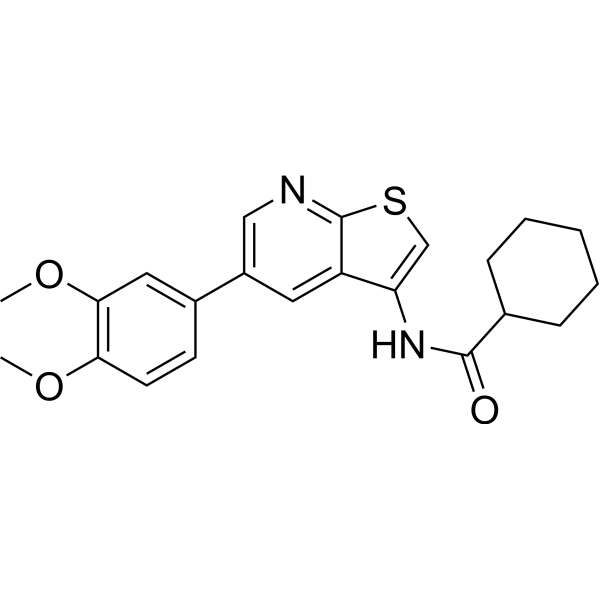 0 ImagesCat. No.: HY-152954CAS No.: 1629227-34-4DRAK1/2-IN-1 (compound 10e) is an active dual DRAK1 and DRAK2 inhibitor with Kd values of 1 μM and 6 μM, respectively.
-
UNC9750
 0 ImagesCat. No.: HY-175477CAS No.: 2967648-29-7UNC9750 is an inositol phosphate multikinase (IPMK) inhibitor with IC50 values of 31.6 and 374 nM for IPMK and IP6K2, respectively.. UNC9750 inhibits cellular accumulation of InsP5, the direct product of IPMK kinase activity, while having no effect on either InsP6 or InsP7 levels. UNC9750 has ≥ 75% inhibition of four kinases (DAPK1, DYRK1B, PDGFR, and KDR). UNC9750 can be used for the study of glioblastoma.
-
DRAK1/2-IN-2
 0 ImagesCat. No.: HY-178967DRAK1/2-IN-2 (Compound Y17) is a DRAK1/2 inhibitor with IC50 values for DRAK2 and DRAK1 of 353.2 nM and 507.4 nM respectively. DRAK1/2-IN-2 can enhance mitochondrial membrane potential and glucose-stimulated insulin secretion (GSIS). DRAK1/2-IN-2 resists lipotoxicity-induced cell apoptosis. DRAK1/2-IN-2 significantly inhibits the secretion of pro-inflammatory cytokine IL-1β, thereby exerting an anti-inflammatory effect. DRAK1/2-IN-2 can significantly lower the blood glucose levels of mice. DRAK1/2-IN-2 can be used in diabetes research.

-
3MB-PP1 (Standard)
 0 Images3MB-PP1 (Standard) is the analytical standard of 3MB-PP1 (HY-102069). This product is intended for research and analytical applications. 3MB-PP1, a bulky purine analog, is a Polo-like kinase 1 (Plk1) inhibitor. 3MB-PP1 blocks mitotic progression and cell division arise through target Plk1 in in cells expressing analog-sensitive Plk1 alleles. 3MB-PP1 specifically inhibits the activity of analog-sensitive Ssn3 (Cdk8). 3MB-PP1 inhibits Leu93 Mutant Zipper-interacting protein kinase (Leu93-ZIPK; IC50=2 μM). 3MB-PP1 can be used for the research of hypha formation of Candida albicans and cell division.
-
Quinocetone (Standard)
 0 ImagesCat. No.: HY-123581RCAS No.: 81810-66-4Quinocetone (Standard) is the analytical standard of Quinocetone (HY-123581). This product is used for research and analytical purposes. Quinocetone is an orally active animal feed additive used to increase the meat production of livestock and poultry. Quinocetone exhibits antibacterial activity against a variety of pathogenic microorganisms. Quinocetone exhibits tissue-specific (liver, lymphocyte) toxicity. Quinocetone induces autophagy in cells through the ATF6/DAPK1 pathway. Quinocetone activates the NF-κB and iNOS pathways, leading to cell apoptosis, hepatocyte vacuolar degeneration and fibrosis. Quinocetone can inhibit Nrf2/HO-1 and induce the generation of reactive oxygen species (ROS), leading to oxidative stress and DNA damage.
- 1
- 2




